Sunday, 2 June 2013

Baader-Meinhof Ramblings

Baader-Meinhof Ramblings

(or all after watching Der Baader-Meinhof Komplex)
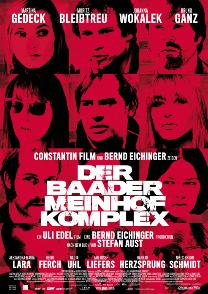


It was half past night when this writer had again watched a German movie all about a group notoriously known for their series of direct actions, all shooked then "West" Germany in the late 60s to mid 70s.

Known by news reports as the "Baader-Meinhof Gruppe", the Rote Armee Fraktion was a small but armed group of young and middle aged "fun, free, and rebellious" intellectuals whom supported National Liberation movements by means of armed struggle. Ranging from sabotage, assassination, and armed robberies throughout Germany "10 minutes", justified as "expropriations" as they took money every bank deemed as supporters of "US imperialism."

Johanna Wokalek (as Gudrun Ensselin)
talking to Vinzenz Kiefer (As Peter-Jürgen Boock) 
Quite Bohemian in regards to their lifestyle as depicted in the movie, especially in a scene where Gudrun Ensslin and Andreas Baader, being "Anti-norm" per se, caters their abode to those whom escaped from the juvenile prisons called "Youth Centres" like Peter-Jürgen Boock. There Gudrun Ensselin (by Johanna Wokalek) had compelled Peter to take a bath alongside her's for "wasting water is prohibited". Quite strange though in modern-day standards to see a scene featuring a man had dip into the bathtub alongside a girl whom happens to be one of the leaders of the impending "revolution". People may deemed as "sexually depicted" on that scene but only to end up merely sort of a chitchat and bathtub sharing.

Police chose to side with the Iranian goons as to stop the protest
It even featured the protests against the Kiesinger-led CDU government, being a US ally and supporter of various dictatorships had brought into the attention as depicted by the action taken in 1967, when the Shah of Iran, Mohammed Reza Pahlavi, had visited West Berlin to attend a performance at the Deutsche Opera. Angered at the Shah's repressive policies in governing Iran, a number of young Germans show up to protest his appearance. The German police, supported by Iranian goons had attacked the protesters and one of them, Benno Ohnesorg, been shot and killed without provocation by Karl-Heinz Kurras.

The death of Ohnesorg somehow triggered criticism against the government as Ulrike Meinhof herself, being Left-wing in her views, used her skill as a Journalist with her articles especially critical of the Pahlavi and the US regime contrary to Axel Springer's Bild with its offices being ransacked by some for the climate that contributed to the assassination attempt on activist Rudi Dutschke by Joseph Bachmann in 1968 with popular catchphrase in left-wing circles sympathetic to student radicalism was "Bild hat mitgeschossen!" ("Bild shot at him too!") and "Springer, Morderer!" (Springer, Murderer!).

Dresden! Hiroshima! Vietnam!
(invoking anger towards a conservative-leaning paper)
Well, the events made the possibility of taking the gun as accepted and bank robberies as justified during those times- liberation was their call despite its inclinations different from the typical revolutionaries of those time, taking action seriously through the deed than to invoke people the call for revolution by organizing and mobilization. Other than the bohemian lifestyle taken as to counter the "standards" of "modern-day" living.

Scene depicting protest during the visit of Reza Shah Pahlavi at Berlin
Anyways, the so-called "fun, free, rebellious" attitude, being a reaction from the prevailing social order,  had  happened not just in Germany but in the entire Europe during the Cold War. As the Kiesinger-CDU government had been criticized by the left because of its policies, resulting to various means of protests led by the youth, were only to be replaced by Willy Brandt's ministership alongside the center-left SPD with promises of "Democracy" and reversal of policies made by the Conservative-leaning Kiesinger.
However, despite lessening tensions, it had rose those who constantly against the system itself-such as the RAF and others like the SPK Sozialistisches Patientenkollektiv (Socialist Patient's Collective), RZ Revolutionäre Zellen (Revolutionary Cells), and the Anarchist-leaning Bewegung 2. Juni (Movement 2 June).

Obviously, RAF had been leading as it was been depicted as bank robbers, kidnappers and even hijackers as what Ensslin said:

"They'll kill us all. You know what kind of pigs we're up against. This is the Auschwitz generation. You can't argue with people who made Auschwitz. They have weapons and we haven't. We must arm ourselves!"

As to set a bomb in a Department Store as a direct protest against rampant Consumerism.

Partisan warfare depicted
Anyways, it's all but entertaining and informative in general as the scenes reflected revolutionary fervor of the 60s and 70s. When National Liberation movements in Palestine, Indochina and the Philippines provided inspiration for both American and European radicals in resisting their respective systems to the extent of taking up the oil bomb and the gun. Bohemian lifestyles, beaches for Nudists, anti-consumerism, supporting Ho Chi Minh and solidarity with Palestine brought these altogether in a movie that invokes not just Tarantinoesque action but a depiction on how made these events happen.

As according to movie critics made last 2008 and 2009:

"When the film opened in Germany last year, some younger viewers came out of theaters crestfallen that the Red Army Faction members, still mythologized, were such dead-enders. Some who were older complained that the film had made the gang look too attractive. But they were dead-enders, and they were attractive. A film about them, or any other popular terrorist movement, has to account for both facts if it seeks to explain not just their crimes but also their existence."
— Fred Kaplan, The New York Times.

“Aust’s film has been criticized in Germany and Israel for making terrorist thuggery too glamorous. But in order to capture Baader-Meinhof accurately, the film needs to convey its appeal at the time. From mental patients to left-wing ideologues, from rebellious teens to sexually frustrated professionals, the gang’s members captivated many Germans with derring-do and self-conscious theatricality.”
— Fred Seigel

Bombing of a police station being shown
Well, admittingly speaking, it's quite too late to write a review-commentary despite watching that movie 4 years ago and revisited last Friday. As this writer, being an Activist would say that Germany, like any other countries in Europe, even Franco's Spain had enough radicals carrying various means of action. Of course, most had chose rallies and strikes, making writeups and various critiques, but people like Gudrun Ensslin, Andreas Baader chose a different one as to invoke the angst of the people. Ulrike Meinhof had somehow sympathized with the protest movement and their actions, whose succeeding events had took armed struggle against the system and the United States, as according to Meinhof:

“If you throw one stone, it’s a punishable offence. If 1,000 stones are thrown, it’s political action. If you set a car on fire, it’s a punishable offence. If hundreds of cars are set on fire, it’s political action. Protest is when I say I don’t agree with something. Resistance is when I ensure that things with which I disagree no longer take place.”

Well, for Meinhof as a Journalist would say that she sought the idea what people urges them to revolt because of a system that values "unity" and "freedom" had to support an aggressor against a country that struggles with the same idea Germany had. She may had value at first the use of the pen over the gun in invoking struggles, and yet as time goes by, in acknowledging the means itself had to "support the pen with the gun" as one of the familiar faces of the group itself, hence "Baader-Meinhof" aside from "Rote Armee Fraktion".

For sure nowadays it would be deemed as "strange", "subversive", "terroristic" to act according to their own perspective especially being a Journalist,  especially on how people had chose to take arms and risk their lives for the sake of their aspirations. That, in the name of "Objectivity" one ought not to be biased to the ideas one or another; yet the actions taken by Salvador Lopez and Marjohara Tucay, being writers had chose to break the norm as they themselves, human have the right to criticize in response to the truths been unveiled- to think that Tucay, then a writer at the Philippine Collegian (newspaper of the University of the Philippines) had disrupted a forum attended by Mrs. Hillary Clinton years ago because of the actions taken by the United States in the Middle East and the Philippines as Renato Reyes said:

"I do believe Marjohara Tucay’s intent was not simply to disrupt Clinton’s speech or disrespect the forum organizers (though that may have certainly been the effect). The protester had a message he wanted to convey and the occasion proved to be the best time to air it. And the message was a valid one. It was about US and Philippine relations, the Mutual Defense Treaty and the Visiting Forces Agreement."

Well, Tucay's actions are different those of Meinhof's despite somewhat sharing views in regards to anti-imperialism as well as their profession as writers. Tucay did took the use of direct action in the form of raising the streamer and chanting anti-US slogans while Meinhof had chose to take the pen as a writer and commentator venting her views prior to becoming one of RAF's known personality. 
Sadly, like Rudi Dutschke and the entire protest movement, they had been demonized by papers and certain media personalities just because of their beliefs in a way what Axel Springer did. Not wondering why people on the other side had took time demonizing and equating the unarmed to the armed just because of their beliefs like "class struggle" and "revolution."

Anyways, if tensions continue to persist, expect a new wave of Meinhofs, Ensselins, Baaders and others, intellectuals per se willing to take the risk as to sacrifice fame in the name of protest.

And it's not their fault why there's a bomb being exploded or a notorious official being killed, just because of the events that made it do so. 


For Miah Llanes and Jeanne Diwata (she looks like Gudrun Ensslin and Joanna Wokalek)

Thursday, 30 May 2013

"All is but a joke, only to see a sickening mess..."

"All is but a joke, only to see a sickening mess..."


It was few days ago as one of the known comedians this year had been faced with a barrage of criticisms all because of her "joke."

As Jose Marie Borja Viceral, known by many as "Vice Ganda", had made several jokes about gang rape during her (or perhaps his) concert at the Araneta coliseum. However, one of the jokes seemingly too off-colour, that it had been directed towards news anchor Jessica Soho, as been mentioned in a skit regarding several personalities starring in a hypothetical adult movie.

Quite desperate and distasteful that idea being vented upon by the artist herself as to curry favor with the rest of the audience. As ranging from media practitioners and mass organizations such as Gabriela, Vice Ganda had to face the ire concerning her jokes as it did harm to a certain personality and even to the victims of a crime against dignity. A skit from Bubble Gang somehow had allegedly used rape as one of the subjects but doesn't use any kind of personality as what Vice Ganda did.
Otherwise, compared to Willie Nepomuceno and his variety of personas, or Pokwang with her role as Tingting Cojuangco, would say that her jokes had gone too far in trying to make a satire using certain people like Jessica Soho. Thinking that most people had been quite contented in her off-colour jokes hence they should enjoy that is overtly desperate as to character assassinate? and other forms of subjectivism?

Anyways, Vice Ganda thinks as if all as but a joke to give everyone a strong laugh over time and again not noticing most Filipinos had no gene for satire nor incapable of doing "forgive and forget", people should had monitored her moves same as other comedians whose jokes aren't really joke but a mere but serious heckle that affects women such as "rape."

Otherwise, was Ms. Viceral had to do "political incorrectness" in her jokes for the sake of popularity like those pointing against Nancy Binay? Well, it is true that Nancy Binay didn't get involved in the senatorial debates, nor her background in governance as shallow; but just because she's brown-skinned she doesn't deserved the seat? She even ain't no Manglapus to speak such serious issues like "Gang rape" that involves prominent people like Jessica Soho! After all, the late Manglapus himself did speak about "Rape" that should sit, relax and enjoy; yet despite its "incorrect" message lies deeper meaning attached to it in terms of the need for the steeling of character, not the common virtue of Philippine lawmakers with lesser lights, many of whom were duplicitous participants in the rape of Philippine democracy and its economy, the drastic decline of the peso, the needless suffering inflicted on its people (sorry Wikipedia). Artists like Roderick Paulate, Jon Lapus, Jon Santos, and Inday Garutay, beauticians like the late Jun Encarnacion had been known for their jokes and stints yet creatively made as to appease the audience with class than for the sake of popularity.

After all, why popularity be emphasised rather than class?

And as for "political incorrectness", why the exaggeration as to waste the idea of free speech? Dan Brown's "Gates of hell" had enough basis than putting Jessica Soho in a bad light what Vice Ganda did! Rape is much serious issue as it provokes the dignity of a Filipina and others as well! Anyways, why the contentment over off-colour jokes on the first place? Then Lourd the Veyra is right in his statement below:


Perhaps there are "Politically incorrect" comedians better than her, for they know how to regulate and limit which is to vent out and doing their craft not for the sake of popularity but of realism with basis and proofs to justify. To think that Vice Ganda ain't no Tulfo bros. nor Seth MacFarlane and even Mike Enriquez as to comment "incorrectly."


After all, not all jokes are funny, but some are provocative enough only to end seeing a sickening mess.

And it's up to the people to hear their bullshits and later on seeing them washing their dirty linen again and again. 

So be careful in thine words to speak.

Tuesday, 28 May 2013

All after hearing Erap backing Dan Brown and seeing apathetics gone complaining

All after hearing Erap backing Dan Brown
And seeing apathetics gone complaining


It seems that the Controversial writer from the United States has found an unlikely ally after his depiction of the Capital city.

That despite its fictitious depiction, Former President and now Manila Mayor Joseph "Erap" Estrada said there is some truth in describing Manila as a city plagued by mammoth traffic jams and overpopulation according to an Interview at ABS-CBN DZMM.

Strange so to speak that, other than he was born from Tondo, Estrada himself had used a study from the University of the Philippines describing Manila has the highest level of poverty incidence. Furthermore, he stated that the city as overpopulated, comparing the city's density as second to Bangladesh as well as having a worse criminality rate and burgeoning debt problem.

"Manila is really going to hell. That's true," he added.


Quite strange to hear how Estrada himself took the message seriously. Or according to Marcela Pena:

 "Someone who took it with a grain of salt."

To think that the former President, this time acting as a "Little President" had rather chose to face a bigger issue in the Philippines' very own microcosm as full of social and physical stench ranging from homelessness, prostitution, garbage, immoralities and any other shit a leader had to show its political will.
However, on the other hand, he belongs to the system whose people behind had exploited and turned everything into a state of mess, that everyone sought him gambling, womanizing, drunk, preferring his clique for a cabinet. Obviously, people would had been surprised, yet silently that the Estrada whom declared Clare Danes "Persona non Grata" had instead backed a writer whom describing Manila as having “six-hour traffic jams,” “suffocating pollution” and a “horrifying sex trade”, alongside facts and figures coming from UP in order to prove.
Well, that Dan Brown's "Inferno", although it is a work of fiction that costs 890 pesos in Fully Booked, lies the reality behind although not been totally detailed, such as the red light districts of "Ermita" and "Malate", rampant criminality in Tondo, even Manila's neighboring cities whose major roads having traffic jams and the like.
Manila and its bigger counterpart, Metro Manila are interconnected, that somehow made Brown himself had to distinguish first the Capital city and the entire region that carries the name of the capital. Otherwise, thanks to Imelda Marcos for the "urbanized" areas of Rizal and Bulacan had made it a part of the capital as a region, or rather say she wants a microcosm with powers somewhat same as her husband's, trying to make a city of man yet end failed as its stench had unveiled over.

And as the message continues with a dozen replies and rebuttals, this writer seemingly felt that it's all but a continuation of various events that everyone has supposedly ought to deal with it. Last may 13 everyone had entered every precinct only to see same people trying to act brand new in their positions they cherished such as Estrada vs. Lim for the Mayorship. Some, if not most people assuming to be the "thinking class" even assailed the poor for voting Estrada yet didn't notice that people had nothing to choose other than the contesting two. Hence, why blaming the poor?

Anyways, since these people professed to be thinking had chose to constantly assail the masses as entirely  consists of lumpens,  of describing their communities as dens of thieves and their actions as inimical to social order, it is true that there are lumpens amongst the poor, that their communities had its stench like thieves and drug addicts; garbage strewn over sewers that caused floods during rainy season and the like.
Yet how about themselves? Those whom living with privileges yet doesn't care the realities everyone has to face and endure. Quite strange that they afford this and that in the metropolis, yet at the same time they can complain  about the poor because of their stench; yet most of the time, with all their lives and perhaps their wealth they had been stuck at their four corners filled with self gratification and narcissistic fantasies "modern living" has to offer. They do vote last May 13 just to show "they are practising their so-called democratic rights" yet was that all? Again, people try to stay away with problems with these distractions than facing them not noticing that they are suppressing themselves as they're trying to escape from a hellish reality in the Metropolis, that despite assailing the poor as illiterate, lumpen, or everything yet without any understanding from their sides, it all end up rather not seeing the bigger picture like some do. They'll only notice it when they're actually losing their lives and reflect that they did a part of a mistake at first they constantly deny with. After all, they had nothing to offer as they get contented in the vicious cycle of eating, sleeping, fucking and fighting despite earning from their acta diurna (daily doing) all of their lives.

That somehow made one commentator said:

"because those moments and lives they gained on candy crush is literally a trade off from the chance of a better life."

Indeed, as they all give up everything for mere short term "worldly" goals and complain if they felt getting disturbed that made their mission "failed". These are even the same people who complain why Nancy Binay won, that why activists had to disturb the system for their revolutionary ideals, that the once convict Estrada afford to become Manila's mayor, and yet these complaining apathetics failed giving any options to the mass as they continue self-gratifying being "born with swag" or everything whatsoever this writer ought to say about them. Where were they when people were against Arroyo? They chose self gratification as to say, as they intentionally acting deaf and blind as to escape the sickening truth through the fantasies the system had offered to. They do vote, but the rest goes with their "selves" and the cycles this writer had said forth.
For sure they can't complain all after entering SM Aura for Sarah Jessica Parker had opened it with class, aloofing the fact that SM had built the entire place "Illegally" and had to face consequences for building without a license; that they disregard heritage as SM demolished Locsin's Benguet center for another SM-esque commercial complex, or even trying to turn Manila as another Hongkong or Singapore, or rather say Macau as a profiteer-guised as a developer tries to reclaim land over Manila Bay near Roxas Boulevard and blocking the well known sunset! Anyways, other than the lumpens they assail much for their misdeeds, these people themselves, with their wordly desires had brought hell further than what Dan Brown hath stated, too bad that they had been educated yet ruined as they tolerate what the system had brought destruction in the name of development, after all, they had been apathetic and yet as they complain it's all but too late.

Admittingly speaking, Brown's statement somehow meant the other side of the "City of Man" Imelda Marcos stated. For sure people dare to say "it is human nature to be worldly" as they accept the cycle consists of eating, sleeping, fucking and fighting" and other kinds of vices, "seven deadly sins" indirectly tolerated by the system. Yes, that city of man, supposedly made to bring upliftment to the common weal, as gone deteriorating by mere desires and less aspirations had becoming a gateway to hell-or perhaps hell itself as to feel the stench being tolerated and enjoyed.
And as time goes by, and still seeing the entire country, through its metropolis, and not Manila itself remained under "hell", then there will be no place in the sun for the people who had long suffered by the clutches from those whom presented to the world how prosperous and shining through the pearl of the orient seas.

By the way, sorry for some crappy English. But hope to understand even abit.
Thank you.

Friday, 24 May 2013

"To Hell with their 'Development'!"

"To Hell with their 'Development'!"

(Or all after the month-long extravaganza that turned into a mess)

By Katleah Ulrike


"So I swear to myself in the future to fall "alone" in freedom 
rather than to accompany the "servants" on the path to triumph."
- Ernst Jünger

At first, this writer had to apologize for being quite politically incorrect in making this writeup.

That all after witnessing the month-long events before and after the elections, it's all but a hodge-podge of intrigue if not various rants, destroyed PCoS machines, election failures, and other kinds of election-related incidents in and around the country. Otherwise, to see people that seemingly trying to act intelligent as to blame the vast mass of people being wooed by empty-handed promises that time and again more of a rehash of the past.

In fact, quite strange so to speak that in seeing same people winning every seat, whether it be those of reelectionists or relatives whose surnames had known in the political arena. And to see Aquino, Escudero, Estrada, it's all but same old crap as this writer would like to say upon it. And to think that those people, including those of pseudo-newbies like Grace Poe, JV Ejercito, Bam Aquino, and Nancy Binay, had been in the top 12 of the latest polls, all but a continuation of sorts, rather than a force to create certain social changes despite their acclaim in a way people sought the opportunist Honasan afford to win over a volunteerist such as Gordon despite popular appeal of the latter.


Anyways, this kind of matter had been "officially" ended as the Commission on Elections hath said over, but the vast deposits, pitch of the past, whether election-related or a major issue had still remain especially those of never-resolved, easy to left problems and the like; as to see people from all walks of life had mixed reactions of glee to disgust after casting votes, having ink stained in their finger and wait for the results, it's all but crap guised as gold yet these same people may as well had chose not to think of it or perhaps disregard entirely the events as to escape and enjoy their self gratification such as those of playing video games, camwhoring and various kinds of self-centered mundane lifestyle.

Otherwise, to see these same people had becoming situationists without understanding. Simply because they vote, or perhaps looked at the results, of the campaign ads, of the issues being posted in the internet, tweeted, shared, yet didn't know what are they talking about despite venting it clearly to everybody else and not on themselves prior to the situation; becoming sort of trying hard political analysts while their minds shook on playing games and doing pictures in front of the mirror. And obviously, these aren't comprise of the poor whom the bourgeois dare to assail for being illiterate. Yes, they assail the poor such as those from the shantytowns for being used yet they didn't notice without knowing which is politically enlightened or a contented one, insulted instead of educating them thoroughly which is which, worse, disregarding a system that disregards education as to favor idiots and equating mendicancy as social justice.

Or as what Anton Dulce said:

"most of us become ‘instant political analysts’ once every three years, but remain apathetic and self-centered the rest of the time. For example, do you know why the average Filipino doesn’t make ‘informed’ (by our standards) choices? Do you know why the majority of Filipinos do not finish their schooling? Do you know anything about the education policies of the Administration?


We demand that the poor vote using the same guidelines, the same criteria, the same lenses as we have, but we forgot that they cannot. We demand that they make an ‘educated’ vote, but when activists come to our classes to invite us to walkout to demand a higher education budget, we dismiss them as nuisances. We demand that they do not sell their votes, but when workers are out in the streets protesting unemployment and high prices, we curse them for causing additional traffic.

In a manner of speaking, it is the poor who are actually political. They practice politics in their struggles to keep their jobs, raise wages, and make ends meet; they practice politics in saving their homes and delaying the impending demolition by yet another month; they practice politics by negotiating with their landlords over the division of the harvest and the terms of their contract."


In other words, why the poor be assailed yet they are the ones greatly affected by every situation such as land, labor, wage, everything related to their ends meet and not of today's self-gratifying "themselves" who are intentionally acting illiterate as they escape from the bounds of today's realities such as poverty and corruption in a way one person stated that "not everyone sees the bigger picture like some do." Just because they live in a shantytowns prone to crime? That they should be equated directly to the lumpens, scum of the earth that involves thieves, beggars, pimps, and prostitutes?

Then perhaps,  right is the man who said:

"They'll only notice it when they're actually losing their lives. Kind of saddening, really, because those moments and lives they gained on candy crush is literally a trade off from the chance of a better life."

That somehow made these people add burden into the gates of hell Dan Brown hath stated. Further putting people in agony despite trying to escape from the sickening reality that ought to face. After all, they afford to comment, they can complain, but their lives had been limited to a cycle that consists of eating, sleeping, fucking, and fighting; that despite working and earning all had been into the four cycles, adding hell than giving a community a chance for a better one. Again, Brown may had been "right" for the description as long as everything gives aggravation to a situation gone worse.


Gates of Hell: misery and development entwined

Speaking of Dan Brown's "Gates of Hell," his depiction of Manila, although more of a fiction, is somehow a half-truth, yet a sickening half-truth as evidenced by its depiction such as "six hour traffic jams, suffocating pollution, and a horrifying sex trade" that a state should address these problems. But come to think of this, these issues are all but a part of a greater one that brought "hell" to the Philippines and not just Manila in particular such as poverty, social injustice, corruption, everything what the late Manuel Quezon and not Dan Brown stated with leaders running the entire society like hell over and over again and its followers constantly opposing.

Otherwise, Manila's a microcosm of the Philippine society, other than being the capital itself. And this time, all after months-long extravaganza, lies a challenge that includes making people from all walks of life understand the bitter truth and how to make a new leaf out of it.


After all, Manila had been described as a City of Man by Imelda Marcos. And speaking of that "City of Man" nowadays people sought its worldly crap that dominated over a city that ought to be imbued with truthfulness, godliness and Beauty as the once governor said. How come Ermita had been full of girly bars same as Malate? How come development should been monstrous than humane in making the entire metropolis suitable place for the present generations to come especially that the Torre de Manila, if constructed had ruined the scene behind Rizal's monument-tomb? And all after seeing old buildings left to rot and eventually demolished by the greedy few whom thinks about profit and the like? "What really hurts is that because of the book, most people would be curious and would check Manila out and they might see the slums and the garbage." as one commentator said, but other than that people had sought vast hordes of people whom despite being educated chose to be idiotic and apathetic as to blame the poor for their woes.


Why the blame anyways? Just because they live in a shantytown? That most if not all of them are lumpens? Well, compared to those who had given up their lives for a prize in a facebook game, these people largely described as "lumpens", "urban poor scum" and everything derogatory had been politically enough as they practice politics in their struggles to keep their jobs, raise wages, and make ends meet; secondly, the state, despite speaking a smattering of rhetoric such as "progress and development" rather "use" them in their ambitions than seriously heed to their problems. Poverty? Why not create a comprehensive agrarian reform and industrialization program in the rural areas and mass housing as to move these people with employment given to them instead of a hodgepodge of rhetoric and band-aid solutions? Well, they can't offer these as they favor those who "can pay", the state had been reduced to an agent that approves those who can after a series of biddings, the people who supposedly cares about the community rather limits its own to a never ending quest of escapism. 

After all, these leaders of today, or rather say the system behind the state, the economy, culture and other sorts of shit had made hell for the common people and heaven as to theirs. The massive megalomania they are trying to vent on had been redescribed as development as to poverty for austerity. Come to think of this: every president has to carry its own legacy of megalomania after their term as to impress the people such as the Film Palace and Marcos bust of the conjugal Dictatorship, the Flyovers of Cory Aquino that eases traffic for private vehicles; and for Gloria Macapagal-Arroyo: NLEX, SLEX, Subic-Clark-Tarlac Expressway, LRT Extention to EDSA and the Footbridges that signifies infrastructure of mobility.

Quite nice to see such infrastructure given, but to think that despite these how come shantytowns remained still and instead of productivity more of impression such as malls rather than factories and granaries? Of roads passing through estates owned by the landlords? Rising costs of commodities and services? Job mismatches and Proletarianization of the middle class? The system, treating development and infrastructure as all but facade, also treats it as a mere showcase of pride in a way boys had to prove which penis is bigger to impress girls during sex. Sorry but it's all but stupid as to those who limit themselves into the cycle earlier stated.
Anyways, all is but a facade to hid the stench as these people described as "development" just like walls to keep shanties away from the scene that is "developed." 

That perhaps made the protagonist felt the disgust as to feel the traffic jam in one of the major roads whose original intention is to ease traffic. And to think that some areas in Manila had been made to impress, so is prostitution thriving like those at Ermita and Malate; Dan Brown's work may actually spoke some examples within the microcosm but not the entire mess that made the entire place a gate of hell or hell itself. 


So why the anger over an American writer instead of addressing the issue being stated? Why blaming the poor if most of the people who had been educated and having privileges becoming apathetic as caring for a prize in a computer game? Here lies hell behind the facade of glass and steel made to impress as to invoke the illusion of progress; so are the leaders, clique of plutocrats caring about their pride as to give mere crumbs and presenting the entire mess as progressive, developed, just, everything from their loudmouths.

And if that's the case then, To hell with their 'Development'!

PS: she plays candy crush, but she doesn't engage thoroughly in it everyday.

Tuesday, 21 May 2013

"Of Clay, Concrete, and the Sketchpad" (or how he convey myths by art)

 "Of Clay, Concrete, and the Sketchpad" 
(or how he convey myths by art)


It was years ago when this writer used to mold sculptures trying to replicate that was, ancient.

Trying to infuse the ancient east and those of the west, it's all but strange as if trying to invoke the spirits then wandering over the earthy abodes people usually tend to appease in times of trouble; that the Bul-ol, the ancient rice spirit of the Ifugaos fused with those of the idol of Thor carrying his Mjolnir.

So was a sculpture based from an old Slavic god.

Perhaps, being inspired by the myths and legends of the past had made to replicate and others dare to say as  desperately making things pagan using art. Kind of, as people nowadays had chose to invoke being idiots as to invoke their mere carnal desires such as their balls or boobs for a brain.

Replica of Thor's Idol

File:Ifugao sculpture Louvre 70-1999-4-1.jpg
Bul-ol
(Ifugao Idol)
In fact, making "Thor" inspired from a Bul-ol would say was based after looking and comparing the two. Quite abit similar although one was made from metal and other out of wood, also to think that both Vikings and Ifugaos are interconnected with nature so as warlike as both having war axes. The difference lies that the former situated near the sea surviving on fish, meat and bread and their longships that crossed the seas as the latter from the mountains surviving on fish, meat and rice  with their terraces theirs said as "bound to the abode of the gods."


Strange though at first but find interesting though to replicate the Norse god by making abit indigenized especially after looking at the similarities with the Bul-ol. But had to use a mixture of cement and clay since his hands are adapted though in that kind of sculpture. His profound interest in ancient art such as Norse, Slav, or Vedic ones brought to the attention of making such idea of making those kinds as inspired.

Sadly, most had been lost if not destroyed those kind of works been made. In fact, it was quite difficult although inspiring for a sculptor to create, rather than replicate that comes from the past such as those "idols" of long ago. Some had been moved out like those from the first picture given.


This kind of sculpture though crude, was done inspired from an old Slavic idol (see below)


Admittingly speaking, these are all but a part of interest. Sculpture somehow had been a hobby that requires imagination and abit skill as to accept that hands be end dirty because of the clay, cement, or tile grout being used just to replicate supernatural beings as centuries-old people did in invoking the spirits of the other world. 

So was in sketching. 

Although this was made different from the sculptures trying to replicate those deities, it happened that sketching that is closely inspired from the past yet its spirit invokes still tends to show how the militant struggle of the people continues.
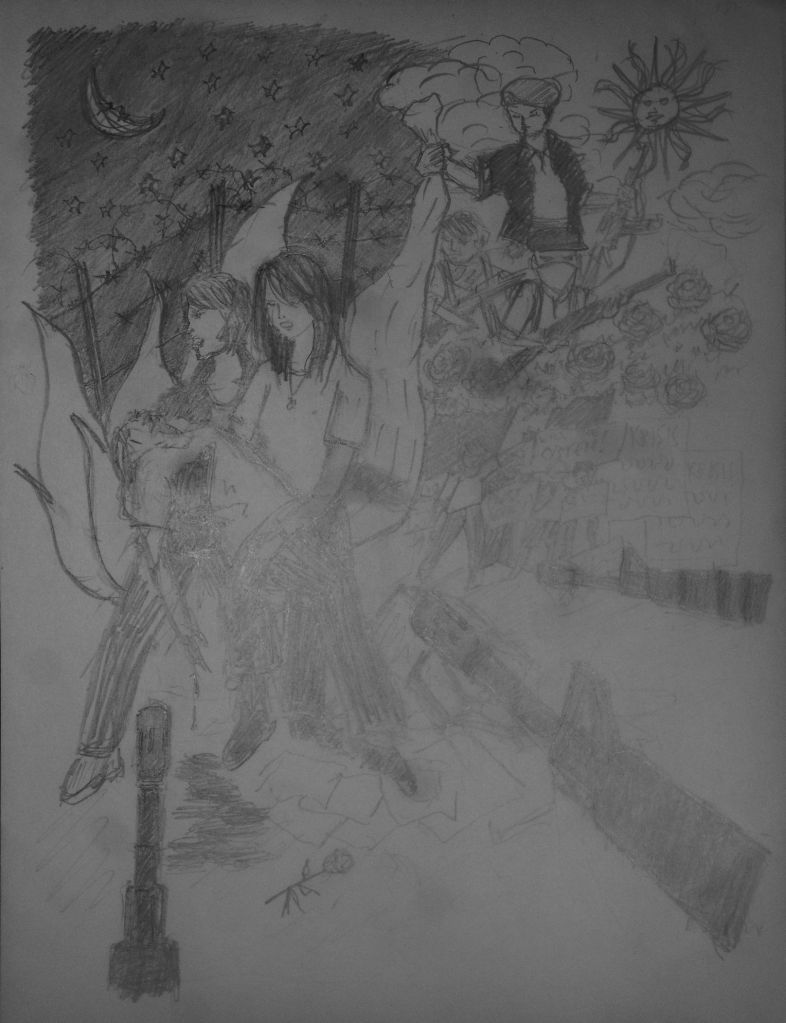
Yes, it was made inspired from an Iranian poster that captures the imagination of the person who sketched another: a man carrying an oil bomb, a girl carrying a lantern and another with a gun surrounded by victims and criminals that dominated and made the society as rotten, tainted by its very own immorality.

"Stoning of the Devils" by Habib Sadeqi

Admitting that had been inspired by Sadeqi especially depicting a pilgrim on his way to Mecca pelts stones at the manifestations of evil surrounding him. That somehow brought this person an idea to create somehow same  but more of a militant than a religious significance as evidenced by three "Rebels" with one raised the lantern exposing the devils that brought total pestilence to everyone via the police, the military, the media, all controlled by the few who cares about themselves and their fantasies. The person whom prepares his oil bomb to be thrown had obliged by reality to do the "deed" same as the girl carrying the gun as to resist the system and to defend the interest of the people. 
The scene of resistance, as to Sadeqi and his Islamic-themed work carries defiance as to present a righteous person as a liberator carrying a message-action against the corruptors, immoralists and of the wretched. The realities had made them open eyes both to show mercy to the oppressed and to bring fire against the oppressors the way Christ said:

"Do not think that I came to send peace upon earth: I came not to send peace, but the sword."
(Matthew 10:34) 

 The Merchants chased from the temple by Jacques Tissot 

Obviously, it tries to invoke how Christ had dealt with the moneylenders as he invoke "faith" over self-interest as to cleanse the temple from their impurities yet people tend to reduce it as a purely spiritual matter despite interconnected with socio-economic and political ones as invoking righteousness over those who had been exposed. Come to think of this: Christ's scourging at the temple, the stoning of the devils during Hajj reflects popular disgust against those who dare to corrupt, so's the sketch below.

"Confronting the Wretched"
(Inspired by Sadeqi's works)

Another work somehow made this person also compelled as he sought a depiction of martyrdom.

"Blindfolded soldier shot at Gunpoint"
Feauring an Iranian warrior being executed at point-blank range, it invokes a religious significance as Imam Huseyn stands behind and waiting along with thousands of martyrs into the awaited paradise. Obviously, the work itself mirrors how Iranian troops, in defending Iran during the First Gulf War had described the entire conflict as "sacred" where every day as "Ashura" and the field as "Karbala" wherein Huseyn and his 72 men killed by the Omayyads in 680 AD.

That somehow brought the idea of making another sketch featuring militants facing the bullets with one of them been killed fighting for their beliefs. However, instead of Imam Huseyn, a militant awaits those who join  in another phase of struggle to avenge the fallen.

"Resist, Avenge till death"
(partly based from the Iranian poster)

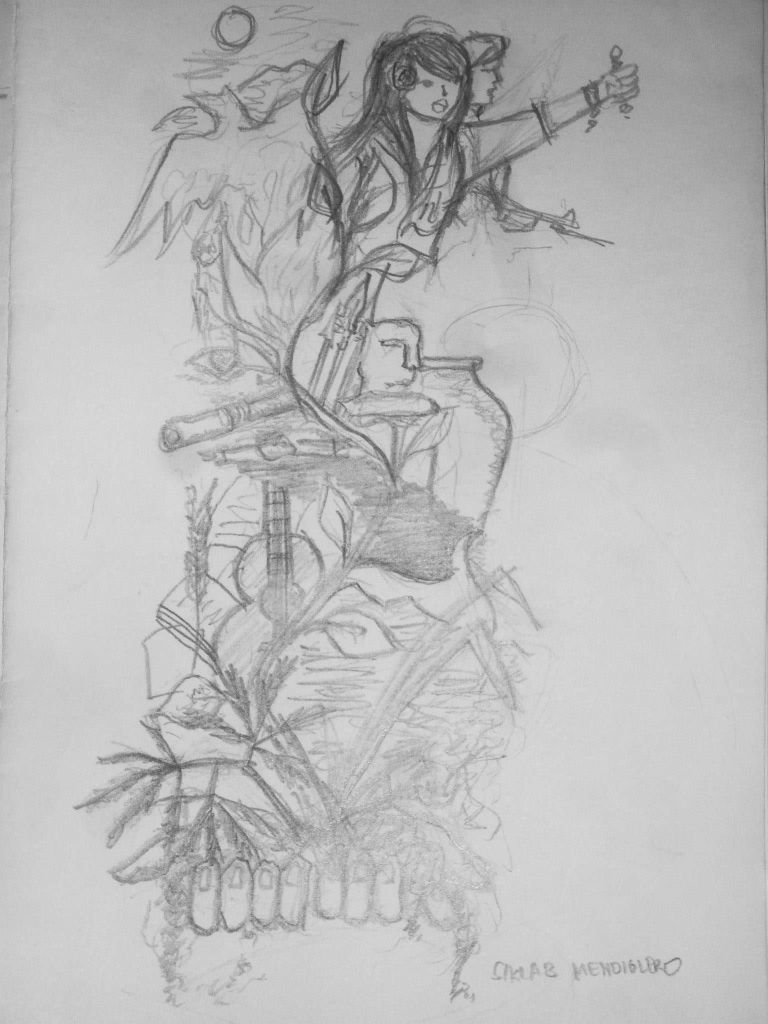
There are other sketches that haven't been directly based on artifacts nor on the posters as well. But it carries a somewhat strain of influence that brought an idea and urge to capture and not entirely replicate both mystic and realistic at the same time.

Like this.


Had been rather influenced with the culture of the indigenous peoples such as the Ifugaos, and even the awareness about their land and struggle would say that the sketch itself invokes a spirit that emphasises struggle from the roots as to a vine creeping passing from the land of their forefathers, their culture, and of course their struggle depicted by a maiden clenching a fist and a rising eagle from the ashes.

Not quite strange compared to those been based partly on religious iconography such as the sculptures. Perhaps, it's been a pastime for this person and his hands to create this and that out of a mind gone fattened with what comes around. 
In fact, others such as his mother described his sculptures as nonsense as to ruin the living room for quite some time, perhaps being the owner of the house would say that she had much disregard his son having focused on art than the profession he used to. Yes, how cares so to speak if this writer had much interest in culture and the arts, the unknown and the antinorm than what they insisted such as "to live just to work only to live." 


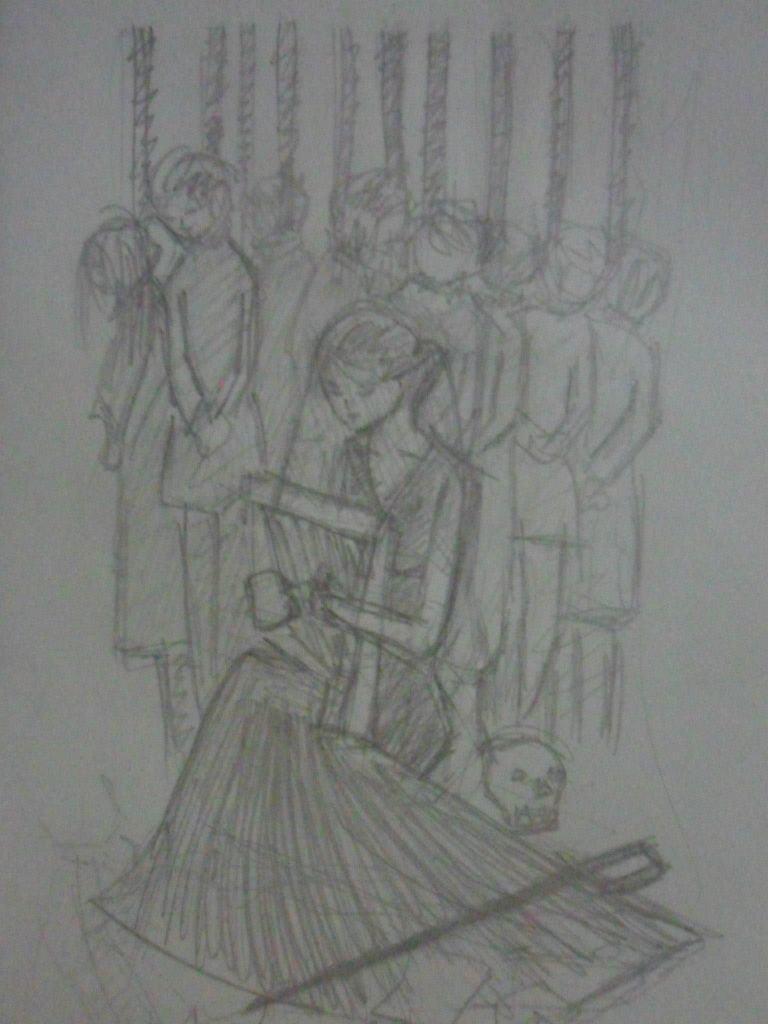
If so, then perhaps that kind of philosophy is all but nonsense since it reminds of to live under such "standards" consists of work, earn and  consume. That sketch, made during the time felt in a bad mood after an argument lies people hanged for being deviant, with a girl playing the harp mourning. 

Anyways, to this person, all meant defiance. His activist days, his love for history and cultures of the world had brought him to the idea of making those as inspired, as based, partly replicated from, or everything whatsoever from his eyes to his mind ought to invoke the spirits through art same as he tries to say and understand.
So are others had much imagination to express with whether merely for the sake of selling or to invoke the aspirations of everyone such as those of its own culture and roots and ought to understood by many.

However, as for the sake of selling, it had been ingrown by those who had made "for arts sake" and saying "they are expressing." And if they're expressing, then of what is expressing if the idea is primarily for the sake of doing it other than to be sold? Strange so to think of nowadays if that's the case as people had been compelled to content in things canned and sold as for the few in "organic" and "well tended." 

As a ContemporAntiquitarian would say that invoking the spirits of the past is not all about idols, the supernatural nor invoking those of yesterday's events. It's all about culture, reality, and struggle in midst of modernity. Slavs had tried though invoking in a way Soviets invoke the once "Mother Russia" into a mother of multinational Soviet Union called "Mother Motherland" same as the Northmen although had been associated much with the Neo-Nazi groups by western media with those of Thor and Odin as inspiration for their battles. Iran had did the same to invoke their own symbolism in their "struggle against a decadent, modern world" people had witnessed today.
Quite weird isn't it for others to think that in replicating as to invoking back-after all, they had given up  But come to think of this, does preserving culture in midst of modernity should be reduced to a means of appeasing tourists as to sculptures for a museum or in an antiquities shop whilst the rest had been looking much into the idiot boxes such as TV, Computers or even Cellular Phones of today? 

Or even this:


Sorry to say so, but these are perhaps should became flowers like their accidental god Narcissus in replicating what that being from Greek Mythology used to indulge.

Wednesday, 15 May 2013

All is but a "Stage" in "Democratic Kampuchea" (Or how these videos tried much to show the contrary)

All is but a "Stage" in "Democratic Kampuchea"

(Or how these videos tried much to show the contrary)


Well, at first, this writeup tackles how a country then ruled by a group of petit-bourgeois "idealists", draped in red had turned a country into a vast work camp from 1975 to 1979.

Usually depicted as people working in farms if not making grandiose irrigation projects, Democratic Kampuchea and the Khmer Rouge had been known for orchestrating the Cambodian Genocide, which resulted from the enforcement of its social engineering policies such as "removing impurities" like those of the with good backgrounds.

However, despite its typical depiction presented in the media, it seemed that the ones in Cambodia (Kampuchea) had tried to present another portion of their way of life.


These movies, somehow would also inculcate a view different from what the western media showed about Cambodia then as contrary to the tragedies happened during that time such as the Killing Fields, the Famine, and other atrocities happened under the adventurist regime of Pol Pot, Ta Mok et al. the scenes made during  shows how Cambodia experimented its own, fusing primitive agrarianism and modern technology in the name of Year Zero and the Angkar; also to think that they even depict a Cambodian as an industrial laborer if not a student who engage in technical and vocational education in pursuit of "reconstructing" a homeland torn by civil war. Obviously, despite its efforts, it turned out to be failures as Pol Pot himself wanted to present to the world how a "Communist" society would be.


Yet instead of a developed society that had undergone construction and development that had shown in those scenes, it was rather a stage reminiscent of Fritz Lang's Metropolis shown years ago. Quite nice to see workers laboring, students studying a vocational course on repairing telephone or electric lines, or people making medicines from herbal plants and the like, but their efforts had failed without the role of the intellectuals, effective and people-minded managers as most had been murdered for being described as "capitalists."

Again, Pol Pot simply made it out of ambition as to create a society without any transition. Obviusly, they had failed to understand Marxism nor looking at the lessons made by Lenin, Mao, Kim Il-Sung or even Ho Chi Minh in regards to their respective countries regardless of their presentations made by the Ministry of Information; to think that, using the idea of "reconstruction", Cambodia at that time was as if making its own "from scratch", literally "from scratch" as they mobilized the entire population, pushing them to undergo "Peasantization", and build more reservoirs, irrigation systems, grow rice, build some monumental buildings, yet neglected the entire urban zone as the Khmer Rouge, with its adventurism wanted anything to be "into the soil", "into the roots" like those of the ancient Angkor.


Quite strange so to speak the videoes as different from what the west had shown in regards to "Democratic Kampuchea." Yes, that Cambodians tried to develop but to think about the genocide that happened those times and the uber-idealistic ambitions of Pol Pot et al. had simply ruined the effort to construct the society compared to China in 1949, Vietnam in 1945, and others that, although difficult, had to endure just to rebuild and construct, improve and modernise the society. But still, Pol Pot chose to skip, do a "Super Great Leap Forward" that was, a failed attempt.
Good to see people cooperating, but sheer anti-intellectualism on the pretext of "just simply capitalist", "bourgeois", "imperialist" or any other rant against the educated, had negated its very own idea of development in a way forced evacuation and disregarding towns and cities had done. Yes, "Democratic Kampuchea", from 1975 to 1979, no matter how they attempted, was all but a stage as what presented by Fritz Lang or Sergei Eisenstein; but come to think of this: Pol Pot, Ieng Sary, Khieu Samphan do belong to the bourgeoisie! Again, it's their idealism, their misinterpretation of Marx, Lenin, or Mao's works made a terrible result that brought not just genocide, but also famine and disease as well. Come to think of this: thinking about a "Super great leap forward" rather than reconstructing a war-torn country same as disregarding then-existing technology as they favor entirely manual labor on the pretext of "cooperation."


However, on the other hand, would say that their presentation tends to show Kampuchea was a vast construction site, a camp where everyone ceaselessly working especially those who had dig deep and build more reservoirs, irrigation systems, grow rice, build some monumental buildings, thinking that "They are the lords of water and land" as what their propaganda says so in making those kinds of projects happen even to see a part wherein these Cambodians had to enter the factories, man the machinery and do sorts of labor as a contribution.

Especially that one scene featuring children studying how to repair electric or telephone wires, everything vocational rather than the typical one that studies arts and sciences, as well as making medicines out of existing chemicals whilst the rest been made of herbs in a factory compound. Yet, as for the latter, compared from the factory that making rubber tires, they mainly utilize manual labor (such as female workers chopping herbs in a wooden chopping board or grinding using a mortar and pestle) despite having existing machinery to create sufficient medicines in a country also ravaged by illnesses such as malaria and plague, otherwise they even tested it on animals such as a water buffalo.
Most of them would say haven't finished college to engage in the sciences, obviously they were being trained though by then existing chemists whom being "survived" just to train people, mainly peasant bred to get involve in a different profession city-bred people used to involve. It even reminds of a poor tailor that, with good hands, sharp eye, and willingness to study even the basics of the medicine profession, being trained by a professional doctor to become a barefoot surgeon.

So was the scene wherein workers making ships despite being made out of wood and propellers all made throgh manual labor. In fact, this writer may found it quite strange that they had to make propellers, old "blacksmith" style despite having existing factories making steel; they even apply putty to the wooden hulls by hand. And as for creation of softdrinks, seems that the Khmer Rouge themselves are drinking Mirinda that seemingly forgotten that Mirinda was Pepsis, and Pepsi belongs to the imperialists!

Anyways, their efforts showed how Cambodia, "Democratic Kampuchea", being a vast construction site of their own "Socialism", presents its own to show their side that includes machinery and modern stuff, or rather say being semiprimitive as to stress the countryside further; but come to think of this: how come they stress much on how to create dams, dig trenches by manual labor, quite nice though to speak about cooperation but their extreme disgust of those who study turned things worse.

After all,
to them it was all "nothing," like Pol Pot, it is neither gain nor loss to their un-pragmatic dream.

Saturday, 11 May 2013

The Kuliglig: Philippines' "Modern" answer to "Old" Benz's Motorwagen

The Kuliglig: Philippines' "Modern" answer to "Old" Benz's Motorwagen


It was a year ago when this writer had remembered vehicles then dominating in the streets of Manila.

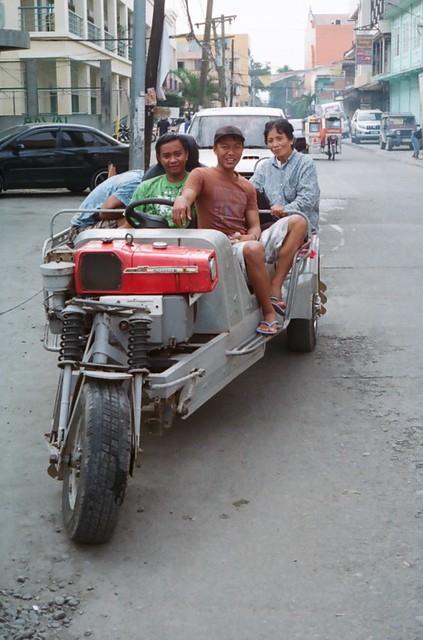
Those vehicles, somewhat reminiscent of Karl Benz's Motorwagens and Ford's Quadricycles in its how-to, had to be started manually by a pulley system as a drive train contrary to the usual key used in cars, jeepneys and even motorcycle driven pedicabs. Quite indigenous so to speak that since the Motorwagen had to be started by steering the flywheel, the Kuliglig had to use a pulley to start the engine straight and man over. 

Originally known for a two-wheeled trailer, and a handy tool for farming and other agricultural purposes, the Kuliglig had became known as a transportation vehicle similar to a pedicab. Obviously, its steel frame had to be similar to a pedicab and fitted with a diesel engine in order to run. Its procedure had been similar to a boat in starting its engines prior to running.

How wonder working class Filipinos in downtown Manila afford to create such vehicles especially in carrying vegetables from the port to the market such as in Quiapo or Aranque. That, those vehicles, reminiscent of Ford or Benz's in their early vehicles, used manual especially in starting its engines. Most had no keys and instead having ropes to start the wheel; and of course, they use gasoline especially diesel.


In fact, not all Kuligligs are similar to those from Manila nor look as much same as the rural one. In the provincial towns, it even made similar to a jeep but a three wheeled version. Again, using the same engine to man the wheels as farmers, also as traders had to drive people if not their produce from the farm to the market; and with all with their ideas regarding improvisions are perhaps as if similar to the inventors of long ago whose engines ran in steam and few on paraffin and gasoline.

The difference? the latter made the engine, the former just had bought the engine from a supplier. But both of course had enough ingenuity to create something different yet out of purpose. Farmers didn't create the vehicle or rather say bought the engine for nothing, it took months or a year to concieve an idea to make something possible other than a hand tractor or a mill, or a water pump to make things least easier.  While in Manila, wherein some of the roads as narrow, Kuliglig and its motor-tricycle Pedicab had to pass to transport vegetables if not for a shortcut due to traffic aside from ordinances disallowing them to enter public roads such as Recto, Avenida or Morayta.


Otherwise, quite strange as well for the Government not to support local craftsmen, if not inventors who took time concieving an idea and improvise, if they do, more of a paper statement and telling people "they're expressing concern" over those who had spend time doing their craftsmanship better. Sadly, some people desribed alot that Kuliglig had been known for noise, pollution, hindrance to traffic and other matters that made the Manila City government attempting to ban altogether that resulted to a protest action that happened two years ago.
Most drivers had been wounded and arrested because of their right to livelihood, they even provide proofs that their vehicles don't do smoke as they use unleaded gasoline or they can seriously observe traffic rules and regulations including those of disallowing themselves to enter public roads like Recto or Avenida. But then, people in Manila would say that those vehicles are rather eyesores that they wanted altogether to be banned in the capital's roadways.


What a crappy reason to say so if that's the case to think about those vehicles as eyesores. Like Jeepneys, these are byproducts of native ingenuity and appropriate technology (appro-tech) as they improvise things that are supposedly temporary. Jeepneys are made due to lack of mass transport such as the pre-war Tranvia. However, the influx of cars, and government's near aloofness in urban mass transport made the idea of reviving the Tranvia never happen until it was superseded by the LRT at Avenida and MRT at EDSA. Idealistically speaking, mass transport, other than easing traffic, also meant for easier, faster transport of goods especially in urban enclaves.

But despite these, how come jeepneys survived as well as Kuligligs and Pedicabs in Manila and other parts of the metro? To think that the Manila city government had even banned Kuligligs in every street especially in downtown Manila! But anyways, despite all the events that happened affecting those vehicles, it's up to the drivers and craftsmen how these vehicles survive. Of course, they wanted improvement and modernity as well in order to provide a good transition. Again, few dared to heed the call of modernity in making things happen from the engine, applying airconditioning, to the appearance to make itself presentable and modern.


In a way that Tuktuks in Bangkok, Thailand somehow they had been trying to be presentable and modern as possible rather than contented as what people see about Pedicabs or Kuligligs in Manila. Jeepneys at least had tried to improve in a way from having air conditioned jeeps to the "E-Jeepneys" sponsored by the Department of Energy and Greenpeace. For in fact, the idea of "just" improvision, no matter how it helped in making these happen isn't enough so to speak nowadays with craftsmen trying to make new things, march with time rather than getting contented and eventually left out not not offering themselves their own transition to a new kind.
The Kuliglig itself had been a variety of uses and perhaps willing to improve more other than a transport for vegetables and people same as the Pedicab. It needs some improvement alot nowadays in order not to be deemed as eyesore in the eyes of the near-choosy "thinking class" as Henry Ford and Karl benz did in their prime years as craftsmen in the beginnings of automobile industry. 

But the good thing? Least that the Kuliglig itself had been trying to relieve what the Motorwagens had made, yet least abit "modern" out of being "purpose-driven."

Anyways, kudos to the makers whom perhaps trying to replicate, no matter how they tried to look "modern", the craftsmen of the past.