Saturday, 14 June 2014

On the recent June 12 protests: from an observer's view
On the recent June 12 protests: from an observer's view


IT SEEMS that last June 12, Independence day was also a day of angst against people yearning for freedom against corrupt bureaucrats and a system whom protects them despite assuming itself as righteous both word and deed.

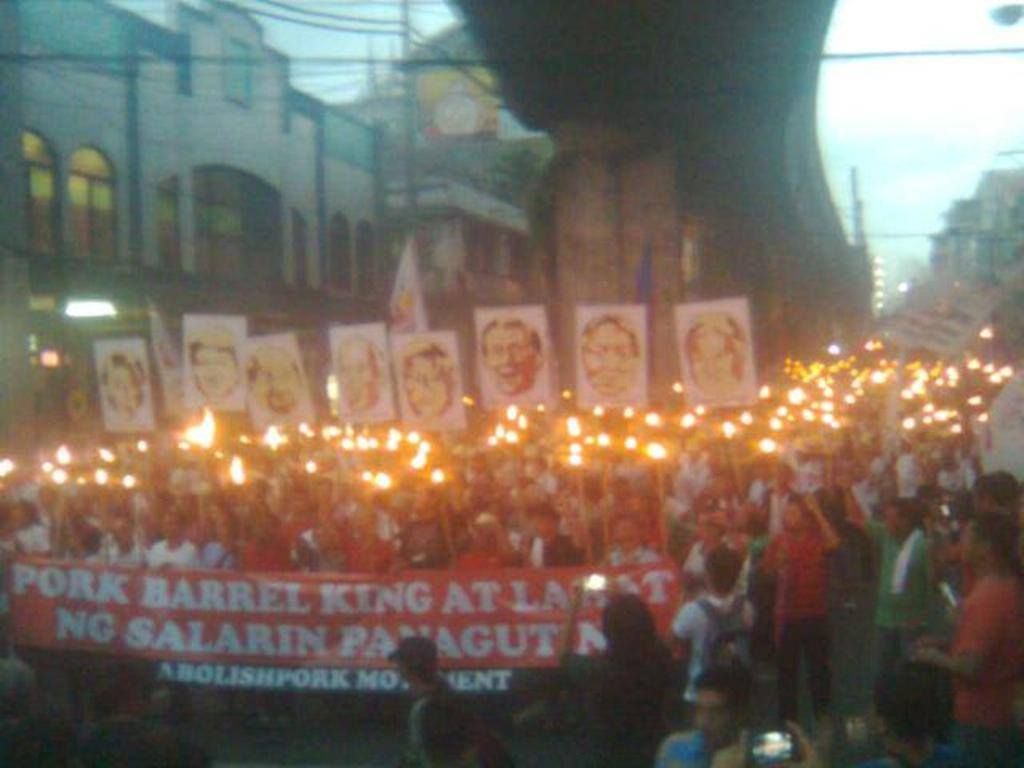
As most of these protesters had marched from US Embassy up to Liwasang Bonifacio, and eventually at Mendiola, these protesters had to endure the sudden cold and heat, and some had even raised posters featuring pictures of senators Enrile, Revilla, Estrada, as well as secretaries Abad and Alcala.

And with their latest chants like "Noynoy Aquino, Pork Barrel King!" and "Pork Barrel tanggalin, Noynoy patalsikin!" (Remove Pork Barrel, Oust Noynoy!) Protesters from different organizations also called for Aquino's ouster, citing his negligence in running state affairs, coddling corrupt bureaucrats with the latest Pork Barrel scam, and failing to implement agrarian reform in case of Hacienda Luisita and other estates owned by the ruling classes.

Bureaucrats involved in the scam were objects of rage in that event aside from the negligent head of state: Executive secretary Abad and Agriculture's Alcala are being emphasized in the program aside from the senators Enrile, Revilla, and Estrada. "As things stand, only a select few have been investigated and prosecuted. Aquino himself has been leading the cover-up of the pork scam by insulating his allies and cabinet members like [Budget Secretary Florencio] Abad and [Agriculture Secretary Proceso] Alcala," according to BAYAN's Renato Reyes.
However, both Abad and Alcala denied accusations with the former insists that he supports the president's anti-graft and corruption program. But people whom are sick and tired of these bureaucrats chose not to believe in their innocence same as the president whom at first promising to scrap pork in the form of PDAF, only to be replaced by Disbursement Acceleration Program, known as DAP; so he was promising freedom of Information, only to favor the newly-passed yet infamous Cybercrime law with its emphasis on CyberLibel.

source: Interaksyon

The protest march includes an effigy of a pig reminiscent of the golden calf being paraded to the amazement of the onlookers. It was first been shown in last year's anti-pork demonstration in Makati's Ayala triangle.

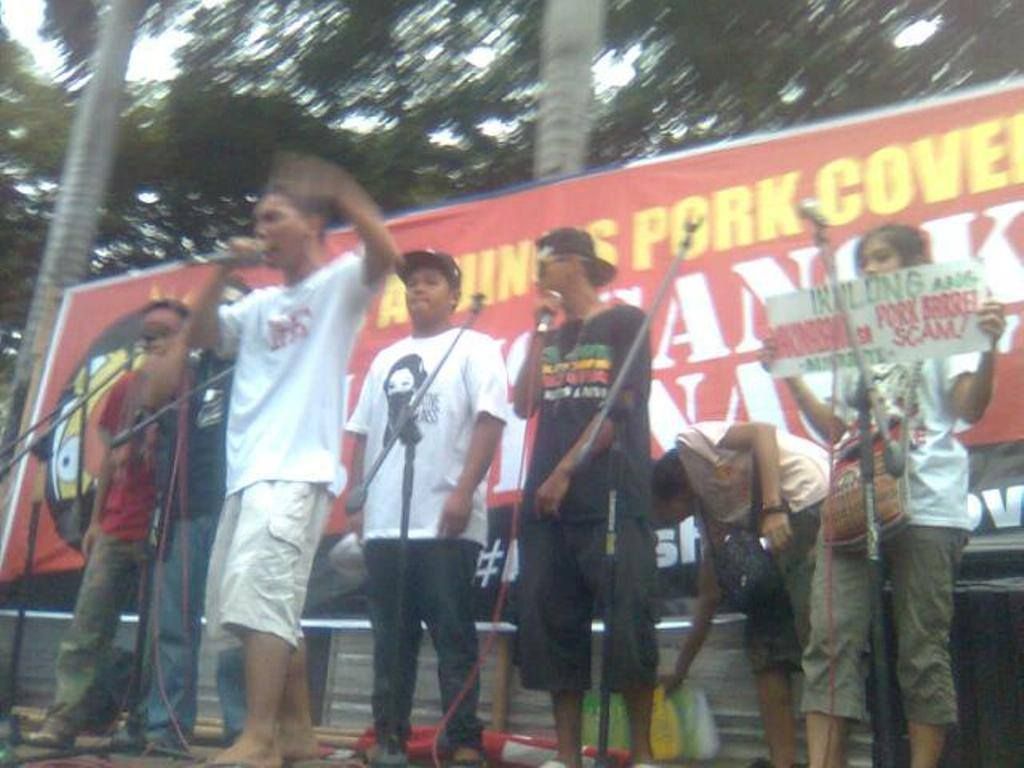
Other than BAYAN, groups like Victims Against Crime and Corruption, as well as individuals like Bishop Oscar Cruz, NBN-ZTE Whistleblower Jun Lozada, Mae "Juana Change" Paner, and Blogger Tonyo Cruz expressed disgust against the present administration and his slow handling of justice against Napoles and corrupt bureaucrats. Street rappers turned activists had also vent their rage through music, while other speakers subjectively heckle President Aquino from being bald to being negligent in national tasks if not coddling criminals in Barong Tagalog or coat and tie.


Scarborough Shoal, EDCA, and costumed protest at US Embassy

Other than Pork Barrel, there were issues being discussed like the Scarborough Shoal and West Philippine sea, stressing Philippine sovereignity over the contested rocks, shoals, and isles west of Palawan; as according to former Congressman Teddy Casiño, he said that BAYAN rejects "incursions of China in our Exclusive Economic Zone," but also opposes a new agreement that will allow US troops to establish facilities inside Philippine military bases. "All these are threats to our independence and sovereignty and we are here to defend them," he said.

source: Philippine Star


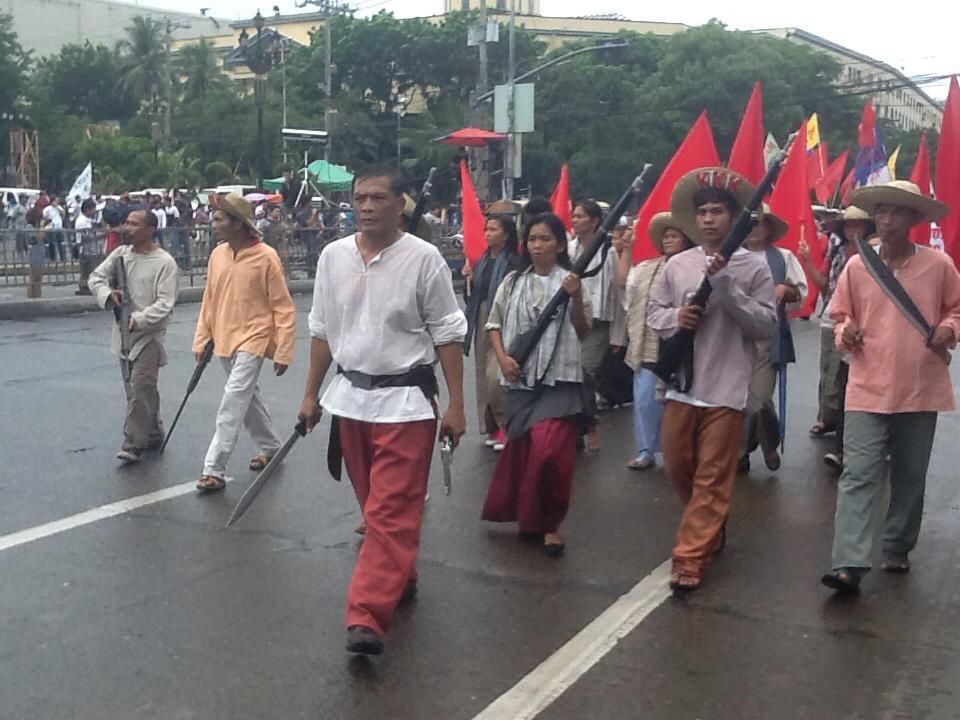
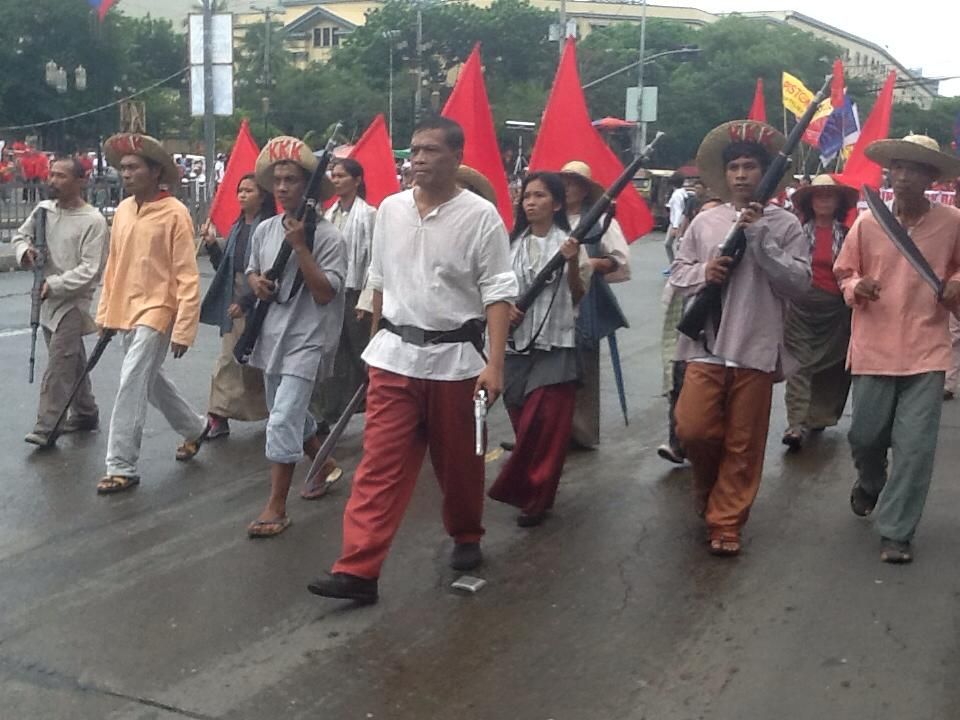
And prior to the march towards Liwasan, a group of protesters, dressed as Katipuneros led the way in marching with rest after a near-scuffle with the cops at US Embassy with the latter confiscating some of the props like wooden guns and bolos. Some of the costumed protesters were still carrying their props as they marched towards the program site.
The protest near US Embassy was against the agreements that protesters described as unequal and one sided. Examples of which are the Visiting Forces Agreement, Mutual Logistics Support Agreement, and the latest Enhanced Defence Cooperation Agreement; so was last year's Tubbataha reef, wherein USS Guardian had ran aground in its coral reefs and the US Navy still has to face a 58 million peso fine left unpaid.

source: Bicol Today
Meanwhile, in Naga

Meanwhile, most news reports shown that President Aquino and his retinue had rather celebrate independence day in Naga city, Camarines Norte instead of Manila's own Quirino grandstand. In his speech, he stated that his family’s legacy taught him "the importance of fighting for equality to break the cycle of vicious injustice." And he is "in a position to apply these principles, to do everything in his power to proffer justice not to a select few, but to the entire nation."

But the protest actions didn't focus entirely on Liwasang Bonifacio and later on, at Mendiola. For a group of activists had afford to voice out angst against the administration, in which Emmanuel Pio Mijares, a student from Ateneo de Naga University had been arrested and detained for 12 hours for criticizing publicly during Aquino's speech in Naga's Plaza Quince Martires, shouting "Walang Pagbabago!" (There's no Change!), "Noynoy Aquino, Pork Barrel King!" as well as raising a red banner that read “Education for all. Stop privatization!”

Mijares is a member of the Youth Act Now and Kabataan Party List, both militant organizations. And was brought to the Naga City police office and will be charged with violating Article 153 of the Revised Penal Code that "serious disturbance in a public place, office, or establishment, or shall interrupt or disturb public performances, functions or gatherings, or peaceful meetings" with a fine of P1,000 and from two to six months in prison.

In response, College Editors Guild of the Philippines condemned the arrest. "If a mere exercise of rightful expression is a basis for incarceration, then the BS Aquino regime is no different [from] the fascist orientation of the Marcos Martial Law," according to its statement. While Karapatan Bicol spokesperson Paul Vincent Casilihihan issued a statement condemning the arrest and detention of Mijares. “Dito mismo nakikita ang kabalintunaan na kapayapaan na sa mismong araw ng kalayaan ay hinuli siya,” (it is here you have seen the irony of peace in this independence day where he arrested.)  Casilihihan said.

The actions taken by Mijares and others in Naga is a part of people's disgust against the administration especially in regards to insufficient distrubution of social services aside from the present Pork Barrel scandal. Up to the extent of disrupting the president's speech and subsequent imprisonment they had to vent the inconvenient truth behind Aquino's "Righteous path" that is marred by corruption scandals and a negligent government when it comes to certain issues like unemployment (regardless of job fairs that means contractualization and insufficient wages), insufficient access to health care and social services (especially those victimized by Yolanda), and peasant struggles in lands owned by the privileged few like Hacienda Luisita, Looc, and Central Azucarera de Don Pedro.


Conclusion

People may misunderstood if not altogether disregard about the protests regardless of the topic like Pork Barrel, Kalayaan Group of isles, or Cojuangco's Hacienda Luisita. Oftentimes, there are those trying to describe those protesters subjectively as Pro-Chinese simply because of the present Republic is acting as if a protectorate of the United States and its series of unequal treaties that somehow made the late Claro M. Recto said right about his country's foreign policy as mendicant, aid in exchange of having its own yard and its matters be intervened. 

But come to think of this, since the Philippines had celebrated its day of freedom against colonizers, what is independence if has to rely on a bigger country than to stand up on its own and acting mendicant aside from a system that is indeed corrupt with officials siphoning off money from the people? Save for those whom had national concerns, is the people had loss of national consciousness save for Boxing rematches and beauty contests? Vietnam is same as China's but did resist its northern neighbor by its own, so should be the Republic whose people takes pride in anything yet failing to act in support of realizing patriotic aspirations. Neither Washington nor Beijing would make a nation great regardless of aid being given or money being invested.

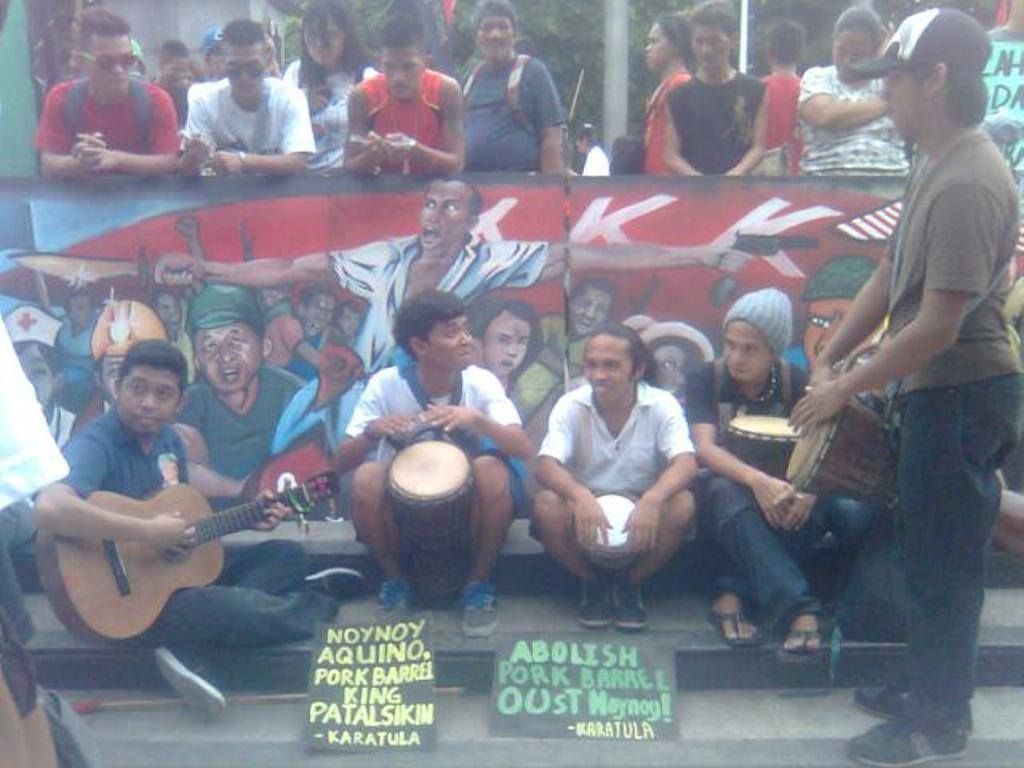
Hence, the struggle continues knowing that age-old problems continue to persist. Protests will still continue citing that peasants have no land to till, workers for their bread, an end to all corruption, and a nation yearning for a just and lasting peace.

Wednesday, 11 June 2014

"Speaking on behalf of industrialization"

"Speaking on behalf of industrialization"


Seems that the debate on industrialization continues to intensify especially when neoliberal-inclined anti-industrialization and globalization advocates continues to babble their sentiments ranging from equating industrialization to oligarchy up to their insistence of just opening the nation and turning it entirely into a freeport-like existence, less governments and big business, especially on behalf of foreign conglomerates acting as substitutes for the oligarchs neoliberalists abhorred much.

In fact, that issue is so decades-old, ranging from legislative debates to social media commentaries, the debate regarding the need for industrialization, especially whose orientation is nationalist and people-centered, continues to be advocated by small and medium scale enterprises, patriotic-minded businesspeople whose intention is to utilize natural resources and curbing employment, yet being abhorred by those who rather insist opening up Philippines and turning it into a freeport, exporting raw materials and importing finished ones, if not having foreign owned companies exploit people for cheap labor, promising them with good wages yet disregarding local holidays if not respecting regulations.

Well, on behalf of those clamoring for industrialization, not all matters pertaining to domestic-based development, especially those of industrialization are those from the oligarchs; oligarchs have confused ideas yet having the same interest as international moneylenders and big-named conglomerates do. Oligarchs owned most plantations, and international moneylenders wanted to expropriate agricultrual for themselves such as turning farmland into commercial complexes such as agritourism and rest and recteation facilities. Therefore, what kind of agrarian reform is the present system speaking? Just like earlier attempts for industrialization, what they made is a façade built for impression. The retreatist character of the system made such aspirations doom to fail, especially that the ruling class failed to pursue what they're offering to the people, much more that they themselves have different points of view.

One may favor industrialization in pursuit of utilizing manpower and resources for domestic pursposes, another favors just opening for foreign investment with themselves willing to cooperate with transnational companies and international moneylenders searching for cheap labor. Some favor protectionism for themselves, another favor globalization and neoliberalism as long as they benefit themselves as well; and the people? They're just being used and fooled by the ruling class whom babbled both sentiments much more that they are still blinded by tangible illusions of grandeur such as commercial complexes and business centers, roads and bridges all made to impress and trying to hide the real situation like latifundia-style feudalism and cash crop-oriented plantation system in the countryside.

This writer had seen anything what the system had done in pursuit of impression. Few officials, businessmen may seriously adhere to their goals of building a better nation; idealists like Araneta had afford to break importing flour though his RFM, Andres Soriano did expand his San Miguel from a mere brewery to a food conglomerate, Guevara with his Radiowealth, and others whose intention is to have a self-sufficient nation. Some dared to have partnerships with companies abroad in pursuit of technology transfers yet a few succeeded and the rest end absorbed by their foreign partners. But the system, two faced so to speak made everyone confused which policy should been enacted. And again, some of these people this writer had stated failed to pursue their "patriotic aspirations" evenly, especially those of their successors whom can't even resolve labor issues but instead making strikes intensified, or failed to compete with imported ones as the system can't even control the flow of imports courtesy of those unequal agreements.
So are the leaders, puppets and representatives of the system at first, can't even pursue people's aspirations seriously and instead aggravating age old tensions regardless of the papers being signed and promises to end unequality in certain agreements. Marcos, for example, had once said about ending decontrol made by his predecessor Macapagal, yet he didn't pursued as he became president; people may admire him for his series of infrastructures in and around Metropolitan Manila and provinces, and yet industrialization failed to pursue because of outside intervenors like IMF-WB. He had allegedly punished the oligarchs according to his writeups, imprisoned Lopezes and "nationalized" Meralco, and yet he substituted those with his cronies to control those sequestered (or in their terms, "nationalized"), and even collaborate with other oligarchs like those of Ayala and Zobel. Did Hacienda Luisita being expropriated that time as well as the others to justify his angst against the landholding oligarchs? No. He even tolerated Enrile in his exploitation that made Samar flooded during rainy season.
Sorry to those whom are too loyal without thinking critically, but he failed to justify his democracy as for the poor regardless of what he did. So is independence regardless of the rhetoric being said of. People may benefit from his rule such as the roads, bridges, and other kinds of infrastructure being built, so as to endure the hardships like some of his policies involving a chunk of tax-supported national budget be allocated to debt servicing, a floating peso, rising costs of goods and services, upholding some unequal treaties, and extrajudicial actions.

And speaking of dictators, not all orderly fashions can spur change and progress. Sometimes, this writer would think that people had assailed North Korea and yet it's much disciplined than those of Singapore regardless of its hardship; you hated corrupt people and calling for trial, yet it is also the same you who cried purge after Stalin had punished those whom did wrecking against the economy in the former Soviet Union. You had admired the modernity what United States had offered, yet failed to develop its own regardless of having national scientists, artists and people with good potential. And now you want progress yet having half hearted thoughts about industrialization and land reform while favoring just opening the country for globalization and neoliberalism? Not all aid can stimulate development, regardless of its intentions such as "aid is altruism" or "aid supports the poor by the rich" with the latter actually exploits them by insisting dependency over self reliance as a society. Once, Lenin called for aid coming from European countries and even from the U.S., yet end rather focusing in themselves, reconstructing although countries that earlier aloof in Soviet's call for aid, like the U.S. did afford, yet limited such as Ford tractors to professionals, even businessmen that happened to be sympathizing with the Soviets. But still, U.S. and other countries in Europe took a hands off on that matter until they notice a different Russia that was a product of its "New Economic Policy" and the first 5 year plans. China did tolerate some businessmen in its early days as a socialist state, yet at the same time focusing on industrialization regardless of Soviet aid, the latter, in expressing proletarian internationalism did gave aid as contrary to the obviously interest-seeking ventures of the U.S. In providing aid and investment.

Anyways, how wonder why Ersoy of Turkey said about civilization of the west as a single-fanged monster. It had brought modernization courtesy of its superb knoweldge and technology yet at the same time unleashes its own barbarism worse than the undeveloped yet willing to march towards modernity. The developed west rather treats both the underdeveloped and developing east as its own farm, gold mine, and oil derrick knowing that their resources as abundant, hence accumulating profits from these and blocking popular attempts to develop in its own. Both by the system and its very own fanboys. Lucky if there are foreign investors willing to support the intentions of a state trying to develop its own by industrialializing itself by means of technology transfers, financial support, to training of personnel and any other means as respected through certain agreements that includes, stresses mutual benefit and equality. As what the 12 point program of the National Democratic Front of the Philippines said:

"Trade and other forms of economic relations with all countries shall be promoted on the basis of equality and mutual benefit. The state, whenever possible, shall engage in barter or counter- trade with such countries as are willing and able to do so.

Foreign investments and loans shall be availed if these provide the country with the least costly access to needed technology, products and markets as defined by specific economic plans. These should not lead to a chain of “reforms” which take the country off the road of socialism and restore the economic and political power of the bourgeoisie."

"Reforms" are often used as a smokescreen for reactions. And if domestic-based development such as those being described, especially those of industrialization, utilizing national resources for domestic use, and stressing mutual benefit in agreements with foreign countries is socialism then so be it!

This writer may still read both those whom favor and those whom not from debate forums to social media sites. They would cite facts and figures, blaming either the domestic oligarch or the much profit-driven foreigner or even both knowing that they exploiting resources, of pitting small and medium enterprises, and fooling people by telling about development that disregards self-reliance. Foreign investment, or even aid can be good or bad. Good in a sense that it supports development, while bad in a sense that it creates dependency. And, sorry to mention, how come countries like China or Vietnam, or even Korea had to develop first their own and encourage to emphasise first their own regardless of opening its own to foreign investment? Foreign investment seemed good yet has to be tempered with domestic based production, in which a government run by the people has to encourage, even protecting small and medium enterprises and supporting not just in making infrastructure but in actual industry as well; this writer also knows that the present system in the Philippines may likely to fail simply because of oligarchs if not self-emphasised bureaucrats whom end up objects of discussion due to economic wrecking. Worse, those oligarchs are also bureaucrats, babbling economic protectionism and at the same time currying foreign investment, speaking on behalf of reforms yet they kept mum in speeding agrarian reform and additional wage increase, industrialization did fail because of their Janus-faced stance that is "sometimes yes, sometimes no." Hence, they are obviously doing economic wrecking, and people should consistently oppose if they wanted to speed up development!
Anyways, pardon this person's English to say "economic wrecking," for graft, corruption, malversation of public funds is part of economic wrecking. But if may ask, when will there be people having real patriotic and pro-people conciousness willing to support these efforts such as to industrialize a society and to utilize resources for the common good? Of what use is educated people if they are to be employees outside than willing to contribute their knowlege in reconstruction and development, innovation and renaissance?
Yes, those whom chose to oppose had points such as oligarchs and prefering the dominancy of international capital to mind over the country's economy, and hence they chose to capitulate unto it; but does not mean need not to focus on production, of being self reliant, so as to justify indepndence and capability to stand up on its own as a nation. Open doors comes income for the high-profile, big named profiteers in the name of international capital; but how about the state? Perhaps a small chunk, or even crumbs despite its policing tasks and sort of ceremonial brouhaha, hence has to rely on aid for their projects, mostly Potemkin and built for impression if that's the case.
Theirs is a two way road, that usually goes on the other especially in today's system.

That's all for now,
Thank you.


Tuesday, 10 June 2014

On the recent fraternizing between Filipino and Vietnamese soldiers in Spratlys

On the recent fraternizing between
Filipino and Vietnamese soldiers in Spratlys


Recently, Philippines and Vietnam staged a display of camaraderie with its troops played volleyball and football in a contested South China Sea archipelago, a landmark act of sports diplomacy that both sides said could ease territorial tensions. Both governments involved expressed a spirit of cooperation, regardless of its political inclination yet having the same aggressor that is, trying to claim the archipelago for oil and to some extent, marine poaching.

At first, it would been surprising for most Filipinos, knowing that Vietnam is also a Communist country just like its northern neighbor, poor and being denuded by "Agent Orange" during during the Vietnam War; one would even remember how members of the Philippine Contingent known as PHILCAG had to fight side by side with the then-South Vietnamese against the north and its VietCong allies. Only to be defeated by the Ho Chi Minh's people whose idea was to liberate Saigon from the US-sponsored puppets like Nguyen Cao Ky and Nguyen Van Thieu. VietCong is often the name some, if not most Filipinos think of when it comes to Vietnam, thanks to years of Cold War with Filipino participation in the American-led conflict.

However, with the late former President Ferdinand Marcos' trying to cultivate relations with communist countries and to show non-alignment, it also includes establishing relations with Vietnam in which former Deputy Foreign Minister Phan Hien and his retinue visited Manila in 1976. Bilaterial ties are somehow friendly from the start despite having claims on the contested Spratlys, both as members of ASEAN, having exchange students from respective universities in Manila and Hanoi, and Vietnam also even provided aid during last year's supertyphoon Yolanda, in which that said country was also affected by its strong wind, rain and flood outbreaks.

Also in recent times, Philippines and Vietnam have accused China of increasingly flexing its military muscle in the region, including the deployment of a Chinese oil rig to the north of the Spratlys. Vietnam had accused China of sinking a Vietnamese fishing vessel last month near the oil rig; while Philippine authorities in Manila had investigated claims that China has begun a series of land reclamation projects on reefs within the archipelago, potentially to build an airstrip.

China, on the other hand, had reduced its socialist outlook as it entered the neoliberal sphere. Starting with Deng Xiaoping's policies lies just opening to other countries including those of United States, even resulted to unjust downsizing of enterprises resulting to unemployment as well as businessmen assuming as members of the "Communist party" and the National Peoples Congress. And as it emphasise its military capabilities so is its chauvinistic intentions, hence further diversions to supposed principles.

But after all, these three countries contesting on Spratlys been dwellth in neoliberalism with China and Vietnam trying to stimulate production and at the same time protecting their small and medium enterprises (especially those of Vietnam) while the Philippines failed to stimulate production, treating industrialization as rhetoric, instead of protecting, letting bigger companies pitting down small and medium enterprises in the name of intense competition till big companies, both oligarch and foreign owned absorbing them such as in case of Church-owned Monte de Piedad end controlled by Singapore's Keppel, and A.T Suaco under US-owned Wyeth decades ago.

People may still hardly to understand this issue citing ideological differences as its main reason. Vietnam is as same as China, being described by western and domestic media as Communist (and often equate Communism to Terrorism with a smattering, exaggerated idea as its basis) yet they open for foreign investment and joint enterprises especially with multinational companies, yet citing China's invasive actions towards both Philippines and Vietnam would say that it is necessary to strengthen relations regardless of political outlook and ideological inclination. From respecting existing treaties to up to soldiers fraternizing with songs and games in contested Spratlys, lies a potential amity capable of having a strong resistance than those of yesteryear's Corregidor, Bataan, and Cu Chi Tunnel.

Lately, as the two countries continue fraternizing, China denounced Vietnam and the Philippines on Monday for getting together on a disputed island in the South China Sea to play soccer and volleyball, calling it "a clumsy farce" and demanded both countries stop causing trouble. One, two, or three persons would somehow think how come their harmless fraternizing as provocative? What the hell is China doing when they're simply playing sports, singing songs and fraternizing as Asians? China may afford to brag their development, that foreign investors (even those of the United States and Europe) afford to invest in the country, that their "socialism" of Deng Xiaoping puts his nation forward despite giving up fundamentals for capitalist-oriented ventures, hence deviating from their revolution and be described social imperialist.

Even Filipino Communist José Maria Sison, expressed opposition to China's claim like uncle Ho's and Le Thuc Do's Vietnam. That statement coming from a Filipino Maoist somehow different from what mainstream mindsets think of that Communists are pro-Chinese or what, just because Mao is from China makes a Maoist pro-Chinese? How absurd and ill-understood to express those whom insist Filipino communists as pro-Chinese simply because they oppose American Imperialism without knowing they also oppose China's big power Chauvinism. 

"Chinese historical claims since ancient times amount to an absurdity as this would be like Italy claiming as its sovereign possession all areas previously occupied by the Roman empire. The name China Sea was invented by European cartographers and should not lead anyone to think that the entire sea belongs to China. In the same vein, neither does the entire Indian Ocean belong to India."

Much more that the New Peoples Army had attacked a Chinese-controlled black sand mining venture in Cagayan, and a mining firm in Agusan. The growing trend of sinophobia would say that they turned a blind eye about these Maoists whom did punish those Chinese businessmen out of exploiting the environment and communities around those affected provinces simply because they are Maoists, while on the other hand seeing Vietnamese attacked Chinese-owned stalls in response to the intrusions made by China over contested Spratlys as a patriotic sentiment regardless of its political line. 
Yet again, ironically Vietnam and China are both communists, and yet how come they fight? Well, as long as respective countries are being attacked by an aggressor it is necessary to join hand in hand against that aggressor, even the rebel has to fight for the homeland knowing that not just that aggressor is trying to claim what is his, but his resources being expoited while the system turns a blind eye in it. 

After all, today's foreign relations deemphasised ideology and instead trying to appear as non partisan. China's expansionism is more of economic interest using historical claims, yet it has no relation with the left and its revolution. Again, people, with its cold war-esque mindsets may still find it hard to understand especially if your enemy is a leftist yet your ally, ironically, is a leftist.

Thursday, 29 May 2014

Adieu! Sayonara! La Marina!

Adieu! Sayonara! La Marina!


Admittingly speaking, time seemed running out prior to making this work.

That, all after she had finished school, and had enjoyed summer by going to beach and enjoy the warm sun and the cool breeze, this time this writer's friend had to leave and return to the land of her birth. Obviously, it is quite saddening for a friend whom she had met two years ago, of seeing in a kitchen window, end gone shy yet afford to draw, then comes friendship and perhaps a good companion.

And the fact that she had inspired a person to write and draw, to express struggle and hope. His works may mimic those of the past, rather than of the present out of reading history books and seeing classical artwork; and the fact that She may not understand the works this person had made other than assisting in her homeworks few semesters ago, yet she even understand a few of this person's thought that is more of culture and politics and her's as parties and outgoing stuff.

But the good thing was, and is the interest in food.

And as she leave, it would take months for this person to recollect, if not inspire again to do his craft of both pen and the pencil in a barren sheet of paper turning into a series of tales and sketches. Yes, Marina may had not wore the red vest, the white skirt nor having the red beret in her head; few girls made this writer drew that kind of figure being stated, and yet, call it strange but she is according to the sketches, for she captured this person's attention and hence end in every artwork, much more that she was a good companion who really acts carefully than assumes.

So was this poem, made two months ago as he anticipate his leaving.


Two and half years, nineteen months and still counting
A fruitful friendship with you continues to grow
And now counting months, weeks, days till leaving
'Gain I alone, as you leave away

Beloved maiden, when you will return back
Will I wait long, hoping see you again
Will I wait long, till the winds make bells pealing
Hoping to see you, yearning to love you
Will I wait long, till my heart gone crying:
Beloved girl, O Marina, my love!

Like flowers growing you're the rose so special
Hoping it never wilt, forever growing
Same as the day when I met you, recalling
Until the day our blossoms rose astound

And as you leave, perhaps all's may forgotten
But deep inside never! Until the end!
The stars are shining and you whose colour is red
And with thine glow, means hope as I desire


Again, to Marina,
Adieu! Sayonara!

Wednesday, 28 May 2014

Reaffirming free expression and the right for information

Reaffirming free expression and the right for information

All after watching "Library Defence Force"
and its relation to the controversial Cybercrime law, FoI bill
and the people's willingness to defend internet freedom
and the right to information


Source: Genkinahito

Some fictions are based on actual statements, if not events and people, that made its makers inspired to create as an elaboration of those.

It was yesterday when this writer had watched a movie before bedtime, watching a movie seemed to help him sleepy especially after a midnight meal and some writing stuff. There were few DVDs to watch, most of them are comedy though, yet one of which seemed to be quite interesting.

Bought from a pirated DVD stall, Library Defence Force, or in Japanese, Tokoshan Sensō, is more than just a story about a booklover whom end joining in a paramilitary group out of her love for books and reading. Quite relating though isn't it? especially that this writer also loves books and even reminds of the days he had to pay fines during his college days out of reading books and exceeding in days prescribed, and even hiding books of controversial nature to prevent being caught. But that latter matter is a long and different story to discuss over.

And like any other Japanese movie, seems that producers turned the original comic book tale into a story just like "Death Note" or "Battle Royale", citing some of Japan's Movies often came from Manga comics and Anime. And like "Battle Royale", it had emphasised on the use arms and killing, but the difference lies a dystopic setting such as a law that imposes much restrictions in the flow of media, that includes book confiscation, burning, and paramilitary men trying to impose the so-called "Media Betterment Act" in bookstores and in websites. That somehow made Iku Lasahara, the book-loving protagonist, joined a paramilitary group, known as the Library Defense Force (LDF) to counter those whom initiate book confiscations, burning, and harassment of readers like her.

According to the story, LDF was made not just in respose to the Media Betterment Act and the councils formed in accordance to the passed law. But behind the story itself comes with actual statements concerning the right to inform, as according to Wikipedia:

The background of the plot is actually based on the Statement on Intellectual Freedom in Libraries that went into effect in Japan in 1954 (amended in 1979), and the terms are a little different from the Freedom of the Library Law that appears in Toshokan Sensō.
The simplified declaration:

It is the most important responsibility of libraries to offer collected materials and library facilities to the people who have the Right to Know as one of their fundamental human rights. In order to fulfill their mission, libraries shall recognize the following matters as their proper duties, and shall put them into practice.

1.) Libraries have freedom in collecting their materials.
2.) Libraries secure the freedom of offering their materials.
3.) Libraries guarantee the privacy of users.
4.) Libraries oppose any type of censorship categorically.

When the freedom of libraries is imperiled, we librarians will work together and devote ourselves to secure the freedom.

In Toshokan Sensō, the fourth chapter of the Freedom of Library Law states:

30.) Libraries have freedom in collecting their materials.
31.) Libraries secure the freedom of offering their materials.
32.) Libraries guarantee the privacy of users.
33.) Libraries oppose any type of improper censorship categorically.
34.) When the freedom of libraries is imperiled, we librarians will work together and devote ourselves to secure the freedom.

The details will be amended anytime according to the Media Betterment Act and its enforcement.

Quite fascinating though to have an actual law being used as a basis for the Manga. That, in response to the rapid book confiscations, burnings, and harassments made in the name of order, some local governments opposed to the Media Betterment Act created self-defense groups, and had been eventually being called as Library Defence Force.

Obviously, the movie, regardless of being fiction, also reminds of man's freedom of expression, and it's up to them whether they put into the test what they had read or leave it nothing but a reading matter limited to scholastic work. But to restrain the right to read, same as right to speech, press and other form of expression, seemed to be a mockery of freedoms being fought for: especially during the times when people had to protest in response to the controversial Cybercrime law after its passage. The said law, like the story's Media Betterment Act is one example of restricting man's desire to read and informed whether in a form of a book or this page itself.
That somehow it had been consistently opposed by many. Both the Media Betterment Act from the movie and the actual Cybercrime law shared the same intentions such as protecting the reader and the viewer. It happened that the former encompasses media in general, from books to the internet while Cybercrime law focused much in the internet with the controversial online libel much being featured. Both laws had insisted censorship, orders arrests against writers, shutting down sites, and with the former, burning down books with topics detrimental to social order such as novels related to murder. In fact, this writer expressed the same aspirations as the protagonist of the said movie that no one has to block free flow of ideas in a society that used to banner freedom and democracy. And Writers have their right to express thought, also knew how to regulate themselves and their work.

But unlike the movie that speaks about protecting every written work against censorship through a paramilitary unit of booklovers, bloggers, internet enthusiasts, stood altogether to counter possible actions made by the controversial law. Months ago came protests both online and at Supreme Court that resulted to a Temporary Restraining Order and hence continuously calling for its scrapping. Those whom taking to the extreme involves hacking government websites knowing that they are also supportive of the law that would arrest online writers, critics, for its hard hitting statements and relabeling it as cyberlibel as such.

However, last February 18, 2014, The Supreme Curt ruled the online libel provision of the act to be constitutional, although it struck down other provisions, including the ones that violated the provisions on double jeopardy. The petitioners planned to appeal the decision. Like the Media Betterment Act from the movie would say that this also means censorship. How wondering that the system, instead of passing the overdued "Freedom of Information act" rather chose to impose instead a bill that means restricting man's right to express through the use of today's paperless press like the internet. Speaking of "Freedom of Information act", it also shared same ideas as the fictional "freedom of the Libraries law", citing the people's right to gain information and the state's duty to give accurate information in the name of accountability and transparency. And Groups like Kabataan partylist, National Press Club, and the National Union of Journalists of the Philippines expressed support over FoI and opposition over Cybercrime law regardless of the state's intentions behind supporting the latter while treating FoI as a rhetoric. So was the movie itself this writer had watched, trying to speak about freedom and order according to the Media Betterment Act yet actually imposing censorship such as confiscating books and book burning.
Strange that this writer sees the outcome such as the actial Cybercrime law having the same procedure as the one from the story he had watched, and as said earlier, shutting down sites, even confiscating hardware and arresting those whom did "cyberlibel" out of exposing the truth coming from facts would be the possible scenario.

And if so, then expect more like those of Iku Kasahara willing to defend against censorship or Guy Fawkes and his explosive actions against a decadent, rotting system controlling the state. 

Monday, 26 May 2014

"Unleash the Panday Pira spirit within!"

"Unleash the Panday Pira spirit within!"


 photo 10341513_320116801472192_7078820227376061446_n.jpg


It was centuries ago when a man from Pampanga who had been well known at the court of the Rajahnate of Maynilad. But instead of the Maharlika class he may had been from the artisan class because of his skill in his craft that had brought into the attention of the Rajah. His craft may consists of creating arms and armor despite the use of bamboo bellows, clay and wax casting, and not quite crude methods of bronze-and-ironmaking, but he was well known for his making of cannons and even farm implants, yet he was eventually known by the books and pictures featuring Filipino scientists and inventors. For he, known as Panday Pira or Pandapira had contributed to the development of domestic-oriented sciences, ranging from metallurgy, steelmaking, to the creation of native-made artillery. 
Mainstream Filipino science, through its books and pictures featuring well known Filipino scientists had recognize that kind of person, whom being depicted a lowly blacksmith-craftsman trying to serve the Rajahs with his craft, yet with his ideas in ironmaking be deemed an engineer or a man of science in today's standard. That even the Spanish occupiers, whom had after occupied the old Rajahnate had sought his cannons, and eventually ordered him to create, proven that the ancient Maynilad was also same as other asian countries of the ancient past having copies of artillery.

However, most of the artillery in which Panday Pira had afford to copy and improve came from Indonesian kingdoms and Malay sultanates. Known by many as Lantaka or Rentaka, the blacksmith had used Iron, Brass or Bronze, casted in lost-wax and clay method, and primarily used to defend the ramparts of Maynilad and on the ships called Parao. Ancient Filipinos such as those from Maynilad, Mamayan, and the sultanates of Maguindanao may attest how they had afford indiginous creation and improvement of things supposedly foreign, all brought from trade including the knowlege being gained from traders coming from both middle and far east. And also citing the Philippines' own natural resources, ancient Filipinos had afford to gather gold, iron, copper, in order to create indiginous copies of sort ranging from jewelry to Keris and Lantaka. Often substituting brass for bronze, and paying traders with Bulawan, known today as Piloncitos, and marked with a symbol that allegedly meant the ancient Majapahit empire.

For Panday Pira, he had simply chose to serve the Rajahnate and his people, doing his hands-on craft such as hammering, casting molten ore through lost-wax, and other exhausting work in the blacksmith's corner. Mainstream Filipino science had acknowledge him with emphasis of his cannon-making (and calling him as the 'first' Cannon-Maker) and yet few knew that he also forge the tools of peace such as farming implants. He may had been similar to the late Mikhail Kalashnikov of the 20th century wherein was known for his AK47 rifle, and yet he also created lawnmowers, whom he rather chose to make rather than the gun well known. 
Both geared for war and in peace, It takes years for a blacksmith to improve towards perfection the craft of forging metals, that, regardless of having it copied, least tries to make it improved, performing better than the ones being bought through trade if not a war trophy.

Personally, this writer had used Panday Pira's example of a nation that has to be forged time and again. Right was Rizal to say, although allegedly that the Nation has much doctors yet less of engineers to steer development in his homeland, that it has to be industrialized to be in par with Japan instead of contenting in cash crops for exports during his time. Fact that the nation had been awash with employees, semiemployed and even job seeking 'professionals', yet it is also the same nation that has no concrete, solid foundations of an idealized state such as a strong industry to provide these people decent employment and further cultivate knowledge and skill for genuine national development, most of which were became mere idealisms and rhetoric such as those of Claro M. Recto, Lorenzo Tañada, and others rallying behind Philippine Economic Protectionism. And the fact that it was years before when the Philippines had steel mills especially in Pasig area like the Philippine Blooming Mills, the system inclined so much with neoliberalism with the influx of cheap steel imports  that comes with a heavy price of bankruptcy on foundries that supposed to create, if not maintain foundations of an industrialized nation-state, while at the same time currying favor foreign mining companies to mine for minerals such as in Marinduque, Cebu, and Palawan for export. 
And Some people whom favor industrialization and domestic-based development would think and ask for themselves why on earth a nation has to mine iron, manganese, copper, or any other mineral if these are unjustly for export and not to be forged domestically? So is wondering that the education system, also supposed to be in pursuit of national development are rather geared to neoloberalist outlook, turning students into employees of bigger entities, observing "standards" to become just obedient servants with promises of higher pay than to cultivate creativity and innovation in their respective fields. Much more that Science and technology is even merely treated as a trade fair showcase than a means to steer further development and progress like those of the first world, with potential scientists are actually merely relegated to just research work for bigger entities, much more that the latter are based from other countries rather than from the Philippines itself.

Last time, this writer had heard news about meteorologists, seismologists, and vulcanologists rather working outside the Philippines citing the government agency's less budget in paying salaries especially weather forecasters. Actually, in a nation wherein storms come and go had been given much greater importance, yet the corrupted system whom controls the state fails to do so. In the fields of research and development, the system rather recognizes yet fails to give support in the needs of these potential scientists with the latter end working in developed countries like the United States, Japan, or in Europe.
Strange that the state afford to praise yet fails to give wholehearted support to these people. When was the time the state really recognize scientists and inventors, innovators and daring 'idealists' whose primary intention of their works was to cultivate development, enhance one's health, or improve security? Ideally, the money-awash 'Oligarchs' should give them a chance in their research and development, of innovation and improvement, yet obviously they chose to content in imported ones as if those are state of the art and hence much improved.
And if there is, then it would been possibly for the sake of impression that person is also philantrophist than seriously adhere in national development. And if there really amongst them whom seriously adheres to national development, then that person be given a sincere worthy of praise.

In fact, of all the Filipino scientists and inventors, why the much andtiquated Panday Pira? There's Fe del Mundo or even Felix Maramba as an examplar of Filipino science and technology, but the antiquated actions of Panday Pira least showed the Filipino back then as capable of producing its own especially those of firearms, that even the Spaniards also consider him for a cannon maker making guns for Intramuros and at the same time making farm implants. He had served the Rajah and later the Governor-General with privileges such as tribute excemption and even enough financial support in his craft, yet he rather stressed serving his fellowmen citing the improvement of the tools both geared for war and peace. And thus, it was more than just cough medicine, antifungal soap that is commonly seen in a trade fair.
Nowadays, few dare to be like Panday Pira, of being innovative in their respective fields of science and technology, of research and development; that even the rebels, sorry to mention them, had afford to make their own improvised command detonated explosive devices and grenade launchers. This writer may say mixed reactions such as a state trying hard or just hopeless to recognize and encourage scientists, engineers, innovators, craftsmen to advance national interest and to support them wholeheartedly as a national asset. Personal initiative, on the other hand cannot entirely resolve the issue of misrecognizing by the state.

To those whom willing to cultivate development and seriously adhere to national rebirth, let the Panday Pira spirit be unleashed again. He may've been dead for long, but actually he's alive and youthful to those whom seriously adhere in the field of science and its desire to put eir practise in pursuit of domestic-based development. Scientists, engineers, and even mechanics should be proud of being blacksmiths of the present, that despite long hours of hard labor, from research to the creation of their works, lies a good outcome in a nation that supposed to be in par with the developed.

Thank you.

Sunday, 25 May 2014

"Neither from Peking or Washington to dictate over Makati and Malabon!"

"Neither from Peking or Washington
to dictate over Makati and Malabon!"


At first, this writeup was made both in reponse to the latest events such as the agreement between the United States and the Philippines, the intrusion of China over the issue of Scarborough and Spratlys, and lastly, the World Economic Forum that became an object of protests days ago in Makati. This writeup, actually may mimic those of the last century's statements from those whom oppose unjust foreign intervention out of patriotic interests, be it may those of Peru's Victor Raúl, or favoring just international solidarity like those of Chou Enlai or Indonesia's Sœkarno. But these examples of these individuals rather banner neither of the dominating powers to impose policies and instead enouraging countries to fraternize in spirit of internationalism and at the same time constructing development in "one country" by its "own people" (sorry Stalin).

Despite emphasing much of development, economics, rather than purely politics as the reader possibly thinks of in this post, this writeup speaks how a nation whom is true to its supposed roots has to go deviant from the so-called norms being imposed by today's international order. Yes, the Philippines had been weak despite assuming strong by mainstream media. That despite having sprawling buildings and modern-day infrastructure, feudalism continues to dominate such as supporting corporate interest in the field of cash crops, of government bureaucrats emphasising their self-gratification tempered by their personality cults, and the system itself, despite bannering independence, non-alignment, and other progressive rhetoric continues to rely on bigger entities, such as the United States and its allied organizations whether to "support the economy" (by imposing neoliberal 'reforms') or "to counter China" (by relying on US troops and reducing domestic defence for mere internal security).

But other than the system whom tries to control the people with illusions, there are those whom acting on behalf of them by sugarcoating terms such as equating globalization with internationalism, of neoliberalism with development, or even austerity measures with reforms. These apologetics had abhor domestic-based development while favoring (un)just catering to foreign capital without solid economic foundations such as production.

When was the time globalization had to be synonymous with internationalism? Is globalization did really benefit developing countries in exchange for being subervient to the dictates of the so-called developed countries? How wonder why people nowadays had shelved or reduced their patriotic consciousness in favor of material benefits coming from those whose intention is to exploit brain and brawn of its subjects. The United States or China may had offered jobs through its companies, or investors willing to invest, but how about domestic ones willing to set genuine foundations of an independent, self-reliant economy? Economists may speak much of intense competition, but in reality, did they allow a nation to cripple its own domestic enterprise in favor of massive influx of imports and calling it "just" as investment?
After all, as what José Maria Sison said, that "the false claim that capitalism has triumphed over socialism, the imperialists are worried to death that the capitalist crisis of overproduction (accelerated by high technology, finance capitalism and neocolonialism) has far worsened and that social turmoil has rapidly spread since the disintegration of the revisionist ruling parties and regimes in Eastern Europe and the former Soviet Union." The United States had experienced recession, that the system had to bailout banks instead of supporting its people. Europe had faced protests such as Spain, France, and the heavily affected Hellas that eventually superseded with the events at Ukraine and Russia; and China, whom once presented as socialist had end succumbed to neoliberalism that made workers protest such as in Shanghai,while at the same time parroting 'nationalist sentiment' in its expansionism against its former tributaries regarding Spratlys and Scarborough Shoal.


Borrowing existing ideas for an indigenous purpose

It seemed strange nowadays that patriotism, or nationalism has been reduced into a masquerade, cosmetic sentiment, if not unjustly withered away in favor of globalization. Based from those whom had favoured the latter, patriotism is all bt a waste of time and hence be applied in an occasional events such as paying taxes, watching beauty contest, boxing and basketball matches. They would even label those whom applying modern yet foreign, rather than indigenous ideas as anathema to their perception of patriotism as all but chauvinism.

Yes, there are chauvinists such as those whom treating patriotism as all but a masquerade, acting like purists yet failing to materialise their "aspirations" and hence be subjected to countless criticism. But on the other hand, there are people who chose to be pragmatic, utilitarian, and likely to be understandable how they had to borrow ideas regardless of being foreign, of indigenise things, forging new tools based on existing foreign counterparts. That out of narrow mindedness most people whom cater closely to globalization and the illusion of 'global village' would say that patriotism is tantamount to just isolationism and chauvinism citing Juche Korea's, or Nazi Germany's example, that being patriotic means limited to things that are all but domestically made, but does it mean prohibiting the use of things foreign especially if the purpose is patriotic such as the use of fs foreign-made, modern gadgetry? Is modernity itself only applicable to the developed countries especially those of the imperialists and hence those whom using modern tools be subvervient to imperialism itself? How about those whom studying in imperialist-oriented schools and working in institutions yet having a dominant strain of patriotism in their aspirations?

From these people whom despite studying in institutions supposedly molded in unjust building of a 'globalized' society yet trying to create the contrary such as emphasising patriotism and nation building are those whom utilize existing thought to create another, if not using existing tools in forging a different creation. Basing on actual realities and people's needs, it is man's intention to use existing ideas to formulate in pursuit of advancement; most of which were indigenized ideas of the occident, if not the usual medicine or soap coming from a certain extract found in an underdeveloped region. And those whom willing to create a synthesis of oriental and occidental thought, if not making an adaptation of occidental thought into oriental setting showed creativity in pursuit of struggle for national and social existence.

Yes, If China's Mao Zedong had to use Marxism in organizing the peasants at Hunan, and at the same time using Monkey King as example and encouraging modern medicine pratitioners to study traditional chinese medicine at Yenan, the Philippines' very own Andres Bonifacio had to study the French Revolution at Tondo and at the same time reading Jose Rizal's works, and sought the repressive lives of an average Juan and Juana desperately wanting freedom against the knout of the guardia civil in Montalban or Balara. Both had least foreign and native influences fused to create an idea that applies on concrete condition and social reality.
And despite knowing that Orthodox Marxists would beg to disagree the use of People's war as they favor just strikes and urban insurrection, and butt-warming Liberals abhor violence as they insist peaceful lobbying and mere negotiations, it was creativity and looking at the real setting made what Mao Zedong and Andres Bonifacio happen to indigenise ideas deemed foreign if to apply fundamentally: one cannot rely just on urban-based strikes knowing that the enemy was eager to kill them, the latter cannot content in just making opinion-based writeups like those of La Solidaridad knowing that the people are yearning for blood against blood. After all, El Filibusterismo and Noli me Tangere reflects then social realities, and it had to realize the unfinished chapters by having blood as its ink and the sharpened bamboo spear as its pen.


Again, to those whom chose to join the "flow"
of misconscuousness

Yet still, despite all the countestatements and trying to understand why there are some who remained patriotic in their mindsets, having firm morals regardless of using modern things, people whom chose to join the flow called "materialism" has to abhor nationalism by telling those whom are patriotic should not use modern things since they are foreign, not knowing that every raw material, or the labor being used also came from the homeland itself. Yes, that your shoes, shirts, or the jeans had been manufactured at the export processing zones with labels coming from abroad such as Levis or Jag. They may not been called "Philippine made" since they aren't really made for domestic use but rather, for export and resold back and called as "Made in the USA." And these materialists of the capitalist kind? They care about the name of the label but not the one whom worked for long for that hell of a kind apparel.
Worse, they care less about their hardship, not to mention how much the wage been paid for them that is not enough to pay obligations nor buy essentials. These workers are willing to go on strike if possible after not given an adequate wage out of long hours of work for those apparel for those pesky materialists of today. Pesky in a sense that their lives and consciousness as all but work, earn, buy, consume till they die. Apathy at its finest, and if they afford to "care" about the issue, as all but a minor matter to think of in favor of how much that goddamn gadget to use on.

These people would had been promising enough if they have strong patriotic consciousness and willingness to contribute in setting foundations of a strong, self-reliant society. Juche Korea had much difficulty after its arduous march, even Cuba during its Special Period. But how about the Philippines with its resources sufficient as what this writer stated? Proper management and willingness to serve the people makes a society successful than to rely on outsider's investment. Of what is productivity if a nation has to rely on outsider's alms? People would say that anything is shifted from production to international capital, that neoliberalism is a key for progress not knowing that it is the same neoliberalism that imposes cheap labor, unjust flow of imports that cripple domestic produce while at the same time turning a supposed growing nation a farm for bigger interests both oligarch and foreign entities alike. Patriotism and self reliance doesn't require to be like those of Juche Korea or Cuba in its austerity measures. Actually, the Philippines, as said earlier has much resources than these two socialist countries western media had abhorred much and thus much encouraging to focus on production and at the same time accepting outside capital also in pursuit of genuine developement; but the important is that a nation needs stronger foundations such as industry, especially in the rural areas to cater potential professionals such as engineers, scientists, to mechanics and others, not just farmers in communal lands willing to man an enterprise with stronger emphasis of catering to the demands of the people.

And that idea is inspired by Recto and Lichauco, or even Amado Guerrero, if not those of Hamilton or John Maynard Keynes or even the Strasser bros. to speak of genuine, domestic-based development over unjust globalization as basis. Some, if not most nor even few people would understand as most are still indulged in what goes on such as a mindset got carried away by wholesale imports and say "patriots, nationalists doesn't deserve modern things and ideas for they're imports and they should content with the ancient." The withering away of history, heritage, reality from their mindsets paved way to distorted "truths" and a series of illusions contrary to what is actually seen and felt.


Neither from Peking nor Washington
to dictate over Makati and Malabon!

As time goes by, few people did their best to remain firm in Filipino heritage and at the same time trying to forge a good outcome to match with today's standards. The era of globalization and international capital made everyone, regardless of its citizenship to forget whom are they and instead becoming rootless, with a smattering of "identity" for cosmetic purposes such as waving the flag and singing the national anthem during a boxing match, a beauty pageant, or some sort of event that includes allegedly "patriotic" sentiment.

But, will they willing to express actively as a patriot? A few as this writer would say, most rather rely on a bigger entity whom they think of had offered much such as modern weaponries and the "effort" to construct such as after the second world war. But despite all these there's no real amity than of interest such as turning a nation that is supposed to be independent, self reliant, into independent but in paper and reliant to a bigger entity especially in regards to national defence or in the economy. Sorry to say this, but nationalism nowadays is all but a cosmetic tool being treated by the system, while seriously adhereing to neoliberalism and globalization in both idea and practise. And paying taxes be end an object of ridicule for scrupulous bureaucrats than the common good benefit in it. Therefore, is paying taxes an expression of nationalist interests? Um, nowadays possibly not really but a matter being insisted by the system with Potemkin roads presented to be sought by people that "they are doing their obligations" as a state.

After all, since this nation really deemed progressive by mainstream media, then how come the system disregard both industrialization and agrarian reform despite parroting or making a "practise of sorts" to compliment those terms. But years ago a government official called those terms as "passé" yet actually the same semifeudal semicolonial order whom is pretending to be independent and democratic is itself passé, trying to survive by remittances if not the service sector full of semiemployed contractuals. When was the time there was really national development and a chance of standing up on its own if most of the proposals were being scrapped off in favor of a floating peso, dependent on imports, and reliance on superpowers? The production of guns and ammunition, the small-scale creation of boats for the navy, and even the refurbishing of American-made armored vehicles may had least trying to create a showcase of self reliance in regards to national security, and yet with latest revisits to age-old military doctrines, with emphasis earlier and current agreements with the United States seemed to have these 'self reliant programs' all but a façade as the armed forces had to satisfy on secondhand equipment that yes, refurbished, while at the same time unveiling its mendicancy by offering territories, as military bases without knowing what kind of 'protection' will the United States would really offer to the Filipino fanboys desperate to counter China without rebuilding itself s a nation. Perhaps it will be just like Vietnam this writer guessed of if that's the case.
Ironically, the Philippines is a member of the non-aligned movement, but seeing such latest events and actions by the present mendicant order it had failed itself to act as non-aligned, nor not really acting as a SouthEast Asian nation but instead a trying hard member of the Organization of American States (with the latter some had end joining at the left-oriented MercoSur).

This writer, like most others, had seen how the Philippines presents itself as a developing nation yet fails to act seriously in it. Some would blame on the post-EDSA outcome not knowing that even in earlier eras the system had intentionally fail to advance people's aspirations for their interests, that self reliance as all but a façade, that patriotism is all but a cosmetic purpose while easily adhering to neoliberalism. The revolt of the poor continues to haunt over Malacanang, Batasan up to the sugar estates and plantations of Central Luzon, Negros and in Mindanao, while writers whom trying to act as successors of Recto and Tañada had to counter those whom favoring a mendicant foreign policy that includes bigger nations interfering in economic, political, and social affairs.
Yet most people care less about these and some rather chose to content in a mendicant status quo, seeing illusions of a nation awash with imports, cash, pseudo-development, with shallow, flag waving patriotism as the icing of the cake. Why does anyone had to rely on an interest-seeking, bigger bully to counter another while at the same time assuming as a nationalist like those of Rizal and Bonifacio? When will they stop relying on secondhand trash and imports and instead forging new ideas and things out of what they learned regardless of being foreign? Remember, Neither Peking, Tokyo, London or Washington has the right to dictate over those of Manila and Malabon. This Philippines had enough influences coming from every country, and even experienced using tools bought from planes and ships landedut or boarded in every port. But does not mean that the Philippines has to act helpless and contented in mere foreign aid than to stand up and be self reliant as old people used to say "change starts from the self." How ironic that everyone used to hear those words, that people should persevere, yet in a system such as what everyone sees is all but relying on a bigger superpower to counter another.