
"When Duterte's 'reforms' as actually 'intensified continuations'"
(Or "How Duterte still continuing an unlikely past with new names and fresh terms")
For all people who still aspire for a genuine, free and independent Philippines, the recent events has created fools out of promising, of disillusioned out of For as people hath sought the rise of right-wing populism, most ended in elation.
For the populist, the feeling of anxiety, joy, and excitement been shared by people around the world as populism shook the existing liberal order they despised. They desired a strong order and thus elected personages ought to fulfill it- although in fact turned out to be half-hearted especially if the promise happens to be controversial particularly those that affects stability, peace, and order.
Unfortunately, the tide of change such as under Duterte end rather a reversal of its promise: for having a camarilla of past administrations, a continuity of past policies with new terms, the regime is all but "was", a continuing past whose leader truly swore to upheld it. If there are reforms made, these meant to appease the people while maintaining the order- just what past leaders do.
This gesture may meant to ease the consciences of those governments and businessmen who have itching to resume business with the Philippines. Like any other administrations, the regime promised a lax controls in foreign investment, or keeping wages low so as to maintain a cheap labor policy. However, for the people (except of course for the fanatic), these reforms is simply a change of terms- from that of a neoliberal 'intellectual'-like to a populist-style 'frankness'. Yet to think that many people, some of which even voted Duterte in the last elections, are still opposed these measures such as the recent tax reforms, the national identification system, the continuity of martial rule in Mindanao; so as demanding a genuine land distribution program and the need to resolve the housing crisis, these and more issues concerning meant brewing opposition by the ruling order- and these people, no matter how just their grievances are, rather end jailed, if not killed and their deaths be reinterpreted by various reasons.
If the government sees fit, it can arrest those who oppose the administration and be given trumped-up charges as in the past; if the government sees necessary, it has to sideline or even booting out those who are truly concerned simply because of being critical. These and more forms of "maverick" stances that's typically attributed to Duterte administration is a reflection of his means to retain the present order enjoyed by oligarchs and despotic landlords. From this, he appears to be like the late Ferdinand Marcos, whose some if not most of his policies enact even after his ouster- again, with new names, terms, and amendments trying to be adapted in this present setting.
For the populist, the feeling of anxiety, joy, and excitement been shared by people around the world as populism shook the existing liberal order they despised. They desired a strong order and thus elected personages ought to fulfill it- although in fact turned out to be half-hearted especially if the promise happens to be controversial particularly those that affects stability, peace, and order.
Unfortunately, the tide of change such as under Duterte end rather a reversal of its promise: for having a camarilla of past administrations, a continuity of past policies with new terms, the regime is all but "was", a continuing past whose leader truly swore to upheld it. If there are reforms made, these meant to appease the people while maintaining the order- just what past leaders do.
This gesture may meant to ease the consciences of those governments and businessmen who have itching to resume business with the Philippines. Like any other administrations, the regime promised a lax controls in foreign investment, or keeping wages low so as to maintain a cheap labor policy. However, for the people (except of course for the fanatic), these reforms is simply a change of terms- from that of a neoliberal 'intellectual'-like to a populist-style 'frankness'. Yet to think that many people, some of which even voted Duterte in the last elections, are still opposed these measures such as the recent tax reforms, the national identification system, the continuity of martial rule in Mindanao; so as demanding a genuine land distribution program and the need to resolve the housing crisis, these and more issues concerning meant brewing opposition by the ruling order- and these people, no matter how just their grievances are, rather end jailed, if not killed and their deaths be reinterpreted by various reasons.
If the government sees fit, it can arrest those who oppose the administration and be given trumped-up charges as in the past; if the government sees necessary, it has to sideline or even booting out those who are truly concerned simply because of being critical. These and more forms of "maverick" stances that's typically attributed to Duterte administration is a reflection of his means to retain the present order enjoyed by oligarchs and despotic landlords. From this, he appears to be like the late Ferdinand Marcos, whose some if not most of his policies enact even after his ouster- again, with new names, terms, and amendments trying to be adapted in this present setting.

"reform" as a form of "reaction"
Initially, Duterte assumed himself as a socialist, a leftist whose rallying call was change in this still-existing semifeudal, semicolonial order. From there he courted support with the underground left, even it is controversial, knowing that their aspirations been considered legit and therefore be resolved peacefully through negotiations and to some extent, concessions.
Quite optimistic actually for knowing that he used to deal with the underground left especially in regards to the release of military personnel being prisoners of war. He did also promised to take agrarian reform seriously, to return displaced tribespeople safely to their homelands, and even not to demolish communities without proper relocation and negotiation with affected communities. He did also appointed left-wingers in departments suitable for them: in Agrarian Reform, Social Welfare and Development, in the National Anti Poverty Commission, Commission on Urban Poor, and in the Labour department.
However, this cooperation doesn't last long. Being sworn first to uphold the order, and surrounded by interests whom funded his electoral campaigns, the regime put half-heartedly, if not failed to realise the promises offered to the people. True that it is the same regime that prosecuted Palparan, but it is the same regime that implicated in the actions toward farmers demanding agrarian justice in lands like Lapanday; it is the same regime that appointed Mariano, Taguiwalo, Ridon, and Maglungsod, but, it is also the same regime that appointed Esperon, Año, and Lorenzana; "inclusive unity" is what Duterte said- only to find the former sidelined in favor of the former military men.
With this sidelining especially those of the concerned, of subservient to interests that aggravates poverty, is this the orderism what people desired of? That with all the welfare packages, infrastructure programs, and the like, how come these turned to be like a hollow rhetoric meant to snare people through the ears? True that the left did appreciate his populist agenda at first as he promised peace and inclusive development, but to have a camarilla mostly refuse of past administrations- some of them even proteges of murderers, then what kind of peace, inclusive development this Duterte stated of? True that he detested Palparan, the narcopoliticians, and threatened profiteers such as Lucio Tan; yet the actually-existing repression on the guise of change meant a continuity of opposition knowing that his camarilla of past refuses and its policies diminishes what the regime babbled through and through! After all, who's to benefit that inclusive development as what being expressed in state media and those of its apologists in social media sites- is it the oligarchs who at some time put their money in it and waiting for paybacks? Or the bureaucrats who cautiously doing moves as the regime "seriously" taketh its anticorruption campaigns?


Well, sorry for the fanatic, but as time goes by, of imitating the late dictator in its vulgar form, Duterte exploited populist aspirations, even the rusticated views of the folk be it in creating numerous projects or its dispensation of justice. Time and again the administration's vulgarity thrives all due to the proliferation of false reports featuring the administration's programs and projects as well as how his supporters fanatically supporting the president and his administration. Time and again they will popularise that is opposing, justifying what is unjust, or worse, putting people in a bad light just because of a belief contrary to their views and agendas like how their idol expressed madly towards them.
What more that it hath brought repression to new heights as it faces the people’s mounting resistance. As both the Military and the Police as having their hands itchy in its yearning to bear down hard particularly on the resurgent labor and student movements, which according to them as "wellsprings" of recruits for the armed revolution.
What more that it hath brought repression to new heights as it faces the people’s mounting resistance. As both the Military and the Police as having their hands itchy in its yearning to bear down hard particularly on the resurgent labor and student movements, which according to them as "wellsprings" of recruits for the armed revolution.
But still, these thugs failed to diminish the popular struggle as it still carries on unabated in both parliamentary and extra-parliamentary arenas. Apologists would cry aloud as grafittis on the wall and protest actions shaken the regime despite repressions usually described ‘rule of law’, just as robber baron-style land confiscations, poor pay and working conditions, and a retrogressive straitjacket of an education system prevailing.

If to paraphrase Adam Müller's 'Die Elemente der Staatskunst', this person is ought to say that the state and by extension the community, hath to be not a mere factory, farm, insurance agency or a commercial company. It is not even like a device or a tool meant to out things in order as one would wish, but rather it is the inner union of all physical and moral needs, of all physical and spiritual wealth, of the inner and outer life of a folk community, all in a great, energetic, eternally active and living whole.
It may sound illusory if not fictional, but man's quest for an ideal community hath been since time immemorial, that in every interaction be it right or wrong lies the totality of human affairs if not a union of many successive generations. But reality failed to realise as such and turned the state into a tool of consolidation than a spearheader of change. Duterte did sneered people through the ears by telling his administration as socialistic, that his rule as just if not enlightened, but given the bloodshed and the interest prevailing, is his change be considered a vulgar form of Marcos's 'constitutional authoritarianism'? Vulgar in a sense that it is divorced from the law by making the law less lawful if not amoral?
In fairness for the late dictator that he himself recognise the state as consolidatory while trying to appear itself a spearheader of change in order to address issues like poverty. Like Müller as well as Fichte, he sees the state as a factor to unite physical, moral, and spiritual wealth to revive the lost consciousness and drivel to achieve progress and stability. From his book 'Notes in the New Society', he, assuming to be progressive, speaks on why the rebellion of the poor may take various forms, if not a search for an ideology which makes that rebellion be the basis of the new society:
"Moral realism requires this ideological basis: the consciousness of the poor permeates them with a profound sense of being oppressed, and not simply because the rich oppresses then brazenly but it is poverty itself that oppresses them.
To be poor is to be without, and, therefore, to be an outsider in the vibrant and meaningful political, economic, and social life of modern human community. Above all, being poor is being invisible; violence makes them visible."
But despite the order's means to let's just say "achieve development", dissident agitation for social change has comparatively more success given the structure's half-hearted action for social amelioration. After all, it was the same Marcos who opted to leave his predecessor's decontrol untouched thinking it is inseparable to free enterprise. So was the floating rate in Peso, the junking of the Magna Carta of Social Justice and Economic Freedom, and the membership in the "General Agreement on Tariffs and Trade"'(GATT).
And Duterte opted to emulate it: continuing VAT with additional enabling law like TRAIN, the policy of borrowing from neighbouring countries and multinational moneylending institutions, obeisance to existing economic agreements, and others that made Duterte's change more like a continuity with new terms and paraphrased statements, of a liberal view guised as a populist outlook.

From this, expect apologists to assail this note out of sheer defence of their idol if not accept critically this note, for their Marcos and Duterte tried their "best" to save the republic, maintain order, and bring some "reforms" whose goal is to upheld cohesion amidst popular criticism. But how come it failed to suffice the problem but instead aggravate the tension? Perhaps to cite George Magnus:
"Policy makers struggling to understand the barrage of financial panics, protests, and other ills afflicting the world would do well to study the works of a long-dead economist: Karl Marx. The sooner they recognise we're facing a once-in-a-lifetime crisis of capitalism, the better equipped they will be to manage a way out of it..."
Citing Magnus's statement, one would say that those from the order did afford to study Marx for the sake of anticipating the situation such as a revolutionary scenario. Duterte, like those of his predecessors, tried their "best" to stem these scenarios yet given their preferential option for the rich, it end failed those "efforts" to mitigate poverty, of bringing reforms, of putting justice on the side of the poor- thus, the revolutionary situation will always kept brewing, no matter how the system tries to patch it off with piecemeal, forchrissake "reforms" and "measures".
Looking back (and fight again)
Anyway, Duterte and his fanatics will still cling to their view that their brand of authoritarianism as democratic if not revolutionary. But the revolution can only be made with revolutionaries and not structuralists. Theirs, be cold and calculating, are rather like melancholic ghosts wandering around Malacañang trying to reclaim the past in a guise of creating a future. Someone by temperament and through experience mistrustful of others, whom they see only motivated in their turn when induced by base interests; skeptical about their views despite parroting it, poor Duterte for as he becoming a negation of what people desired of- and so is his camarilla.
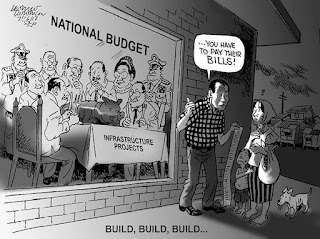
A country treated as a fief,
if not a Government treated as a syndicate
If to paraphrase Adam Müller's 'Die Elemente der Staatskunst', this person is ought to say that the state and by extension the community, hath to be not a mere factory, farm, insurance agency or a commercial company. It is not even like a device or a tool meant to out things in order as one would wish, but rather it is the inner union of all physical and moral needs, of all physical and spiritual wealth, of the inner and outer life of a folk community, all in a great, energetic, eternally active and living whole.
It may sound illusory if not fictional, but man's quest for an ideal community hath been since time immemorial, that in every interaction be it right or wrong lies the totality of human affairs if not a union of many successive generations. But reality failed to realise as such and turned the state into a tool of consolidation than a spearheader of change. Duterte did sneered people through the ears by telling his administration as socialistic, that his rule as just if not enlightened, but given the bloodshed and the interest prevailing, is his change be considered a vulgar form of Marcos's 'constitutional authoritarianism'? Vulgar in a sense that it is divorced from the law by making the law less lawful if not amoral?
In fairness for the late dictator that he himself recognise the state as consolidatory while trying to appear itself a spearheader of change in order to address issues like poverty. Like Müller as well as Fichte, he sees the state as a factor to unite physical, moral, and spiritual wealth to revive the lost consciousness and drivel to achieve progress and stability. From his book 'Notes in the New Society', he, assuming to be progressive, speaks on why the rebellion of the poor may take various forms, if not a search for an ideology which makes that rebellion be the basis of the new society:
"Moral realism requires this ideological basis: the consciousness of the poor permeates them with a profound sense of being oppressed, and not simply because the rich oppresses then brazenly but it is poverty itself that oppresses them.
To be poor is to be without, and, therefore, to be an outsider in the vibrant and meaningful political, economic, and social life of modern human community. Above all, being poor is being invisible; violence makes them visible."
But despite the order's means to let's just say "achieve development", dissident agitation for social change has comparatively more success given the structure's half-hearted action for social amelioration. After all, it was the same Marcos who opted to leave his predecessor's decontrol untouched thinking it is inseparable to free enterprise. So was the floating rate in Peso, the junking of the Magna Carta of Social Justice and Economic Freedom, and the membership in the "General Agreement on Tariffs and Trade"'(GATT).
And Duterte opted to emulate it: continuing VAT with additional enabling law like TRAIN, the policy of borrowing from neighbouring countries and multinational moneylending institutions, obeisance to existing economic agreements, and others that made Duterte's change more like a continuity with new terms and paraphrased statements, of a liberal view guised as a populist outlook.
From this, expect apologists to assail this note out of sheer defence of their idol if not accept critically this note, for their Marcos and Duterte tried their "best" to save the republic, maintain order, and bring some "reforms" whose goal is to upheld cohesion amidst popular criticism. But how come it failed to suffice the problem but instead aggravate the tension? Perhaps to cite George Magnus:
"Policy makers struggling to understand the barrage of financial panics, protests, and other ills afflicting the world would do well to study the works of a long-dead economist: Karl Marx. The sooner they recognise we're facing a once-in-a-lifetime crisis of capitalism, the better equipped they will be to manage a way out of it..."
Citing Magnus's statement, one would say that those from the order did afford to study Marx for the sake of anticipating the situation such as a revolutionary scenario. Duterte, like those of his predecessors, tried their "best" to stem these scenarios yet given their preferential option for the rich, it end failed those "efforts" to mitigate poverty, of bringing reforms, of putting justice on the side of the poor- thus, the revolutionary situation will always kept brewing, no matter how the system tries to patch it off with piecemeal, forchrissake "reforms" and "measures".
Anyway, Duterte and his fanatics will still cling to their view that their brand of authoritarianism as democratic if not revolutionary. But the revolution can only be made with revolutionaries and not structuralists. Theirs, be cold and calculating, are rather like melancholic ghosts wandering around Malacañang trying to reclaim the past in a guise of creating a future. Someone by temperament and through experience mistrustful of others, whom they see only motivated in their turn when induced by base interests; skeptical about their views despite parroting it, poor Duterte for as he becoming a negation of what people desired of- and so is his camarilla.

In other words, the people who are increasingly aware of the realities realise that the one who babbled change and hope is but a tyrant who chose to upheld the order. On the first place: will one call it change when in fact his cabinet members are mostly refuse from past regimes, reusing old policies with new terms and themes? From this no wonder why people protest if not willing to sacrifice.


