"TO SAVE THE CENTER, DESTROY THE CENTER"
France’s upheaval, the failure of political moderation,
and the limits of Filipino restraint
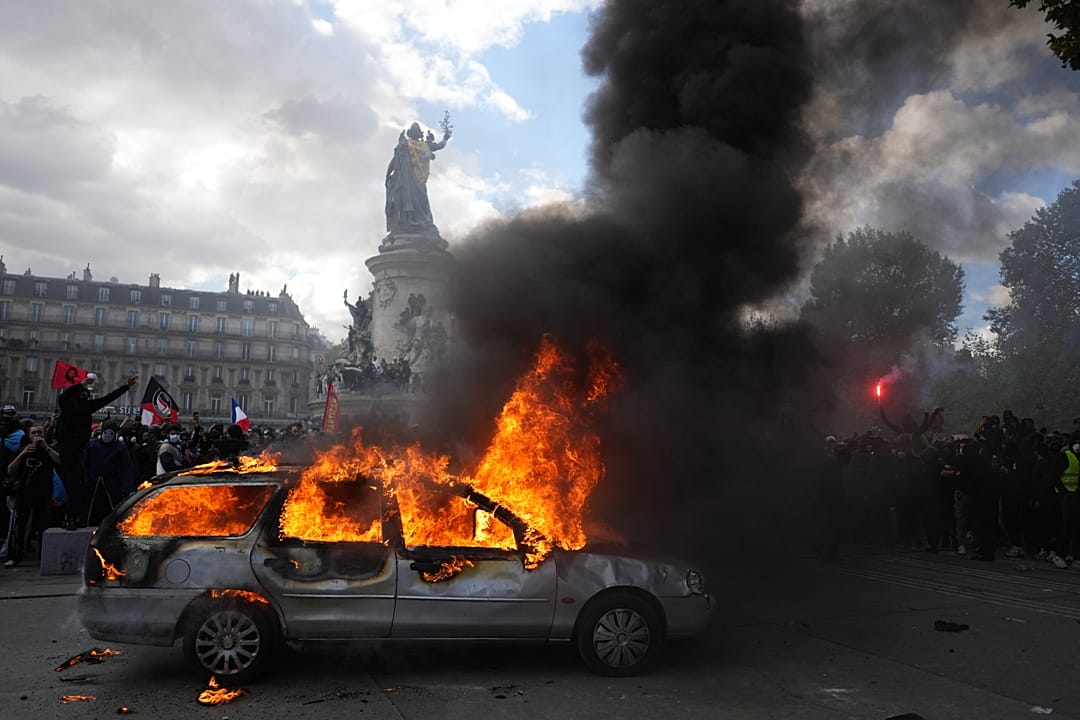
The spectacle of France in turmoil has once again brought forth the familiar pronouncements of those who regard public order as the supreme achievement of civilized government. As buildings burn, demonstrators clash with police and shopkeepers confront the destruction of their businesses, the argument is readily made that whatever legitimate grievances originally brought people into the streets have now been overtaken by criminals, looters and political extremists. The same accusation has been extended to the disturbances in Italy, where demonstrations over economic hardship, public expenditure and other political questions have similarly descended into confrontation.
There is considerable truth in the observation that criminal elements take advantage of public disorder. Arson and looting are not transformed into admirable activities merely because they occur in the vicinity of a political demonstration. The destruction of a small shopkeeper’s livelihood is not an achievement of the working class, and an attack upon an ordinary citizen cannot be defended as an exercise in revolutionary justice. But those who consider this sufficient explanation for the present European disturbances have committed a rather elementary error. They have confused the criminal acts arising within a political crisis with the political crisis itself.
The more pertinent question is why an initially recognizable collection of grievances should develop into a confrontation in which the original demands no longer appear sufficient to explain the behavior of the crowds. In France, what began with students complaining about overcrowded classrooms, insufficient teaching personnel and deteriorating school facilities became inseparable from public dissatisfaction with rising living costs, the erosion of social services and the continuing demand for fiscal restraint. By October 17, 2026, more than half a million people had participated in demonstrations across the country, while the subsequent violence prompted arrests on a scale not seen in France for years. Similar unrest in Italy suggested that the dissatisfaction was hardly an exclusively French phenomenon.
There is a tendency to imagine that a demonstration is legitimate only so long as it remains within the boundaries originally prescribed by its organizers. Students are entitled to complain about schools, workers about wages, farmers about agriculture and pensioners about social security. But once these groups begin demonstrating together, and once the confrontation expands beyond their immediate demands, the movement is increasingly described as disorderly, infiltrated or manipulated. That judgment assumes that economic grievances exist in neat administrative compartments, each capable of resolution by the appropriate ministry. In reality, a society’s economic arrangements connect the classroom with the workplace, the supermarket with the public treasury, and the household budget with decisions taken by governments and financial institutions.
When these connections become apparent to the people experiencing their consequences, a protest ceases to be merely a petition for administrative improvement. It becomes an argument over the direction of society. That is precisely the development that makes governments uncomfortable, for it is one thing to negotiate with teachers over the number of classrooms and quite another to confront a population questioning the economic policies that have made those shortages a permanent feature of public life.
The situation cannot be expected to remain peaceful merely because governments insist upon peaceful conduct. This is not to suggest that violence is either inevitable or desirable. It is to recognize that public demonstrations do not take place in a political laboratory where every participant possesses identical motives, every grievance has a readily available remedy and every confrontation with authority concludes in orderly negotiation. The larger and more diverse a movement becomes, the more difficult it is for its original organizers to determine its character. Police actions, factional rivalries, political provocations, frustration with failed negotiations and the participation of opportunistic criminals can all change the course of events. A government that responds exclusively through police measures may restore control over the streets without resolving the conditions responsible for filling them.
The history of France should be sufficient warning against the belief that the distinction between legitimate protest and riot has always been as clear as contemporary commentators would prefer.
During the French Revolution, demands for constitutional reform and representative government became entangled with popular anger over the price and availability of bread. The women who marched upon Versailles in October 1789 were not conducting a polite seminar on constitutional government. They were responding to material hardship, and their confrontation with the monarchy acquired revolutionary significance precisely because the demand for bread could no longer be separated from the question of political authority. The revolution itself contained peaceful assemblies, popular insurrections, bread riots, political terror and eventually the violent destruction of the monarchy. It would be absurd to suggest that every act committed during those years was therefore justified. It would be equally absurd to maintain that the revolutionary process was illegitimate simply because it did not remain peaceful.
The events of May 1968 provide another example, although they were not bread riots in the strict historical sense. What began in the universities developed into a national confrontation as millions of workers joined strikes and occupations. Barricades appeared in Paris, students fought with police, and the government of Charles de Gaulle confronted a crisis that challenged not simply its immediate decisions but the prevailing organization of French social and political life. The movement was neither a single ideological organization nor an uninterrupted procession of peaceful demonstrators. It contained different interests, competing revolutionary visions, workers seeking material improvements and students rejecting the authority of institutions they regarded as archaic and oppressive. Its significance lay precisely in the inability of the established political system to contain those grievances within their original boundaries.
One may therefore ask whether the familiar accusation that contemporary demonstrations have become riots really explains very much. Certainly they have, in particular places and at particular moments. But the description is not an analysis of how the transformation occurred. To label a crowd a riot is to identify its immediate behavior, not necessarily to understand the political and economic process that brought it into existence.
The political center and the preservation of disorder
The greater danger for the established political order is that the present unrest exposes the exhaustion of the political center as it has come to be understood in much of contemporary Europe. For several decades, moderation has increasingly been associated with a particular combination of economic liberalization, fiscal restraint, institutional continuity and the avoidance of policies considered unacceptable to international financial markets. Political parties may differ substantially on immigration, culture, social values and the language in which they present their programs, yet considerable agreement frequently survives on the proposition that public expenditure must be disciplined according to prevailing economic orthodoxy.
This is particularly troubling in France, whose postwar prosperity was achieved not through the wholesale abandonment of the state but through an extensive tradition of economic planning, public investment, industrial modernization and social protection. The achievements of the Thirty Glorious Years rested upon a political settlement in which the state accepted substantial responsibility for the productive and social development of the nation. The French Republic was expected to do more than administer contracts and enforce commercial rules. It was an active participant in the construction of industrial capacity, infrastructure and a society in which economic advancement could be translated into improvements in ordinary living conditions.
The subsequent influence of neoliberal economic thought did not abolish the French social model, nor did every alteration of the postwar settlement constitute an act of betrayal. France still retains considerable public institutions and protections. Nevertheless, the steady elevation of fiscal discipline, privatization, competitiveness and market confidence has changed the political expectations placed upon governments. The citizen who once understood public services as an achievement of national development is increasingly instructed to regard them as financial commitments whose continued existence must be justified before the demands of budgetary balance.
This is where the supposed political center has encountered its crisis of legitimacy. The center presents itself as the reasonable alternative to ideological extremism, promising administrative competence and a pragmatic accommodation between markets and social welfare. In principle, such moderation need not be objectionable. A genuine third way could combine industrial development with social protection, economic initiative with public accountability, and fiscal responsibility with a clear obligation to preserve the material foundations of citizenship.
But there is an enormous difference between a third way that actually reconciles competing social interests and a centrism whose principal accomplishment is to protect the existing distribution of economic and political power. When the range of acceptable policies is already restricted by the priorities of powerful financial interests, moderation becomes less a method of achieving compromise than a means of preventing substantial change. The center is then no longer the meeting ground of society. It becomes the position from which society is instructed to accept the limitations imposed upon it.
Under such circumstances, remaining in the middle does not necessarily mean remaining impartial. A government that refuses to alter an unequal arrangement is taking a political position, even when it describes that position as neutrality. The decision to preserve an existing economic settlement is itself a decision about whose interests deserve protection. And when the settlement increasingly imposes hardship upon workers, pensioners, farmers and students, the claim that the center represents the national interest becomes progressively less convincing.
It is in this sense that the seemingly contradictory proposition acquires meaning: to save the center, one must destroy the center itself. This does not require the destruction of democratic institutions or the abandonment of constitutional government. It means that a political center which has become synonymous with the preservation of the status quo must cease to exist in its present form if a genuinely representative center is ever to emerge. Its monopolization of political respectability must be broken, its economic assumptions challenged and its claim to be the only reasonable custodian of national affairs rejected.
The task is not to abolish compromise but to make meaningful compromise possible again. There can be little genuine reconciliation between social interests when one side is repeatedly asked to adjust its demands while the basic privileges of the other remain beyond negotiation. What passes for moderation under these conditions becomes a continuing process by which the burdens of adjustment are distributed downward while the authority to determine economic policy remains concentrated above.
One can understand, therefore, why demonstrators cease to be satisfied with assurances that their concerns will be examined by the appropriate authorities. They may have reached the conclusion that the authorities themselves are part of the problem. The demand is no longer confined to correcting the administration of a particular service. It extends to challenging the political and economic arrangements that determine why the service remains deficient in the first place.
When the headquarters becomes the problem
There is an uncomfortable historical parallel in Mao Zedong’s famous injunction to “bombard the headquarters,” issued in August 1966 during the opening phase of China’s Cultural Revolution. Mao accused elements within the Communist Party leadership of suppressing revolutionary criticism and adopting positions that, in his account, served interests contrary to the socialist purposes of the revolution. His argument was that the institution supposedly entrusted with advancing a revolutionary project could itself become an obstacle to that project, particularly when officials acquired privileges and interests that depended upon preserving their own authority.
The notion that a governing institution can be captured by interests contrary to its declared purposes is hardly peculiar to Maoism. It can be found in criticisms of bureaucratic capitalism, oligarchic government and the degeneration of political parties that once claimed to represent workers and the poor. A political organization founded upon popular aspirations can become increasingly absorbed in appointments, internal privileges, access to public resources and the preservation of its own influence. Eventually, the organization may come to treat criticism from its supposed constituents as a threat to institutional stability.
In this limited sense, Mao’s accusation raises a question of enduring relevance: what happens when the headquarters of a political system becomes more committed to defending its occupants than fulfilling the purposes for which the institution was established?
But the history of the Cultural Revolution also supplies a devastating warning against treating Mao’s proposed remedy as a model for democratic politics. The assault upon the party establishment did not produce an orderly liberation of the Chinese people from bureaucratic privilege. It unleashed persecution, factional violence, the destruction of institutions and widespread suffering. Mao himself was hardly an innocent outsider confronting an entrenched establishment; he was the country’s supreme political figure, using revolutionary mobilization in a struggle that also served to reassert his authority. The consequences demonstrate how easily an appeal to popular rebellion can become an instrument of arbitrary power when political accountability is replaced by ideological denunciation.
The distinction matters. To recognize the danger of institutional capture is not to approve every method adopted by those claiming to combat it. A corrupted headquarters must be subjected to scrutiny, democratic pressure and genuine accountability, but a movement that destroys all restraints upon political power may merely replace one privileged hierarchy with another. The question is not whether society should tolerate a governing class that has abandoned its responsibilities. It is how society can reclaim authority over that governing class without surrendering its own freedoms to the next group claiming exclusive possession of revolutionary virtue.
Applied to contemporary Europe, the analogy concerns the political establishment’s increasing tendency to regard the preservation of its governing arrangements as an end in itself. The political center insists that its policies represent stability, yet many citizens experience that stability as the continuing deterioration of their economic security. Public expenditure is restrained in the name of responsibility, while the ordinary household is expected to accommodate rising costs and uncertain employment. The government claims to be protecting social order, while its critics contend that the existing order has become a mechanism through which insecurity is perpetuated.
For those who have reached this conclusion, the demand to preserve the center sounds less like an appeal to reason than a demand to preserve the privileges of those occupying it. The center cannot indefinitely maintain its authority by presenting every challenge from outside its established consensus as a descent into extremism. Its legitimacy must rest upon material achievements and responsiveness to public needs, not simply upon the inadequacies of its opponents.
Why the riot cannot be separated from the protest
It is here that the familiar denunciation of the French and Italian demonstrations as no longer legitimate protests becomes politically inadequate. The existence of criminals within a large mobilization does not abolish the grievances of those participating in it. Nor does the violence of one group necessarily establish the intentions of another. The student seeking improved school facilities is not automatically responsible for the masked individual looting a shop several streets away, just as the trade unionist demanding higher wages cannot be presumed to approve an attack upon a police officer.
Yet it would be equally mistaken to treat every violent incident as entirely external to the broader political confrontation. Demonstrations sometimes become riots because the relationship between protesters and public authority deteriorates to the point where neither side expects an accommodation. Police may encounter genuinely violent groups, while otherwise peaceful demonstrators may regard particular police tactics as provocative or excessive. Arrests, injuries and the circulation of dramatic images can intensify anger beyond the original grievance. Some individuals may then come to believe that peaceful demonstrations are incapable of attracting the attention that violent disorder commands.
There is no reason to assume that this belief is always correct. Violence can alienate potential supporters, weaken disciplined organizations and provide governments with an opportunity to shift the public discussion away from economic grievances toward security. It also creates conditions in which criminal opportunists may act without possessing the slightest commitment to the movement’s political demands. A smashed storefront cannot feed a hungry family merely because the person who smashed it claimed to be protesting inflation.
Nevertheless, the possibility of escalation must be treated as a political problem rather than simply a moral failure of the crowds. Governments that permit legitimate grievances to accumulate while treating organized demands as administrative inconveniences should not be surprised when public confidence in established methods of protest begins to weaken. The fact that violence is destructive does not eliminate the need to examine why some citizens have ceased to believe that peaceful methods will be heard.
France’s political tradition makes the contradiction particularly visible. Its citizens possess extensive social protections compared with those available in the developing world, yet they mobilize vigorously when they believe those protections are being eroded. The French recognize that the public institutions now taken for granted did not simply descend from the generosity of enlightened governments. Many were the products of prolonged struggles involving workers, organized political movements and generations of demands for social rights.
This makes the claim that the protests are somehow un-French because Palestinian banners appear among the crowds especially ridiculous. The French did not require immigrants, foreign activists or international causes to develop a tradition of insurrection. Their own history contains enough revolutions, barricades, general strikes and popular disturbances to make such an accusation historically illiterate. France has always been a country in which domestic political struggles intersect with broader ideological and international questions. The appearance of a Palestinian flag does not cancel the French citizenship of the person carrying it, nor does it invalidate the demands of a worker protesting the cost of living.
Those who insist that genuine French patriotism must confine itself to approved symbols appear to misunderstand the very republic whose traditions they claim to defend. One suspects that certain defenders of the tricolor are less troubled by the absence of a national flag than by the persistence of the republican and revolutionary traditions associated with it. Their ideal France may be closer to the old monarchy and its fleur-de-lis than to the turbulent political culture through which the modern Republic emerged.
France is not simply the country of Dior and Chanel, of magnificent boulevards and cultivated luxury. It is also the country of the socialist, the trade unionist, the republican radical, the communist veteran and the student who questions the legitimacy of established authority. The conservative image of France and the France of the organized left are not separate nations. They are competing expressions of the same historical society, and the conflict between them forms part of the country’s political character.
The Filipino who appears to be patient
For Filipinos, however, the more disturbing lesson lies not in the French habit of protest but in our own habit of restraint. We have grown accustomed to describing the Filipino as resilient, patient and capable of enduring adversity with remarkable good humor. These qualities are regularly celebrated by officials and commentators who appear to regard public endurance as sufficient compensation for inadequate services and deficient economic arrangements.
The Filipino commuter must rise earlier because transportation remains unreliable. The public school teacher must improvise because educational resources are insufficient. Families must borrow money when medical treatment exceeds their means, while workers are expected to accept wages that frequently fail to provide a satisfactory standard of living. Millions have sought employment abroad because the domestic economy has failed to generate enough productive opportunities for its own citizens.
These circumstances produce an extraordinary degree of individual adaptation. Yet they also permit the government to shift the responsibility for its shortcomings onto the people compelled to suffer their consequences. What should be a matter of national economic planning becomes a question of personal discipline. What should be an obligation of public administration becomes an occasion for charity. What should be a political demand becomes another demonstration of the Filipino’s admirable willingness to make do.
The apparent tranquility of Philippine public life should therefore be approached with considerable caution. A population that does not regularly paralyze its cities with nationwide strikes is not necessarily a population satisfied with the conduct of its government. It may simply be one that lacks the organizational resources, employment security and social protections necessary to sustain such action. A worker dependent upon daily earnings may have every reason to resent the prevailing economic arrangements while possessing equally compelling reasons not to miss a day’s employment.
There is also the more subtle constraint imposed by the national interpretation of legality and political respectability. Filipinos are repeatedly reminded that public grievances must be expressed within the limits of the law, that political disagreement must remain peaceful and that the institutions established by the Constitution must be allowed to perform their responsibilities. None of these propositions is objectionable in itself. Indeed, the protection of constitutional liberties is indispensable to democratic government.
The difficulty begins when appeals to the rule of law are employed not to defend citizens against arbitrary power but to discourage citizens from exercising effective pressure upon those who possess it. In such circumstances, law is gradually presented less as a protection of popular sovereignty than as a discipline imposed upon the sovereign people. Political criticism is welcomed so long as it does not substantially disturb those being criticized. Demonstrations are tolerated so long as they do not interfere with the normal operation of the institutions whose failures have provoked them.
The resulting conception of democracy is peculiar. Citizens are informed that they possess the ultimate authority in a republican state, yet they are frequently made to feel that any vigorous exercise of that authority constitutes a threat to stability.
The 1987 Philippine Constitution itself does not support so narrow an interpretation of political life. It declares that sovereignty resides in the people and that all government authority emanates from them. It protects freedom of expression and peaceful assembly, establishes the principle that public office is a public trust and provides mechanisms through which officials may be held accountable and removed from office. These provisions do not create an unrestricted legal license for violent overthrow or attacks upon persons and property. They do, however, make clear that government authority exists conditionally, under constitutional restraints and ultimately for the benefit of the public.
The rule of law was never intended to mean the indefinite political immunity of those who govern. Neither should the law be treated as an instrument through which the powerful can demand obedience while postponing accountability. Its authority depends upon the confidence that it provides meaningful remedies against abuses of power.
When citizens begin to perceive that legal institutions are exceedingly efficient at regulating ordinary conduct but remarkably slow in correcting official misconduct, that confidence becomes increasingly difficult to sustain. It is then that the distinction between the rule of law and the use of law to preserve an established political order acquires practical significance.
The Philippine experience makes the question particularly acute. The country has already demonstrated, most dramatically in February 1986, that popular mobilization can alter the direction of political authority. The People Power uprising was not understood merely as a routine expression of dissent. It was a confrontation with a dictatorship whose claim to legitimacy had been profoundly undermined. Its achievement was not that the population secured permission to complain, but that citizens, supported by a broad coalition of social forces, compelled a transfer of political power.
Yet the subsequent restoration of constitutional democracy did not eliminate the economic arrangements that had long concentrated wealth and political influence. Elections continued, institutions were restored and successive administrations presented competing visions of reform. Nevertheless, many of the structural problems confronting ordinary Filipinos survived the changes in national leadership.
This has contributed to the peculiar frustration of contemporary Philippine politics. The public is frequently encouraged to concentrate its dissatisfaction upon personalities rather than institutions and economic relationships. The replacement of a president becomes the principal expression of political change, while the underlying conditions of employment, land ownership, industrial weakness, public services and unequal opportunity remain comparatively resistant to alteration.
The Filipino may therefore become increasingly suspicious of the proposition that another election, another investigation or another promise of administrative reform will necessarily produce substantial improvement. He may not reject constitutional government. He may instead begin to doubt whether the existing political establishment possesses either the will or the capacity to make constitutional government serve its declared social purposes.
Deep beneath Filipino restraint lies the possibility of a more profound desire to express accumulated anger. It is not always expressed in organized political language. It appears in bitter humor, conversations among workers, denunciations of corruption and the growing suspicion that the respectable procedures of political life have become highly effective at preserving the privileges of those who already possess them.
Under such circumstances, some citizens may begin to imagine that only a disruption of normal political arrangements can force genuine change. Their dissatisfaction is directed not merely against particular officials but against the continued operation of institutions that appear incapable of correcting their own failures. The temptation is to seek a disorderly interruption of an already disorderly system, particularly when orderly methods seem to produce little beyond the reproduction of existing conditions.
That sentiment should alarm the political establishment, not because it is necessarily a revolutionary program, but because it indicates the possible collapse of confidence in conventional democratic remedies. A society does not become secure merely because its discontent remains largely invisible. Nor can the government assume that people who continue to obey the law have therefore accepted the justice of their circumstances.
There is, however, a danger in confusing the desire for rupture with a credible program of political transformation. The collapse of ordinary restraint may produce a mass democratic movement, but it can also produce criminal opportunism, sectarian violence or the rise of authoritarian figures who promise to impose order upon the confusion. A population that has lost confidence in existing institutions requires more than the satisfaction of seeing them humiliated. It requires the capacity to establish institutions that will answer to the public more effectively than their predecessors.
This is why organized labor, students’ associations, farmers’ organizations and independent civic institutions remain indispensable. Their value does not lie merely in their ability to assemble crowds. It lies in their capacity to translate diffuse grievances into sustained political demands, to prevent popular anger from becoming the private instrument of ambitious politicians and to create the conditions under which an existing settlement can be replaced by something more accountable.
An orderly society for whom?
Those who dismiss the present French and Italian disturbances as criminal riots frequently conclude by asking why similar events are not occurring on the same scale in the Philippines. The implied answer is that Filipinos remain more sensible, more disciplined or more respectful of law. It is an attractive explanation, particularly to those who equate the absence of visible confrontation with successful government.
But the relative absence of spectacular disorder is not an adequate measure of social stability. A country may experience few nationwide strikes while millions endure economic insecurity. Its government offices may operate without interruption while its public services remain inadequate. Its streets may be free from barricades while its households struggle under debt, insufficient income and the accumulated costs of failures that the state has not corrected.
There is also an element of class interest in the demand for uninterrupted order. Business establishments naturally depend upon predictable operations, and workers themselves require the continuity of employment and public services. Yet a conception of stability concerned exclusively with protecting commercial activity can neglect the economic conditions of the people upon whom that activity ultimately depends.
The worker who cannot afford adequate food, housing or healthcare does not experience social stability in the same manner as the investor whose principal concern is the security of financial returns. Their interests are not necessarily irreconcilable, but they cannot be reconciled merely by instructing one party to remain patient while assuring the other that economic policy will preserve its expectations.
A responsible political center ought to recognize this distinction. Its purpose should be to mediate social conflicts by changing the conditions that produce them, not merely to suppress their public expression. Economic growth must create productive employment and improvements in living standards. Fiscal policy must be judged not only by its effect upon borrowing and market confidence but also by its consequences for essential public institutions. Industrial development must become a national undertaking rather than a collection of isolated investments whose benefits fail to reach the wider economy.
If these obligations are neglected, the political center gradually forfeits its claim to represent moderation. It becomes instead the custodian of an arrangement whose inequities it is unwilling to disturb. That is the point at which the defense of the status quo ceases to be a stabilizing influence and begins to contribute to the instability it professes to oppose.
The French demonstrations are therefore significant not simply because of their size or the violence that has accompanied them. They are significant because they reveal a widening refusal to accept the proposition that existing economic arrangements are beyond substantial revision. Those marching in the streets do not necessarily possess a common political program, and some may eventually support movements whose objectives are mutually incompatible. But they increasingly share the conviction that the prevailing political settlement is not adequately serving their interests.
The presence of criminal elements within the disturbances does not erase that conviction. Nor can the authorities indefinitely rely upon the spectacle of burning vehicles to divert attention from the deeper causes of public dissatisfaction. The restoration of order may be an immediate necessity, particularly for ordinary citizens endangered by the violence. It cannot become the entire substance of public policy.
For the Philippines, the lesson is more uncomfortable. Our celebrated resilience has allowed society to survive the inadequacies of government, but it has also helped conceal the cumulative political cost of those inadequacies. The Filipino has too often been expected to compensate privately for failures that should have been addressed collectively. That arrangement has survived partly because the burdens of protest fall heavily upon those least able to bear them.
There may come a time when the population no longer accepts the claim that patience is the principal obligation of citizenship. Such a development need not involve the burning of buildings or the abandonment of constitutional order. But it would necessarily involve a rejection of the notion that the preservation of established political arrangements constitutes an adequate substitute for economic and social justice.
The true challenge is not to persuade people that disorder is preferable to democracy. It is to prevent the continued failures of democratic institutions from making disorder appear more effective than the lawful exercise of popular sovereignty.
This requires confronting a political center that has confused its own survival with the survival of the Republic. If the center is to remain worthy of public confidence, it must be prepared to dismantle the arrangements through which entrenched interests have come to dominate its decisions. It must recover the capacity to challenge privilege, redistribute the benefits of development and make the state answerable to the citizens whose authority it exercises.
In that respect, the destruction of the old center is not necessarily the destruction of constitutional democracy. It may be the precondition for restoring the social substance without which constitutional democracy becomes increasingly hollow.
The French have repeatedly demonstrated that public order is not an unconditional gift bestowed upon governments. It is a political relationship sustained by the belief that institutions remain responsive to the society they govern. When that belief deteriorates, protest becomes more difficult to contain, its demands become broader and the distinction between ordinary political disagreement and a crisis of legitimacy becomes increasingly uncertain.
Nobody does revolution quite like the French, although their history also reminds that revolutions are neither guaranteed to succeed nor guaranteed to produce the justice promised in their name.
For Filipinos, the greater danger may lie in believing that the absence of a French-style upheaval proves that the Republic is sufficiently stable. A population compelled to tolerate persistent institutional failures may remain outwardly restrained for many years, but such restraint should never be confused with permanent political consent.
The question confronting governments is not merely how to prevent the next demonstration from becoming a riot. It is whether the prevailing political order still possesses the willingness to correct the injustices that make increasingly radical opposition conceivable.
If the established center can answer that question only by demanding further patience, obedience and sacrifice from those who have already borne the greatest burdens, it should hardly be surprised when those citizens eventually cease to regard the center as a solution.
And if the political establishment insists that every challenge to its authority constitutes an assault upon democracy, the public may ultimately conclude that democracy itself must be rescued from the people who claim to speak exclusively in its name.