Saturday, 11 May 2013

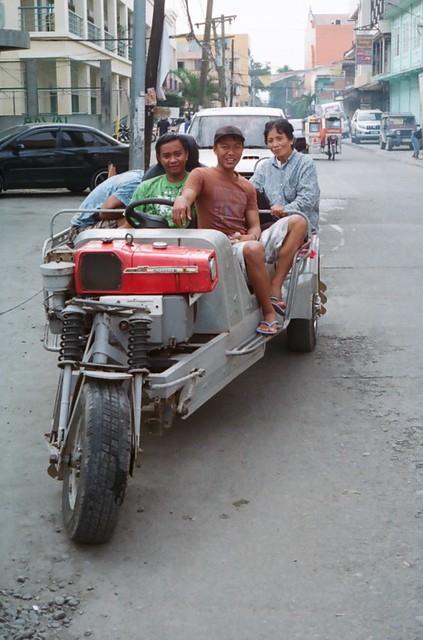
The Kuliglig: Philippines' "Modern" answer to "Old" Benz's Motorwagen

The Kuliglig: Philippines' "Modern" answer to "Old" Benz's Motorwagen


It was a year ago when this writer had remembered vehicles then dominating in the streets of Manila.

Those vehicles, somewhat reminiscent of Karl Benz's Motorwagens and Ford's Quadricycles in its how-to, had to be started manually by a pulley system as a drive train contrary to the usual key used in cars, jeepneys and even motorcycle driven pedicabs. Quite indigenous so to speak that since the Motorwagen had to be started by steering the flywheel, the Kuliglig had to use a pulley to start the engine straight and man over. 

Originally known for a two-wheeled trailer, and a handy tool for farming and other agricultural purposes, the Kuliglig had became known as a transportation vehicle similar to a pedicab. Obviously, its steel frame had to be similar to a pedicab and fitted with a diesel engine in order to run. Its procedure had been similar to a boat in starting its engines prior to running.

How wonder working class Filipinos in downtown Manila afford to create such vehicles especially in carrying vegetables from the port to the market such as in Quiapo or Aranque. That, those vehicles, reminiscent of Ford or Benz's in their early vehicles, used manual especially in starting its engines. Most had no keys and instead having ropes to start the wheel; and of course, they use gasoline especially diesel.


In fact, not all Kuligligs are similar to those from Manila nor look as much same as the rural one. In the provincial towns, it even made similar to a jeep but a three wheeled version. Again, using the same engine to man the wheels as farmers, also as traders had to drive people if not their produce from the farm to the market; and with all with their ideas regarding improvisions are perhaps as if similar to the inventors of long ago whose engines ran in steam and few on paraffin and gasoline.

The difference? the latter made the engine, the former just had bought the engine from a supplier. But both of course had enough ingenuity to create something different yet out of purpose. Farmers didn't create the vehicle or rather say bought the engine for nothing, it took months or a year to concieve an idea to make something possible other than a hand tractor or a mill, or a water pump to make things least easier.  While in Manila, wherein some of the roads as narrow, Kuliglig and its motor-tricycle Pedicab had to pass to transport vegetables if not for a shortcut due to traffic aside from ordinances disallowing them to enter public roads such as Recto, Avenida or Morayta.


Otherwise, quite strange as well for the Government not to support local craftsmen, if not inventors who took time concieving an idea and improvise, if they do, more of a paper statement and telling people "they're expressing concern" over those who had spend time doing their craftsmanship better. Sadly, some people desribed alot that Kuliglig had been known for noise, pollution, hindrance to traffic and other matters that made the Manila City government attempting to ban altogether that resulted to a protest action that happened two years ago.
Most drivers had been wounded and arrested because of their right to livelihood, they even provide proofs that their vehicles don't do smoke as they use unleaded gasoline or they can seriously observe traffic rules and regulations including those of disallowing themselves to enter public roads like Recto or Avenida. But then, people in Manila would say that those vehicles are rather eyesores that they wanted altogether to be banned in the capital's roadways.


What a crappy reason to say so if that's the case to think about those vehicles as eyesores. Like Jeepneys, these are byproducts of native ingenuity and appropriate technology (appro-tech) as they improvise things that are supposedly temporary. Jeepneys are made due to lack of mass transport such as the pre-war Tranvia. However, the influx of cars, and government's near aloofness in urban mass transport made the idea of reviving the Tranvia never happen until it was superseded by the LRT at Avenida and MRT at EDSA. Idealistically speaking, mass transport, other than easing traffic, also meant for easier, faster transport of goods especially in urban enclaves.

But despite these, how come jeepneys survived as well as Kuligligs and Pedicabs in Manila and other parts of the metro? To think that the Manila city government had even banned Kuligligs in every street especially in downtown Manila! But anyways, despite all the events that happened affecting those vehicles, it's up to the drivers and craftsmen how these vehicles survive. Of course, they wanted improvement and modernity as well in order to provide a good transition. Again, few dared to heed the call of modernity in making things happen from the engine, applying airconditioning, to the appearance to make itself presentable and modern.


In a way that Tuktuks in Bangkok, Thailand somehow they had been trying to be presentable and modern as possible rather than contented as what people see about Pedicabs or Kuligligs in Manila. Jeepneys at least had tried to improve in a way from having air conditioned jeeps to the "E-Jeepneys" sponsored by the Department of Energy and Greenpeace. For in fact, the idea of "just" improvision, no matter how it helped in making these happen isn't enough so to speak nowadays with craftsmen trying to make new things, march with time rather than getting contented and eventually left out not not offering themselves their own transition to a new kind.
The Kuliglig itself had been a variety of uses and perhaps willing to improve more other than a transport for vegetables and people same as the Pedicab. It needs some improvement alot nowadays in order not to be deemed as eyesore in the eyes of the near-choosy "thinking class" as Henry Ford and Karl benz did in their prime years as craftsmen in the beginnings of automobile industry. 

But the good thing? Least that the Kuliglig itself had been trying to relieve what the Motorwagens had made, yet least abit "modern" out of being "purpose-driven."

Anyways, kudos to the makers whom perhaps trying to replicate, no matter how they tried to look "modern", the craftsmen of the past.

"To Marina" : The poem and the story behind

"To Marina" : The poem and the story behind 


Well, it was made months ago after listening to Alexander Ivanov's "Nevsky Prsopekt." Quite interesting for this writer to listen a Russian song whose melody itself brought this writer to make his own version. However, he took weeks to think and write to make it aligned with Ivanov's melody. It's all but strange that in listening to a Russian song, and his experiences made him compel to do a poem that would say "singable" to the tune of Ivanov's song. 

Admittingly speaking, "To Marina" is all but same as other poems made for someone who cared most. Yes, this writer had dew gifts to offer, it happens that this writer also do poetry for quite some time that this poem was earlier posted in the "Poems and Ramblings from the Gothic steel church" made three months ago.

Obviously, it recalled some of the earlier poems like "Gia" whose melody is from a Russian song. However, "To Marina", or rather say the person behind the poem had been a good friend, a maiden in shining armor that cares better like any other girl this writer had met and perhaps cherished with. It is quite undeniable for he to write over everything if not to draw as to express something few dare to do upon other than spending money. 

As for spending money would say that yes, he spend but is that enough for a lasting friendship? Perhaps the lessons of the past, a ruined relationship makes money a two way road to nowhere. Only to thank God that why should spend every bill yet goes to nothing? If she can't give true love then laissez faire (let alone)! There's another who's better, least that she understands, that she doesn't feign "love" for goddamn sake.

Well, here's the poem itself.


"To Marina"

Alone walking in darkness
Feeling the cold quite helpless
Looking the skies and thinking
Thinking of old school love
Yet in this world of struggle
Protest march and street rumble
Sought one seemed contradicting
I don't know what's coming

Quite strange to see fate had made in
Through the window our eyes both seeing
Shyness eased so is the contradicting
With my heart I don't know why is throbbing

Perhaps this is the answer to prayers
And the dreams and the sketches and others
All the art that perhaps she's the feature
With a love that's to shown...in future

Then as we met together
Twas two days and after
Seeing smiles and laughter
With the food and wine
You inspire me for so long
And your love made me strong
In this world of struggle
You made me quite known

So inspiring to see your presence
Inspiring that exceeds your existence
With your beauty and charm is the essence
All your love that molds I despite absence

Yet I don't know why fate comes to see you
Through your eyes casts a spell says "I love you"
Yet you end up with I felt dismaying
With an open ending

Perhaps you're with another
While I am still alone
And yet your name is still inscribed
In my heart ready to thrown
But then you are worth remembring
Despite the pain and suffering
I hope someday will come
If this story end done

I don't know why your name keeps calling
Same as your presence keeps returning
I tried to forget and I am trying
Yet I can't withstand the outmost feeling

perhaps your name all means forever
And our love is all mean together
Perhaps fate had bound us no other
Forever, my love, Marina.


That's all this writer hath to say. 
Thank you.

Friday, 10 May 2013

Reminiscing the boilers and factories at Tondo: or how come he remember the old Procter and Gamble factory at Velesquez st.

Reminiscing the boilers and factories of Tondo:
or how come he remember the old Procter and Gamble factory 
at Velesquez st.


Well, it was years before when Tondo, one of the districts in Manila, that had been known for its factories during the early days of the Republic.


That, with factories sprawling and usually owned by foreigners if not the old rich, Tondo had brought the poor from nearby villages and had worked in its factories making every good vital to the needs of the Filipino majority, ranging from soaps, coconut oil, shortening, butter, everything whose raw material had to pass from the river through the barge if not from the tanker passing Velasquez St. or the Lopez Bridge.

Strange though to recall as people cares about historical sites, yet to think how Tondo, one of the abodes of the Ancient Kingdom of Maynilad and the Proletarian haven that made Bonifacio organize the "Bogaderos" and the rope and cigar makers, had left a good legacy whose goods had been manufactured in its factories just like Chicago and its Packingtown.
And to reminisce over its past, recalling how the chimneys puff out its smoke from the machines, seeing water towers and edifices of concrete walls and steel roofs, Tondo, in every Manileno's view before may had meant industry as Escolta may had meant commerce and Port Area as trade. Manila during those times had been really the center wherein business, government and other affairs had been discussed although Quezon City had been its capital.
Quite strange isn't it that speaking of Quezon City as the Philippines' Capital yet the Presidential palace and the Congress, Supreme Court are still situated at Manila, and at worse, to see the former had been left to private interests that seemingly drew different from its original purpose. Where's the planning then if that's the case?


In fact, in recalling those pasts situated in Manila, those times had meant people ought to work hard and steer the nation into progress as a young Republic. That every businessmen, idealistic enough had been clamoring to prioritize domestic goods rather than contented in imports, while at the same time foreigners stubbornly pitting them below by forcing to compete with theirs such as Procter and Gamble whose factory in Tondo (the pictures shown) had celebrated its achievement of its first million hours without any disabling accident; strange but true that they prioritize safety whilst thinking about achievement in making things possible such as making soap and other goods presented as "cheap" in every supermarket  to the variety store.
And with its machines steering constantly, and people, from engineer to mechanic, chemist to factory worker had worked for hours making everything successful that even the bystander  had smell the scent of soap being made in the factory somewhere in Velasquez St, had invoke how industrial districts of the past like Tondo meant something worthy than what is  known today.

Tondo Manila Philippines.jpg

Obviously, it's really different to see Tondo today than those of the past; of course, other than the shantytowns, it had been left far from its aspirations of seeing a developed community with politicians caring about themselves than its constituents around the district. This writer may say that Tondo, being the pioneer villages of Manila during the Spanish and early American era had been idealized as an industrial component other than Escolta for finance and trade, Intramuros for its historical significance, Ermita and Malate for tourism and a Miami-like setting, everything around Manila being the capital that had modeled from those both from Europe and America. Yet sadly, the war and the succeeding years had shattered the aspirations that war repatriations, loans, had failed to revive the grandeur that somehow the old dared to recall those times. Sporadic and unjust, uncontrolled development of course had also resulted to shantytowns whose people had once working in every factory whose owners had failed to support them after hours of work other than promises and the like, mass housing had been taken for decades yet most of it had been in the drawing board and likely to be disregarded as such; and Tondo had been known in the movie Insiang by Lino Broka that had been filled with shanties with remnants of factories aside from the Slaughterhouse as its intro. Industry centered at Manila had been diverted to new complexes such as Muntinlupa, Cavite, even Laguna, Batangas and in Mariveles, Bataan. Most of it still owned by foreigners, that even Procter and Gamble had set up a new facility that somehow gave up its original plant decades ago.


In fact, this writer had made an earlier writeup about the flour silos of Pasig  that he visited months ago, but in looking at the pictures such as those from Procter and Gamble (via its alumni page) he missed passing the district of Tondo although he remembers his childhood days jeeps passing through from Tayuman to Navotas, with old factories of long ago had been paved way to commercial complexes as the old Alhambra cigar factory had been demolished for a commercial center in Tayuman. Of course, people from all walks of life had to think of it as a part of their daily doings that their district they cherish most changed a lot from having factories, shanties to grocery stores and apartments risen from its "industrialized" past.

Otherwise, they had chose to disregard the industrial significance as most equate factories with toxic wastes and air pollution, and care much about "progress" made by commercial establishments such as those from Puregold, Tutuban Centermall, or the Chinese-dominant 999 or 888. While those who once work in those kind of edifices had cherished their very pasts, and even told to the chosen few how productive those times no matter which department, or company they came from. Alhambra? we had heard that name of expensive cigars and cigarettes yet its plant had been demolished for a supermarket; La Tondena? The name itself, known for Ginebra San Miguel and Anejo Rhum was true to its background yet it end up gave way for Ginebra San Miguel Inc. if not for a name such as a bakeshop or a drugstore somewhere near Tutuban.


Anyways, those times wherein factories in Manila are all meant dreams of progress so was the scent of a newly cooked soap. That somehow this writeup would say abit nostalgic in a way this writer passed that said area via the jeepney.

Old edifices of the past such as those from Procter and Gamble would say that industrial architecture, like the "Human Resources" building above as historical in a way its roof, appearance as reminiscent of the houses of long ago yet made applicable to industrial setting such as simplicity. And to think aside from being old, made in the 1950s, it's quite rare thinking how come since they've been demolished entirely there are none that is been left intact to remember the district's legacy as an old industrial complex? Tutuban, originally a train station, had been developed just because of having a mall being set upon, while in the US, Sands Casino had to apply industrial architecture as they acquire the old steel complex at Pennsylvania as a continuing reminder of its legacy.
But Again, people care less that even most, if not all conservationists who cares about houses and churches, and lately commercial complexes at Escolta. Legacy in regards to industrial architecture is less to think upon other than expensive to maintain such as an old building in a middle of a district known for crime and everything with a bad light. However, despite those shit to describe around, it would also say that yes, this writer had interest in industrial architecture, archaeology, everything that seemingly ContemporAntiquitarian in reflecting the aspirations of both present, future via its past.


And perhaps, as surviving chimneys, boilers, water towers, edifices of concrete and steel roofs such as those pics shown had been left rotting and eventually demolished, paved way for the mixed commercial and residential complexes of today, and shantytowns been paved way for mass housing such as in Vitas if not for residents to move at Montalban, Rizal; this writeup may described as a strange, yet unique historical recall so to say about one of Manila's less known legacies.

Anyways, thanks to Roberto Languayan, Willie Lorenzana, Ex-P&G'er for the pictures and its past memories being shared upon. It happened to be that this writer used to see those buildings as he rode the jeepney from Navotas to Tutuban via Lopez bridge, and in recalling those edifices, made him compel to do this writeup reminiscing the boilers and factories at Tondo.


Tuesday, 7 May 2013

All after seeing Iran's "Revolutionary" Artwork

All after seeing Iran's "Revolutionary" Artwork

Another "revisit from the earlier writeup" about Iran's Revolutionary posters


It's almost a week all after this writer had made a writeup regarding Iran's artwork during the "Revolutuonary events" pre and post 1979, and again it had been rarely seen in western media other than describing Iran as an "International Pariah."

Usually consist of posters that utilizes Islamic iconography and Iranian symbolism, those works tend to invoke the sentiments of every Iranian against repression from both domestic and foreign interest, same as invoking their faith as a unifying factor.

And despite differences in beliefs, perhaps this writer had seen the beauty of their artworks yet rarely seen. Of course, few had interest in Revolutionary work other than Russia, China, or even Cuba with its street and pop-inspired art. Iran's very own "Revolutionary art" may had deemed radically inspired especially during its past, but in utilizing Iranian art, such as those of its symbolism and other folkish features lies the message of struggle.


Especially those of Tulips as a symbol for martyrdom. Taken from Persian myths, the tulip symbolises those who had died in every battle, hence from the once blood and corpse-strewn fields lies those flowers that corresponds to their sacrificed lives.

In fact, it had been this writer's curiosity that made him do the writeup regarding those artworks given. That usually, speaking of Iran's very own art may had meant Persian architecture and sculpture same as the well tended gardens at Iran's Safavid and Qajar-era Palaces and Mosques, but in looking at their works seems to be different especially in reflecting social reality, the use of Islam like those of depicting Ali and the martyrs of the Shiite sect, coffee-house painting as another means of invoking struggles, they had invoke the militant fact no matter some had been quite morbid or surreal such as those taken after the events of muharram or the depiction of gun or ammo-carrying women during the first Gulf War; Martyrdom? Their shiite faith and the actions taken by then Pahlavi regime, the United States, even Saddam Hussein's Iraq had created martyrs that had been featured at the walls of Tehran's buildings, and the paintings made by Kazim Chalipa and Hasan Isma’ilzadah.


This mural for instance haven't been fade and quite abit "cheesy" due to the butterflies in an image of a martyr. May look strange too as the west may ought to say that butterflies are for girls, yet also to think that those fluttering creatures also invoke same as those of tulips. In Russia would say that the use of Cranes invokes hope, so were the butterflies.


So was this artwork.

Obviously, it reflects the Islamic faith as part of the Iranian struggle. Other than the word Allah being prominent, the supplications bearing  "lam" and "alif" letters had stretched vertically into banner staffs featuring banners of jewel-toned green, red, and gold waving across the black background, all reminding of the banners waved at the battle of Karbala in Iraq according to the Shiites. It also reflects the continuity of mourning as it expresses in calligraphic form.

Revisiting their artworks would say that it took months and a year to search and see another wave of Persian art that was a fusion of past and present, that invokes the antiquity of the Safavids, the anger of the majority and the reality that was then behind the grandeur usually presented in western media. 

Personally, this writer, as he felt inspired from those works had made some samples partially based from the artworks given. May sound strange as he tried to replicate in a different way, the ones that invoke "every place as Karbala and day as Ashura" would say that it carries a message such as "Everyday is struggle and every place lies protest" such as this:


Partially based from the artwork "Stoning of the Devils" by Habib Sadeqi had made him drew and perhaps carry the same idea, but it reflect the social reality with a radical response: a man carrying an oil bomb, a girl carrying a lamp and another with a gun, all surrounding with "devils" that controlled both field and factory and as perpetuators surrounding incidents pointing against those who are against their policies as evidenced by a man lying in blood and a "Pieta" scene with fires. 

Perhaps, made in respect and inspired by Sadeqi as it invokes struggle against the devils whom invoking repression in both body and spirit that until today, in every rotten system urges everyone who are repressed by their conditions, who had been suffered by blows or being bled dry to their near-death expectances to cast the first stone or in the drawing, the oil filled bottle, shout and oppose them as possible. 

Otherwise, why settle for art for art's sake alone and joining into the flow of nonsense? 

Sunday, 5 May 2013

Of Forge, Factories, Computers and the Information superhighway:Regarding people's clamor for Industrialization in the Information age

Of Forge, Factories, Computers 
and the Infomation superhighway:  
Regarding people's clamor for Industrialization
 in the Information age


"The Industrial Age was over. The wealth of nations had already shifted from production to international capital. The Internet had revolutionized anything. During the Industrial Age, the Philippines was a regional power. It had a manufacturing base for products but it died a natural death during the 1990's when the trade barriers where eradicated."

These are the words stated in a writeup concerning the need for industrialization in a predominantly agricultural country such as the Philippines. A sentiment what middle class intellectuals choosing contentment over free trade and foreign investment than those of domestic based development as means to solve the crisis especially those of unemployment and access to goods from the countryside.

At first, this writeup was made in response to the trade liberalizationists speaking in favor of trade and commerce than those of promoting industrialization and domestic based development. It's all but strange so to speak that as they favor trade and commerce had to deindistrialize in the name of International capital and opening of trade barriers.

However, despite having industrial bases, the Philippines failed to industrialize as it failed to generate development such as those of the rural areas; otherwise policies from abroad tend to limit Filipino industry to those of consumer goods and to some extent, assembly line production in the guise of import substitution. Volkswagens under Guevara and Carrier under Concepcion are as examples of these policies that mainstream media announceth as "Industrialization". Otherwise, international policies tend to emphasise further the Philippines as a predominantly agricultural country and giving a semblance of industry may meant modernization and perhaps domestic growth in the cities like Manila.


But why to deindustrialize the way flour factories, blooming mills, or any other industrial complexes ought to be dismantled in favor of commercial complexes surrounding Metro Manila? Yes, the information age has risen, but in regards to underdeveloped and developing countries, they shouldn't been developing themselves first and innovating?
Looking at the example of Japan during the Meiji period, Soviet Russia under Lenin, Singapore during Lee Kwan Yew and China during Deng Xiaoping,  these require planning despite opening themselves to private investment.


Japan may had opened to the world as the outside had been dwellth in modernity such as steamships and iron-clad armor while theirs had been dwellth in feudalism and the samurai sword; of course the system had no chance but to modernize the way they should replace their decades-old matchlocks with those of guns made in England and America. But still, despite opening themselves to the world lies the domestic-based artisans, especially those who had studied Rangaku 蘭学 (Dutch learning) to practise further western knowledge and of course, spearhead then "modern" technology in developing their homeland and reclaim its prestige in countering a deteriorating China of the 19th century.
And although it was closely monitored and heavily subsidized by the Meiji government, it enhances the power of the great zaibatsu firms such as Mitsui and Mitsubishi to create foundations for domestic-based industry as alternative to dependency on western goods. To modern parlance, these Zaibatsus are deemed as oligarchs as they monopolize industry. However, these zaibatsus, supported and guided by the government had steered the nation in its modernization scheme especially those of borrowing technology from the West to improve its domestic industry. Most had even utilize their Rangaku learning enough in the field of Medicine, Military science, Arts and Trades to create a "prosperous nation" and a "strong army" in Asia,
Thus, Japan gradually took control of much of Asia's market for manufactured goods, beginning with textiles. The economic structure became very mercantilistic, importing raw materials and exporting finished products—a reflection of Japan's relative poverty in raw materials.


Meanwhile, in Soviet Russia, the New Economic Policy of Lenin had allowed private individuals to own small enterprises while the state continued to control banks, foreign trade, and large industries. The policy itself was at the same time a strategy with Lenin himself stating about a strategic retreat to recuperate from the damages during the civil war with small scale enterprises being heavily regulated if not being sequestered by the state under "War Communism".
It took years to develop and innovate in pursuit of recovering Soviet society from the civil war. However, the said policy paved way to the first five year plan that emphasises further the role of industry and collectivization, mechanization of agriculture. Soviet Russia had used the NEP temporarily as a mean to create foundations then paving way to Stalin's first five-year plans in pursuit of a more rapid development with greater state control, taking the view, among other things, that profits should be shared among all people, and not just among a privileged few.

These examples, despite being described as "past" somehow lies the bottom line that there's a need to revisit technology, and despite modern day periods, industrialization and innovation will always be a call for the third world in pursuit of developing their communities rich in resources yet having worse poverty conditions. In other words, why keeping themselves as gardens and breadbaskets of the developed nations if they have enough intelligentsia and laborers to create good foundations for their own economy and society?

It is all but strange for those who speak on behalf of "information revolution" to disregard "industrialization" not noticing that the latter requires innovation such as those of developing the country's capabilities especially in the field of  science and technology. They had even forgot that in Agrarian Reform lies increasing productivity since agriculture serves as the base for a self-reliant economy. Industrialization does not mean building factories and creating massive industrial complexes to the extent of sacrificing agriculture, but also involving appropriate technology to the interest of the people such as the farmers who are in dire need of making produce easier for distribution such as making their villages also involve in manufacturing activities.
And through these efforts will be aimed at building up the country’s science and technology infrastructure: research and development in the basic and applied sciences; upgrading existing indigenous technologies; adapting technology advances in other countries and ensuring an adequate supply of skilled and competent scientific and technical human resources. 

And despite having the internet, computers, modern day gadgetry had further modernized everything, it does not mean that industry should be disregarded and get contented in trade and commerce as others tend to say so. The fact that how come China had to innovate in the field of science and technology during Mao Zedong such as those of a rocket made by a US-trained engineer? The latter chose to serve China after years of serving in the US military in creating rockets and hence his capabilities had to improve, innovate the existing Chinese technology that was partially based from the Soviet model. Even the Soviets during Stalin's era had even used IBM, Ford and Buick, but at the same time supported the domestic industry that brought MiG, ZiL and others as it modernizes the society. Anyways, long before they had names owned by foreign and capitalist, they are all but tools with a purpose.
Quite strange that to those who preach globalization had limited idea on nationalism and hence treated as a mere chauvinist tendency; or Capitalism that those who are against the system afford to use modern technology whose names are well known amongst the Capitalists. But, come to think of this: haven't they heard about those things are like ropes that used to hang? Or is patriotism should disregard appreciate modern idea, technology because it is foreign? Seems too narrow for those who oppose and even those who justify. Otherwise, not all anti-imperialist or anti-capitalist are similar to the Luddites who had destroyed machines simply because they had no jobs.

And although for years the Philippines had been widely acknowledged for its strategic location for trade and commerce, in engaging trade with its southeast Asian neighbours like Vietnam, China, or the Majapahit empire, it doesn't mean that those communities had to get contented to it, for they even had to produce its own, to the extent of gathering knowledge such as the creation of foundries for iron, aquaculture and good farming methods, the Lantaka gun, despite being brought from the arabs and perhaps the west had even produced such as those made by Panday Pira and other craftsmen known for using brass or iron.
Even during the Spanish era, it had to make effort in encouraging industry such as Governor Blanco's Sociedad del Amigos de Pais, that other than cash crops also include the creation of cloth that suddenly end crippled because of the influx of manufactured ones from England and America.
Furthermore, attempts to revive industry especially during the early American, Commonwealth and the new Republic had been limited despite efforts to stimulate such as those from the National Development Company and the "Filipino first policy" that involved attempts for Industrialization like Araneta's RFM. Policies from IMF, WB, GATT and WTO had to limit attempts if not to impose gaps in what industry should be set upon, a semblance would be to show how modern and growing a nation would be during those times.
But still, the Philippines had been dependent on imports while exporting materials essentially for the US and other markets; that even Industry, even until today had been limited to consumer goods other than assembly line production and import substitutes that mainly owned by foreign companies if not being "died out" as what the commentator quoted above.
Cosmos Bottling? End controlled by Coca Cola as one example.

But does it mean that Industrialization in the information age should be disregarded in midst of unemployment and rural development? Nope. The Singaporean model had started from developing its own capabilities prior to opening itself for foreign investment, their Temasek holdings had been the state's investment arm yet compared to the National Development Company, it carries sufficient share in regards to joint state-private enterprises compared to the latter that chose to create prior to privatization, just to stimulate industry, to funnel funds and just acting as a steward rather than a partner in building joint state-private enterprises, cooperatives, other than state-controlled in steering development as a sovereign wealth fund (investment fund, held in foreign exchange reserves, that is owned and managed by the national government. The excess foreign liquidity is invested in various financial instruments or used to acquire shares of stock in corporations, mostly multinational firms.).
However, the latter chose to be a government's arm in privatization than to support for what being stated in this writeup. Development is just a sentiment of the state in currying those from outside than to put action from the inside, all in pursuit of making things possible such as those of solving the unemployment crisis and developing numerous results then as prototypes or worse, figments of imagination.


Once, in seeing pages concerning military modernization they clamor for tankettes, guns, missiles, planes, or any kind of military materiel yet how about a call for industrialization to make these happen about tankettes and missiles? All after thinking how makers of Hari Digma had been rejected as the state favors a British-made Simba for an APC. Also to remember that the armed forces, while clamoring for modernization is at the same time maintaining a self reliance stance yet local makers are rather making prototypes with officials acting quite skeptical over these; of course they would congratulate the effort but they stick to buying British or American made weapons so to speak. Japan started these with buying, but they developed their own, so was Malaysia and Indonesia, how about the Philippines then if they rely on buying in pursuit of modernization while disregarding industrialization with the same purpose for the armed forces? Perhaps, they had nearly forgotten the past when craftsmen like Panday Pira had to copy foreign made rentaka, and made it better for the lantaka.
Well, self reliance is all but a word to be spoken for the thinking class and hence be pressed to the so-called "lazy" workers who worked long hours yet calls for a wage increase, to the individual itself in order to make effort for their income. But not in a sense what a resource-rich society should had been. That even a nail had to be imported from China despite having local factories capable of doing the same nail, where's the self-reliance in it then?

Anyways, according to Giovanni Tapang, saidth:

"Having a sound industrial policy that focuses on modernizing agriculture and shoring up our capability to locally produce capital goods is key to the establishment of a modern and diversified industrial economy. We need to build, among others, our own base metals industry, chemical industries, machinery manufacturing, pharmaceuticals, electronics, industries for food processing, textile, garment, mass housing and agricultural commodities. Having these built here in the country would not only address the problem of producing our basic needs but would also secure jobs for many so that they will stay home instead of going abroad.


The objective of building these industries is to maximize self-sufficiency in the local industrial production of capital, provide intermediate and consumer goods for domestic needs and to ensure food security and self-sufficiency in the country. In generating and mobilizing domestic capital, we create real jobs and ensure rapid and sustained economic growth."


However, people who dared to be against the idea speaks about failures and the like simply because of foreign enterprises able to compete with domestic ones, coupled with imports from abroad that cripples industrialization; obviously, they wanted to say "give up and focus on the service sector, on tourism and foreign investment " but in looking at the failure of the past does not mean that industrialization should be scrapped in favor of just focusing on trade and exports as what others stated, rather than looking at the lessons and the means to rectify to prevent future mistakes to be happen. Yes, it is true that foreign investment can be helped in promoting national development but how about efforts of the people in building the nation further? Otherwise, this is a question of sectors to be preferred: does it mean that the only sector should be emphasised thoroughly is the service sector by the government and the middle class whilst the farmers and workers had to be left away and say that their suggestions as "passé"?

Perhaps, in this so-called information age and days when production is shifted to international capital, of opening borders, it's all but making half of the world a town and country as Lin Biao stated before. The Philippines had been a farm and garden controlled by the local oligarchs, landlords, and corrupt bureaucrats, compradores, that in turn as agents for the trusts that controlled major enterprises including those of technology like Japan and America. The policies? All but alibis that justifies neocolonial economic practises as been sought. 
To think that if the Philippines is indeed rich in resources yet the system had preferences which sector to emphasise upon, and having dependent on trade in which exploiters, foreign or bureaucrat alike had to extract just for export, why not as well create basic industry instead? This is not mere out of nostalgia as people who dare against used to say, but rather looking at reality in which the Philippines should solve upon. Especially in terms of developing the countryside for its resources, solving unemployment and balancing town and country. 

And as for the system that describe such calls as "passé"? Then damn that system, not just the landlords, bureaucrats, imperialists, oligarchs what the middle class state much but also those of the middle class who think less and drank more for Christ sakes! They can't even give the right for a worker a decent wage then how about redistributing the land and promote domestic based development?

Again, damn those people!

Thursday, 2 May 2013

The fee, the wage, the comments and all other shit

The fee, the wage, the comments and all other shit

By Katleah Ulrike


At first, it is indeed fact that the Cardinal and the Dominican institution had no relation. But in the message shown had to dig deeper or scratch the surface in order to understand the matter. 

Based on their comments from a well-known page, it's all but a hodge-podge of nonsensical statements and ad hominem attacks rather than understanding what comes behind. And quite usual that in resorting to ad hominem, comments like "Hayop Ka" (You're an animal) lies a person who can't understand further what comes behind those pictures, or in reading their words somehow meant crass personal attacks as it emphasises the commenter than the comment being posted. Obviously, that guy who said "hayop ka" shows his irrationality as he vent emotions too much and undermine someone else's personality.
Anyways, like any other page, Argumentum ad hominem seems to be too much amongst these commentators no matter they use pen names or their real ones, even this person had to play some of their sentiments for attacking this person for christ's sake.
Otherwise, it's their choice to do so.

But as for the topic based from the picture, it would say that Tagle and UST are different in its ways and means, that the former speaks of wage increase while the other had yearly increased its tuition. Contradicting so to speak about their statements all despite belonging to the same entity.

And in reading their so-called sentiments, one example of their comment tried to present as intellectual-like in its leaning and those who dare to oppose hence as indirect fallacy (partially based from Filipino):

"What's the connection of Bishop Tagle over that matter? And UST is a private school! Tagle's statement is all about the Government should increase its wages, why is the tuition increase in a private institution got involved there? You may complain if Public Schools have tuition. UST administration and not Tagle decides these and you don't even know the reasons, breakdown that made tuition and other fees be increased."

Well, that commentator doesn't understand although it somewhat tends to justify UST having increased its tuition and at the same time complaining what's the connection between Tuition increases and Tagle's statement concerning Wage Increase.
At first, Tagle's statement about the need for wage increase is a need for the workers whose children who also studied in private schools (including those of UST) who yearly increase their tuition and other fees. And as for Public Schools, come to think of the tragic events in UP, that with its own STFAP (Socialized Tuition Fee Assistance Program) and no late payments resulted to Kristel Tejada's death. Tertiary education had even experienced decreasing number of students studying due to the policies being imposed especially those of yearly increases thanks to the treatment of education as a corporate affair.
It may look indirect, but still, workers, full or part time had to demand wage increase in midst of increasing prices of commodities and services including those of EDUCATION-related expenses like those of tuition and other fees.

Meanwhile, another comment tends to be too emotional:

"Hypocrites! Tagle isn't involved with the Dominicans and how they handle UST as an institution. You shitty people, everything you see is all but wrong!"

Well, like others, that person behind that overtly emotion triggered comment justifies yearly increases. A sentiment of a laissez faire that undermines both right and wrong in regards to imposing policies. Yes, everything being sought in regards to the Church is all but wrong such as interfering such as in a supposed secular society! Worse, how come the church afford the right to invest shares in Philex Mining, BPI and San Miguel if that's the case while having themselves "Ok'ed" in yearly tuition increases? "They Giveth and Taketh away" according to one rebuttal. Thinking how the church of the poor had to invest every tithe in corporations like Philex or BPI than to support the masses in the name of social justice.
So, frankly speaking, that person who's against the "shitty people" described as "hypocrites", tends to defend a hypocrite who uses faith as a tool for their interests according to the secular minded and the atheist. 

Also to think that all despite any major differences or no direct relations such as the Dominicans,  the Jesuit-bred Tagle and the Catholic Bishops Conference of the Philippines (CBCP), they are all belonged to the same entity that usually speaks of Social Justice and Preferential Option for the Poor other than forgiveness and reconciliation. People may had looked at the picture with those who justify ToFI had resort to ad hominem that unveils mere stupidity and aloofness to the topic that they don't dig deeper in the issue behind such as  those of working class parents whose children also studied in private schools not just UST; thinking that they increase tuition fees yearly and likely to complain about expenses and low wages. 
It is indeed fact that UST is also a private institution, a corporation that they afford the right to do tuition increases that effects most of its students such as those who had to stop. But Activists within its confines even pressed  the order behind the corporation, aka the administration that they should open their accounts and books in order to look for its breakdown of expenses and the like concerning the increase and yet, being a private institution lies exemption to accountability. Otherwise, during consultation, had to vent grievances about yearly increases especially in midst of socio-economic crisis as evidenced by increasing prices of commodities and services. Yes, if administrators have the right to do so, so are the students who have the right to complain in the spirit of academic freedom.

That somehow Gerry Lanuza called as "Private corruption" in having institutions exempt from accountability especially regards to their financial-related matters. Not noticing its profound effects to the the students, employees and the like especially in midst of continuous socio-economic crisis like those of increase in prices of commodities and services. Workers whose children had studied in private institutions had difficulties especially in paying tuition as well as other basic expenses. People who dare to complain about these working class would dare to say PUP and other state-supported institutions as solution, but it is enough? Nope, the laboring people had spend long hours working, making value of human labour only according to its economic purpose such as those of paying debts. Yearly increase in tuition fees somehow added complains to the laborers as well that urges students to stop or work part time, but as for the latter may resort to work full time especially if that establishment afford to pay 20.000 for a minimum and thus forgetting academics in favor of plain simple economism as workers do.

"There are different groups or organizations within Christianity." What a smart comment to hear that, but does it mean they afford to do their want using faith as its pretext? It's all but same that they tend to interfere in secular matters especially those of politics as they present themselves as sentinels of morality. Different groups, but same book, different organizations but same morality they tend to carry the way Calvinists and some Catholics acknowledge usury in a form of additional interest in paying fees and the like.

And in midst of increasing prices of commodities and services the state can't even provide a "GO" signal for wage increase especially in companies owned by millionaires? Foundations providing scholarships can be good but not enough the way most of it had became fronts for not paying their obligations especially those of taxes and other contributions. Meanwhile, the Church had afford to say so in opposing exploitation while another had people face the music such as paying fees that increased yearly; they can't even pay taxes since they're excempted from it, but come to think of these as the Atheists dare to speak about: is the Church who preaches social justice had to exploit as well? Like Janus, it became a two-faced institution, hence confusing in the eyes of an individual who is exploited thoroughly by time and expenses to pay for.

Perhaps, there will always be a barrage of opposition in regards to the picture other than those who justify tuition increases, that CBCP, the Cardinal, and UST are different; but come to think of this, why there's a need to speak about social justice while another church-supported institution had to increase its fees yearly? Well, there lies the contradiction. 
Come to think about their Encyclicals such as Rerum Novarum and Laborem Excercens, they even emphasised primary concern with "the need for some amelioration of misery and wretchedness pressing so unjustly on the majority of the working class", but how about the corporations controlled by the church? Did they ameliorate the misery of those who pay increasing expenses yearly such as those in UST? Once, the Federation of Free Workers staged a strike in UST decades before, but the order chose to oppose, not noticing that the union are leaning to Catholic Social Teaching such as those from the encyclicals.

And also thinking that not all students who belonged to the working class are scholars, nor all working class students are those who are studying in State Colleges and Universities, "Public Schools" as what one commentator said. Worse, concluding that Church-controlled Universities are only for the elites, and trying hard middle class who afford to pay and religion is a business corporation with a vow of secrecy in regards to financial matters and monies invested in certain institutions whether in the field of Education, Mass Media, and even Beer making like San Miguel. 
As for San Miguel, matters regarding labor issues been discussed thoroughly especially about wages. They even had the right to strike, but still like any other workers, they still clamor for a real living wage not a "libing wage" as what Kilusang Mayo Uno stated in one of their press releases.

Frankly speaking, If private institutions like UST, ADMU or even Public institutions like UP afford to do ToFI, then it is Tagle's right to call for Wage increase the way Workers have the right to strike or sabotage. Plain and simple. 
If not, then why getting serious if the answer is all but sarcastic or satire especially in attacking the person other than the statement such as "Hayop Ka". After all, they love brawls with balls instead of brains all in their heads showing bravado all the time. 

Tuesday, 30 April 2013

The mythological roots of working class symbols and its significance


The mythological roots of working class symbols 
and its significance


People had noticed much that the Hammer and Sickle, Red Flag, or even the Red Star had been deemed as a symbol of Communism. As it had been represented the unity of the laboring people of town and country, their symbols manifested the tools of the exploited in the struggle for social revolution as envisioned by the past especially those of Babeuf, Marx, and others that until today had been struggling for. 

However, despite its high social significance, and to the disdain of every systems such as Capitalism, it also had traditional meanings as been understood deeply. 


For the Druids of the past, the sickle is the tool that used for gathering sacred or healing herbs for the ritual especially during the season of harvest, especially those of crops would be dead and still offer life, with Druids whom generally see no difference in the concept of life and death but both part of the wheel of the universe. 


While the hammer, being symbol for the workers, is also the tool that is being held by the god Thor, Hephaestus for the Greeks, as well as Neptune for the Romans, all as those who forge weapons and tools. Futhermore, Thor's hammer, Mjölnir,  is related to words such as the Icelandic verbs mölva ("to crush") and mala ("to grind"), and Swedish noun mjöl ("flour"), all related to English meal, mill, and miller. Hence, with the Sickle to reap the wheat, the Hammer serves as the grinder as its analogy.

These two symbols united, other than a union of workers and peasants lay a significant meaning such as those of a union between man and the sacred, a contact to the divine in a way the sickle corresponds to the harvest whilst the hammer for the forge, all but creation inherited by the divine to the people whom tirelessly trying to create a society "in each according to work, in each according to need." 

However, it is quite strange for people so to speak that the symbol became a "bogeyemblem" for the so-called free world especially during the cold war. But in looking at its roots somewhat lies a different meaning that brought curiousity for the writer prior to making this writeup such as Druids and ancient gods, harvest and forging as basis for the symbol itself; obviously, for the fanatics of the Christian or any kind of faith would say that it is hence deemed as a symbol for the anti-Christ or an evil being simply because of its pagan roots, not noticing that those symbols corresponds to creation left by the divine and hence entrusted to the people. As peasants, and guildspeople of the past also took revolt against the wealthy landlords and the established order, they often took their tool as its very own weapon the way being used as for their labor. 


That even the Red flag, whose meaning is the blood of the workers is itself a colour for the royalty; and it also corresponds to the intermediate stage of human spirituality as a follower after black (as an initiate) and before white (as a master). The red star, representing the five continents, also had significance to religion such as Christianity and Islam. 

Perhaps, it takes long time for people to understood deeply the symbols deemed as contrary to the system as Marx's "Spectre of Communism" continues to wander throughout the ages that even until today with the laboring people, being creators of history continues to struggle with its tools of trade raised against the rotting, dilapidated social order. 

Or as what Suzanne Collins said in her Hunger Games:

"May the Odds be ever in your favor."