Thursday, 25 September 2014

Our Dream: FARMERS' COCONUT MILLS in the NEW COCONUT-BASED ECONOMY

Our Dream:
FARMERS' COCONUT MILLS
in the
NEW COCONUT-BASED ECONOMY

Based from a writeup by Rey Callope Sabio
With a preface by Lualhati Madlangawa Guererro


At first, it is a pleasure for yours truly to repost this writeup made by our fellow writer and advocate Rey Callope Sabio and his idea uplifting the coconut industry by means of new ideas such from growing to prociessing. In an agricultural country such as the Philippines, coconuts is one of the most important produce to be consumed and exported just like Rice and Bananas, however, in spite of exporting the said produce, farmers remained destitute especially those whom worked hard yet indebted and difficultly paying, or worse, being fooled by middlemen whose intention is to buy cheap from the growers and sell dear afterwards.

But this time, this person, along with Rey Sabio offers an alternative that would say empowers the coconut farmers, redevelop communities, as well as contributes in the development of modern yet organically based agriculture in the Philippines today.


Introduction

It may consider it as idealistic to some and uninterested to those whom prefering the usual ways of growing and processing. Yet in spite of these, it is time for the coconut farmers of the Philippines to be emancipated after more than 100 years of enslavement by the old copra coconut industry.

Within the next 10 years or by 2024 the copra coconut industry that is benefited by the few will be gone, replaced by the new fresh coconut processing industry called FRESCO. The more than 300,000 koprahans, mostly drying and small yet crude all milling facilities spread all over the archipelago will have been replaced by some 8,000 Farmers' Coconut Mills. These we call FARCOMs. And through these, a new 'New Coconut-based Economy' is emerging with the growing enlightenment among the 3.5 million coconut farmers.

Actually, we are witnessing a widespread discontent and anger against the long existing exploitative and oppressive ways in the coconut sector. Especially those of middlemen buying cheap if not landlords making growers in debt and difficultly paying it.

But at First, what are these FARCOMs and the New Coconut-based Economy all about?


Copra -- Sick, Poor Old Man

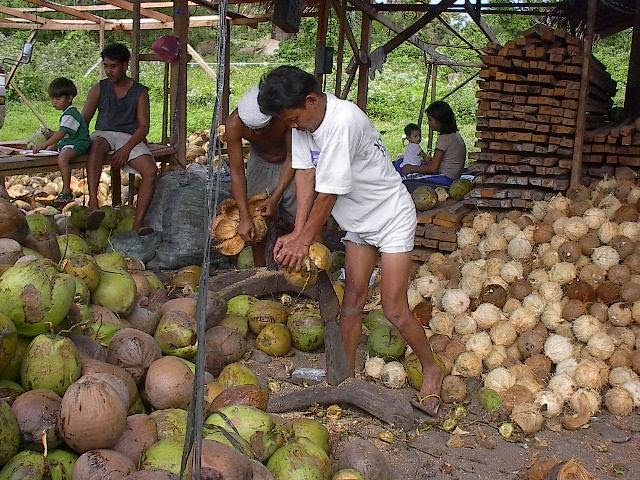
Copra is coconut meat primitively dried for many days by smoking or in open sun. Because of the crude method, it is basically dirty and cheap. It takes so much hard labor to produce copra. The farmers while making copra look like zombies, perspiring, stoic and sad.

This is done for the sole and exclusive purpose of crude coconut oil extraction in an oil mill hundreds of kilometers away from the farm. The main use of crude coconut oil (CNO) is industrial – the production of soaps, detergents, chemicals, explosives and the like.

For years, the farmers have been made to understand that only copra can be produced by them out of the coconut and were disabled by government from doing otherwise. The copra is deliberately priced low and must be sent to coconut oil mills owned by the big industry players who reap all the profits.

In the last fifty years, the processing of coconut water and production of clean coconut oil, coconut milk and coconut flour emerged. However, only the big players were allowed to do this. These three products constitute 75% of the value of the coconut fruit, the coconut oil being only 25%.

CNO is crude, filthy and poisonous oil. Enormous costs need to be incurred to cleanse it if it must be useful -- by RBD process (refine, bleach and deodorize). In this modern time, dirtying a naturally fresh food product only to subsequently clean and clarify it to be of use is unacceptable and defies reason, likely to be a problem especially in regards to health.

The underlying result of adopting this old technology is the continued concentration of economic gains and power in a few people, citing the fact that they exploit farmers and reapinh their profits, to the exclusion and impoverishment of a great number of people: the coconut farmers.

Indeed, the copra system is a sick, poor old man.


Fresca – New and Young

Fresca is granulated coconut meat dried cleanly within a few hours after the fresh nuts are opened. Fresh-looking, Fresca is white, clean and delicious food. It is produced right in a farm site where copra used to be made but now turned into a sanitary enclosed production area. This is called village level processing facility.

A final product itself, Fresca is processed further to produce Fresh Coconut Oil (FCO) and Coconut Milk-Flour (CMF) by using an expeller and pulverizer. FCO is popularly called Virgin Coconut Oil (VCO).

The capacity of a frescahan is the same as an average koprasan: 5,000 nuts per day. It can produce the same volume of copra from 5,000 nuts -- 1,000 kilos of fresca. From this, 600 kilos (60%) is extracted fresh coconut oil and 400 kilos (40%) coconut milk-flour. These two products are worth P 80,000.00, all in a day’s work.

Fresca is not produced by hard labor, but by happy farmers who collectively own the frescahan for their common use.


Fresca vs. Desiccated Coconut

Technically, Fresca and Desiccated Coconut are one and the same. The difference is that fresca is produced at the village level on a small scale by the coconut farmers themselves, while desiccated coconut is produced by the large producers, about ten companies in all.

Small is 5,000 nuts a day, while large is 500,000 nuts a day. Although small compared to large production, 5,000 nuts/day is 1.5 million nuts per year which is large for the coconut farmers.

The term Fresca is significant in language, being the opposite of copra which is the historical cause of the farmers’ poverty and exploitation by interests.

While Copra underlies the farmers’ and communities' poverty, Fresca is the source of their prosperity and genuine development.


What is FRESCO?

FRESCO stands for fresh coconut processing. It is the name used for the new fresh coconut industry which is the opposite of the old copra coconut industry. It is an integrated system that produces all values of the coconut fruit, unlike the old industry which produces only copra, copra oil and copra cake. Fresca is just one of the multiple products of FRESCO processing.

The main products of FRESCO are:
1.) Fresh Coconut Meat (chunks, grated, grains)
2.) Fresca
3.) Fresh Coconut Oil (FCO)
4.) Coconut Milk (whole coconut milk, skim milk)
5.) Coconut Water beverage and concentrate
6.) Coconut Flour (milk-flour and flour).

FRESCO has two models: 1) Village Level Processing and 2) Central Processing.

Within the village level frescahan, other minor but valuable products are also produced: liquid smoke, coconut shell charcoal and coconut ash.


FARCOM: its description and economics

FARCOM stands for Farmers' Coconut Mill. It is the village level processing facility (frescahan) that will replace the koprahan and to produce Fresca.

The 300,000 koprahans spread all over the Philippine archipelago currently process 12 billion nuts every year out of the 15 billion nuts produced annually by the 3.5 million coconut farmers.

Only 8,000 FARCOMS are needed to process the same volume of nuts.

Let’s look at the economic performance of a FARCOM: If it processes 5,000 nuts a day it can generate Php 10 million income per year. (SEE TABLE). If there are 200 participants in a FARCOM, each farmer-member can earn Php 50,000 a year as dividend.

The FARCOM will buy from its members, the 5,000 nuts at Php 10 per nut. Thus the farmers will earn Php 50,000 a day for their fresh nuts.

The capital cost to establish a FARCOM is Php 5 million. Thus, within a year, this capital requirement can be recovered within a year given the expected return of P10 million a year.

One FARCOM can grow organically into 8000 FARCOMs within ten years. Definitely, the copra industry can be gone within ten years if we pursue the FARCOM roadmap today


Coconut Agriculture and Industry in perspective

Coconut agriculture is apart from coconut industry. But both are the basic constituents of the new coconut economy.

Under the New Coconut Economy, the coconut farmers, as well as as their communities will prosper in the New Coconut Industry as well as in the New Coconut Agriculture.

Since the farmers will be concentrating on farm activities, having been freed from copra making, they will have time to tend to their farms to increase total farm yields. Fertilization of the coconut trees will be addressed to increase the current yield of 40 nuts per tree per year to 100 nuts per tree per year. The increase in yield will translate to higher farm incomes.

Farmers shall also practice multi-cropping to further increase their total income and to strengthen soil from possible erosion. Crops like coffee, cacao, corn, cassava and other crops can be planted in between the coconut trees to optimize land usage.


***

Rey Calliope Sabio is a photojournalist and farmers rights activist. And one of his interest is advocating the interests of the coconut farmer sector.

Tuesday, 23 September 2014

Go! Privatise them till they end bleedingly dried!

"Go! Privatise them till they are bleedingly dried!"


"Go! Privatise them till they are bleedingly dried!"

These are the words this writer think of in regards to the present situation involving mass transport in the Philippines. Given the fact that the government has been lax in solving public problems, transportation woes, and big profiteers willing to take over state-owned and controlled assets, privatisation is what being tackled much by today's bureaucrats wanting to downsize in exchange for sweetheart deals and kickbacks from the private sector.

But for most people whom endure the heat and rain in stations, privatisation mean additional cost of fares since the primary objective of the private sector is to gain profit. Public utilities such as MERALCO, MWSS, and Petron were once supported by the state, only to be bought out (or in case of MERALCO, reverted) by the private sector. And in it means further rising costs of services in regards to power distribution, water, and oil for transport; much more if these same profiteers wanting to take over rail-based mass transport from the state. The latter controlled LRT and PNR, while the MRT is under a joint venture under a "build-operate-transfer" scheme.


However, the state continues to toy with the idea bureaucrats had offered regardless of criticism. people may not understood this, but the State, or the system that controls the state discreetly cripples, mismanaging mass transport in spite of allocating its budget and its tie-ups with private profiteers. Masses, mainly students and workers are still struggling in heated conditions due to near-defected air conditioning if not waiting for at least half an hour with its trains having checked once in a while.
Worse, in spite of bragging, it did not spend money for restoring, improving, rehabilitating. That even the head of state, who obviously representing the compradore-landlord clique has been silent on the matter, but instead, has done is pour money for additional buses, which is wrong since roads are already flooded with cars, trucks, and buses in spite of schemes intended to control the flow of traffic like truck bans and number coding.

And because of these, ranging from traffics and other related issues, trains and improvement of rail-based mass transport are needed more than ever. If the system insist the motives of the compradores means excaberate traffic no matter how they justify it is. One would remember the railroad from Manila International Container Terminal to the main station at Tutuban been neglected decades ago due to buses, and now there are concerned citizens calling for reviving and improving for the sake of degongesting containers left at the terminal once and for all.


This writer find it sympathizing to those whom are clamoring for reviving the said railroad as well as additional trains and improving stations in LRT, MRT, and in PNR. What a shame if the system can't afford to resolve knowing that they have enough cash courtesy of 'foreign investments' and 'remittances' from the Filipino diaspora abroad; much more that it adds fury to the populace citing issues about corruption within the state bureaucracy. The state, sill clings to its initial standing of silence with some paper reforms being peddled off, with the latter that is obviously recommended by those wanting to keep the country weak in exchange for loans and rebranded as development. One of which is the dictates of the United States.
Speaking of the United States (sorry, but even Americans themselves disagree from intervening), with all the modern anemities the Americans had offered since the past, the Philippines, supposedly a communitarian society like those of its neighbours, rather ended chose to be a trying hard rugged individualist like its Star-Sprangled Master. The latter did utilise trains for moving products and people, but sadly it had been mismanaged as the profit-oriented private sector is silently crippling it in favor of cheap cars and trucks. The Philippines also had its 'share' of their idea by letting a massive influx of imported cars, trucks cripple mass transport like Trains and Tramway systems with the latter not been recovered after the war and waited for its 'revival' in the late 70s and in 80s.

And in spite of having mass transport like the Light Rail Transit (LRT), Metro Rail Transit (MRT), and the old but still reliable Philippine National Railways (PNR), the President rather said to the populace that massive traffic jams full of automobiles means moving forward and growing progress. Yes, that compradore folks wanted to gain profits in their selling automobiles rather than invest in maintaining and improving the entire railway network in the archipelago; and although nothing's wrong in having an automobile, sorry to say but Filipinos treat automobiles first as a source of self-pride than a means of transportation. So much for an American legacy to be consumeristic actually, buying for the sake of impressing than making things least easier.

But, since big private profiteers are willing to invest, this writer, along with those whom are concerned say that these companies rather wanted to invest for the sake of having more profits than providing services for the people. As noticed, that the MRT, a joint state-private entity faced major problems such as the lastest incident that resulted to a dozen people injured. But how about the LRT which is still under the hands of the state yet facing problems such as defective ticket dispensers, unused escalators and elevators?
There are indeed major problems in regards to the mass transport system in the Philippines, but the intention to mismanage or neglect these is an indication of the compradore-dominated state to have its fellow compadores take over for the sake of profit with high-priced tickets, or worse, to cripple it further with minsmanagment and negligence in favor of their real intention such as letting pride-obsessed people buy cheap automobiles no matter how increasing the cost of fuel it is. Lately, the Department of Science and Technology (DoST) had afford to create its own mass transit such as in UP Diliman and in Taguig, but since it is part of the system, does it mean the system will seriously invest in it (in spite fo its experimental stage) the way it afford to brag about rehabilitation and improvement of existing mass transit systems?


Well, in spite of efforts made by those whom are concerned, and to sum it all, bleeding anyone dry by a negligent state and a compadore hungry for increasing profits while disregarding efficiency and safety. Apologetics of the neoliberal order would wanted the latter to take over as if they are capable courtesy of their so-called 'jobs', that they are willing to endure getting bled dry just to have an expensive ride.

But for many, the more they bled dry, the more they uprise against a system that chose to have its services laissez faire to those who greedily wanting to profit from it. Privatizing public service means giving up its obligation to ensure the welfare of many, while trying to protect the itnerest of the moneyed few (or 'producers' as what Ayn Rand stated). That LRT, MRT, as well as the entire railway network is both a profiteering venture and a hindrance to their interest in the eyes of these compradores.

Sunday, 21 September 2014

We will never forget their tyranny

We will never forget their tyranny


"That Napoleon, just that particular Corsican should have been the military dictator whom the French republic, exhausted by its own warfare had rendered necessary, was chance; but that, if a Napoleon had been lacking, anothr would have filled the place as proved by the fact that the man was always found as soon as he became necessary: Caesar, Agustus, Cromwell, etc."


- Freidrich Engels, to W. Borgius, 1884.

These are the words this person had read first from an old writeup prior to making this post.

Both made in commemoration of Martial rule and of last few months surrounding protest against a corrupt regime trying to act as just, it seems easier for those who had experienced how the present order tries to act firm with its varying levels of capacity to preserve no matter how opposing the majority of people taken against them.

As the present Aquino administration discreetly, yet still obviously continues to toy the idea of having more power via charter change and term extension, it seems that these people, as well as the fanatics supporting, are trying to replicate what was made decades ago: of substituting the New Society of the past for today's Righteous Path.

Most People may deny its similarities and insist differences about the two, but there are those whom sought its similarities in spite of changing names and watering down its core ideas. But still, it appears as exploitative no matter what it is just like the mountains whose trees been cut by Enrile during martial rule and uncontrollable mining in the mountains of Mindanao at present.

That both Marcos's New Society and Aquino's Righteous Path is full of rhetorics concerning reform and development. Marcos did spoke against corruption, of agrarian reform, industrial development, and uplifting people from poverty; so is today's Aquino. Both had its share of oligarchs, technocrats, murderers, and decrees that the latter as watered down to make more less Marcosian and much Aquinistic.
Yet in spite of appearing themselves as patriotic, these two leaders, both past and present are stooges of the star-sprangled master. Both of their fanatics clamor much of having a head of state that are capable of resolving problems through a series of paper reforms and sneering everyone through the ears with their rhetorics; that they have their share of left-wing terminologies to appear that their actions as much revolutionary than those from the mountains with their liberated zones.

But for the common people who are victims of centuries-old repression would say that these men are dictators, tyrants, despots whose idea is how to extend their stay at the presidential palace. The former had its children grew old and treated MalacaƱang as their own abode, while the latter chose to be single in spite of numerous relationships people had sought on television. But again and still, these men had made big numbers aroused, organised, and mobilised in their actions, their grumblings had been getting louder day by day in spite of being called barbaric or ill-mannered by apologetics in every social media site.

Much more that those whom are trigger happy are wanting to create a sea of blood amongst those who struggle and the innocents whom they mistaken for; those who justify would have called it as a prophylaxis to cleanse anything what they think of as threat no matter how innocent they are or not, simply because their impressions came first than their innocence with a variety of statements to justify from. Yesterday's Marcos and today's Aquino had employed a mixture of deception, harassment, and outright plunder to justify their control with the help of their coteries, worse, paraniocally thinking that they're in a state of siege as stated by their actions whether discreet or exposed.

Yet still, can't stop the growing protests as earlier stated. Much more that it becomes a fertile ground for the growth of Revolution as the present system tolerates their own nonsense and betrayed public trust. No matter what the protests and various direct actions been called barbaric or ill-mannered, these barbarians they've called off are countering those civilised thugs and its apologetics such as in the academe and in social media sites last week.
The latter appear 'civilised' such as insisting dialouge to the anger-filled populace, yet these civilised are actually barbaric with all their thievish actions against the people, bleeding them dry actually with rising costs of goods, services, and higher taxes that affected their income and at worse, benefits. And the so-called barbarians whom they afford to heckle are actually civilised, yet with repression, disenfranchisement, and bleeding them dry by vested interest, these people are willing to go beyond the parameter of 'legality' to assert what is just no matter how precious their life is. 

But in spite of all the heckings from the other side, the criticisms pointed against the system would say that it is both a test of democracy being peddled and a committment given that these people offered an alternative to the corrupt order. To use Marcos terms (apologies), "of what is Democracy if it is not for the poor?" 

Yes, the Filipino poor, dispossessed, repressed, and struggling is worth fighting for Democracy, fighting to grab the power that is still firmly handled by those whom making a bastardisation such as those from above. The Filipino nowadays chose to be a Jacobin as what Marcos abhorred, but that Jacobin is full of vigour that they want to cleanse its own backyard out of its filth, of tyrants trying hard to be righteous, no matter how precious their life is.

For now, here's a Video feat. the song "Solidaritatslied" by the German band Commandantes.


Saturday, 20 September 2014

Of additional powers, hooligans, and the willingness to vent dissent

Of additional powers, hooligans,
and the willingness to vent dissent

(Or how this person tries to connect those who create their dubious moves
and those who really felt its negative, anger-provoking effects)


It was few days ago when this writer had read an article about the Aquino administration continues its desperate attempt to have additional powers by requesting the legislature.

Using the projected electricity shortage looming next year, the letter attempting to bestow President Aquino additional powers is too broad as according to Senate President Drilon, and likely to have possible adverse impact citing the experience during the Ramos administration as an example.

However to most people, President Aquino’s attempt to insist both Senate and Congress bestow himself additional powers also means additional burden, especially those of Workers and Government Employees, that are still marred by rising costs of goods and services, as well as overtaxed and underpaid, expressed disgust in the issue. They used the electic issue as its basis, much more that there are other related issues such as the infamous Disbursement Acceleration Program (DAP), Pork Barrel, and neoliberal economic policies.

Actually, the administration may afford to have additional powers courtesy of his lackeys in the legislature but does it mean it can ensure the welfare of the people, that Peasants still clamor for Land, and Workers, Government Employees still calling for wage increase and an end to additional taxes. There are more problems to tackle so to speak but the administration rather takes it too easy through a series of half-baked solutions, influence peddling, and crass rhetoric commonly heared and supported by fanatics.
Worse, it aggravates the rising costs of electricity plus corruption via sweetheart deals with big businesses though ‘Public Private Partnerships’. Aquino and his clique had afforded to babble development but do not mean it alleviates clear and present suffering of those who worked hard yet underpaid while facing additional taxes and increasing costs of goods and services especially electricity.

That somehow made it realized by a series of actions directly pointed against them. That lately, protesters from the University of the Philippines stormed the School of Economics wherein Budget Secretary Florencio Abad had attended a forum. Abad, known for justifying the infamous DAP and other neoliberal policies of the administration was nearly cornered by the students clamoring for his resignation as well as ouster of his boss; that made yellow fanatics, neoliberal apologetics to the core afford to call them as hooligans and ill-mannered as such.

Ill-mannered? Hooliganish? Then how about the thugs in uniform, toga, and coat trying to justify rising costs and less wages? It ain't be reformistic as what they babble with buta counterreactionary as it actually shows. One would remember that the Philippines has the highest electric rate in Asia as well as having billions of pesos to pay for the loans got from IMF-WB; while the Govenment think-tank Philippine Institute of Development Studies (PIDS) had afford to state that minimum wage should be relaxed and private companies should have the right to pay below minimum. These issues are quite problematic and anger-provoking, much more that people whom had endured and heard all these bullshit are likely to go beyond the line and start venting vulgar against those whom initiate and justify further with terms like 'development'.
Why on earth the system had allowed its own community to have higher electric rates, of having its bigger chunk of the budget be allocated to debt servicing whilst willing to apply for another loan, and a think-tank insisting the same babble as what foreign overlords wanted to? Stupidity at its finest for the system, its apologists, and the fanatics who afford to call protesters as barbaric, hooliganish, and the like. Hypocritical if they afford to oppose DAP, Pork, rising costs of goods and services, yet they assail those who really vent rage on one of its justifiers.

And since these thugs and goons afford to tackle about solutions, why additional powers? Public-Private Partnerships? Commercialization of state assets? Term extentions and the like? Haven’t they learned from the anomalies that took place during the Ramos and other past administrations? Did the Electric Power Industry Reform Act (EPIRA) and other neoliberal trade acts alleviate the consumer? Did that DAP stimulate development with all of the half-baked infrastructure and influence peddling to the people? No! Much more that the people, whether they are Worker, Peasant, Student, Government Employee, and SME persons are greatly affected by the problems caused by palliative measures as well as tired of rhetorics peddled by Aquino and his folk.

Again, the actions made by the present administration acts as a sampling of a coming dictatorship that is ‘carefully tended by his lackeys and justified by his fanatics. The latter afford to call the protesters near and far as hooligans, ill-mannered, or in yesteryears as seditionists and treasonous especially after assailing against an administration man such as Florencio Abad in a state university. These hooligans have the right to rebel against an order that afford to toy with emergency powers and term extensions, much more that they justify inequality, injustice, and a series of artificial crisis courtesy of having laissez faire to the wreckers and profiteers as means to 'steer development'.
And if so, then these hooligans are worthy of praise as they afford to really vent rage on behalf of those who can't yet willing to, than those who obviously taking the side of the repressor with all of their statements pointing against them. Call them ill-mannered as you wish, but in a so-called "democratic" society lies a voice of dissent, and that is include the right to turn down tyrants by means of their actual and virtual ostracons with their names written against them.

Thursday, 11 September 2014

Charlene

Charlene


Charlene, 
There are no stars glowing from the sky,
Even from this song bursting from what hearts
Echo the unfolding violence of our time
It had resist the countless calls of change
Into entrails of bitterness and poverty
As evidenced by the shantytowns and the countryside
And men whose minds filled with hunger and hatred
But wombs are still fertile with hope
Yet may come what may

Charlene,
There are no stars glowing from the sky,
That speaking of the devil,
Army men with its civilian-clad intelligence agents
Goons garb in uniforms
High coolish rookie policemen wade through
The rank and file of chanting young demonstrating radicals
Flooding out of communities and universtity halls
Their nightsticks eager to slash soft flesh
And water cannons to burst itchy feelings in one's skin
Plainclothesmen taking pictures of those who aspire and inspired
To be disappeared after as time comes forward

Charlene,
There are no stars glowing from the sky,
Peasants, out in the fields still suffer from onslaught
Of both sudden rain and heat
Of burning furuous summer suns
And of drenching torrential rains
Yet the worst suffering they face
Is the hellish face of landlords denying request
In spite of giving the biggest share of their crops
If not giving the lords few crumbs to hungry stomachs 
That deny the passage of progress
And even a bit of promise is nowhere seen on the horizon

Charlene,
There are no stars glowing from the sky,
That mass transport drivers and workers complain
About rising prices of oil and other products
Cut short the promise of bountiful boundaries
And still low paid costs of living allowances
While their wives nag time and again like fishwives to death
And still the majority of apathetic citizens remain deaf
Trying to escape with their newfound enjoys
From all the clamors of the suffering nation

Charlene
There are no stars glowing from the sky,
That call center agents with their overtimes
Feeling stressfull from time to time
The nagging voices of the complainants
Be replied with the foul mouths of the burned outs
Coffees for weekdays and beers for weekends
Necessities and state fees drain monthly allowances
Reason enough for them to commit suicide

Charlene,
There are no stars glowing from the sky,
Whores and prostitutes sell short time bliss
To loveless husbands and forsaken lovers
Also to worldly and warm-blooded teenagers
Over the districts whose notoriety is life
Yet as wild flowers spontaneously bloom 
Diseases come too soon
Yet still red lights reek like wild flowers strewn

Charlene,
There are no stars glowing from the sky,
That the system controlling the society is going down the drain
Self gratifying, profiteering
Anything terrifying
What with graft and corruption, state terrorism intersped
In between to the benefited:
To the moneyed elite
To the powered structure
To the kingmakers, fiefs, and lords
The moneyed few sprinkling crumbs
Trickle down yet the have-nots none

I know you can't understand all these
As you hear the music playing
You kept running from all realities
Despite feeling pain astounding
Yes, there are no stars in the sky
But we seen dogs eat dogs
And the old rapes the young
Even if the night is darkly pregnant
Promising a brilliant array of dotting twinkling stars
Still, there are no stars in the sky

Charlene,
Yes, there are no stars in the sky
But instead a red lantern glowing
Raised by your militant hand.

To Charlene Bernabe,
2014


Of people maligning technology while contented in imports

Of people maligning native-made technology 
while contented in ready-made imports


"What a waste of talent!!!! Design a real vehicle Prof with real materials. Not a vehicle made of bamboo."

These are the words this writer had sought in one of the comments section about a professor who afford to use domestic materials in his so-called creation.

Known as "Bangkarwayan", that creation, rather than invention from a University of the Philippines-Manila Professor Benjamin Mangubat had afford to use both solar and wind power as its source of energy, and yet what is been heavily featured much is the use of bamboo and other native materials as its body.
Technically, the name Bangkarwayan comes from the Filipino word "Bangka" (boat), car, and "Kawayan" (bamboo); and aside from its Its dark brown coat gives an age-old appearance reminiscent of early 20th century experimental vehicles of the west. On land, it can reach 40 kilometres per hour, drawing power from two sets of five 12 volt batteries; while on water, it has rudder, a propeller, empty plastic bottles for floaters, and a separate smaller engine.

According to Mangubat, he wanted his students to think out of the box when it comes to creating things and ideas, and often cites Dr. Jose Rizal as his model of inventiveness and creative thinking his students should ought to emulate. However, he said that most of his students are simply bookish rather than being creative and expressive. "I want to show my students that I can also walk my talk." He added.

However, in spite of his contributions, as well as others trying to instil resilience and creativity, most people rather chose to criticize these people as anti-progress if not wasting time, or worse, crazed in making those creations. The quote stated above showed the narrow mindedness of a "learned person" that as if trying to offer something "better than bamboo."
But since he and others is trying to offer something, or even babbling about science, then how come they can't speak about industrialisation? Mangubat may have succeeded better if the Philippines had been industrialised, and industrialisation involves utilizing things for the greater interest even those of Bamboo.

Remember: there's a designer whom used Bamboo in making a bike, as well as speaker for Iphones.

But actually, they can't say something other than downplaying their contribution. Yes, the Bangkarwayan is also prone to accidents and likely to fail due to its appearance, but Professor Mangubat afford to ride in it, that he tested the speed of the vehicle as it ran by wind and the sun; people whom afford to heckle are just plain contented in petrol-powered vehicles, that they treated their vehicles as primarily a source of pride, a status symbol than a means of transporting themselves.

Much more that they enjoy the imports while doubting the credibility of what is carefully crafted in its own backyard. Massive influx of foreign goods had crippled domestic ones as the government fails to protect no matter they urge people to "buy Filipino" via its own propaganda mill. Cheap advertising tricks had urged many to equate something foreign as absolutely modern not also knowing that some, if mot most parts are also assembled in the processing zones around the country like microchips for computers and cellphones, if not the age old shoes and apparel being sold expensively while its workers low paid and crisis striken.
And yet in spite of having processing zones afford to assemble for their foreign clients and their familiar names, few people like Professor Mangubat had kept the Panday Pira spirit of forging new things out of existing knowledge in pursuit of contributing to its own community. People may still cling to their slander but did they try? Did they also think out of the box to create new things and ideas in par with the modern?

 photo 10341513_320116801472192_7078820227376061446_n.jpg

For sure some of them had once tinkered with science and technology, that also some of them they took courses whose emphasis is on science and technology, but out of practicality their jobs are far from its supposed interest; if there is then they less took part in forging and more of spending. They afford to criticize the prevalence of the Filipino Jeepney, and yet they can't speak, even once about industrialising the society and develop the countryside in order to utilize resources and develop what's anew and beyond the familiar.
The Department of Science and Technology had afford to create a mass transit vehicle such as those in UP Diliman and in Taguig; but the present system that overseers the said department, in its issue about its own mass transport such as its Light Rail and Mass Rapid Transits, failed to resolve and hence became a subject of criticisms and heckles, much more that the budget they afford to say about 'for rehabilitation and improvement of stations and buying new trains' is all but a hollow rhetoric as they continue toying with the idea about privatising the entire Mass Transport System.

And since they afford to brag about rehabilitating and buying new trains, did the system afford to support campaigns for industrialisation, especially in realising the nation's need for a bigger and greater heavy industry? People had seen jeepneys that had been assembled in ParaƱaque, but the engine comes from Japan. Men like Mangubat did afford to create their own engine, but these are embryonic, experimental with the system failed to support them through what's been said earlier.
Simply because it harms their interests such as those of oil companies and compradores benefiting in selling cars. Industrialisation is a rhetoric to be dabbled upon by these people in order to sneer the idealistic through the ears, but half-hearted in realizing its importance in a growing society.

Back to what's been said earlier, these so-called critics had no words to say other than contented in imports and letting foreign investors move freely in its motives. Nothing's wrong in foreign investment on the first place, but has to be tempered with domestic development such as stimulating production and the encouragement of a patriotic, scientific, and mass oriented education in order to cultivate Filipinos creativity, ingenuity, and deeply rooted in its heritage and identity (more than the usual flag waving and cheering for imports). Mangubat wanted his students to cultivate in a way Jose Rizal insist in his written works and actual deeds.

But since they afford to assail, rather than criticise, what did they do? Just contented in imports simply because they are modern? Brand new? That Industrialisation is passe in favor of letting a country be just opened and contented in foreign investments, prioritising profit-oriented tourism and redescribe outsourcing as industry?
For sure most of them are butt-hurt in reading these words, much more that they would insist that the Philippines should be contented in things imported, if not forcing the nation be opened altogether to the world without focusing on its own, no matter how beneficial it is but too lowly as compared to high-end of the west.

Wednesday, 10 September 2014

"A message from the writer"

"A message from the writer"


This is paranoia on the part of politicians because of their unrepentant guilt as public figures.

Scared of being scrutinized by many because of their unpopular actions and self-profit, few of them  who are sick and tired of denials have afford to file a bill that been described as "An Act protecting against personal intrusion by any person with intent to gain or profit" that is, actually trying to invade one's privacy such as those whom are self-expressing in front of their own lenses and accusing them of taking pictures of someone no matter how uninvolve in that scene.  

Actually, as years passed by, from the dawn of printing to the use of modern-day gadgetry, they acknowledge the power of the people having technology in their hands; and they will try to suppress it as much as they can in the name of "order." 

And however good the intent of that bill is, such as those of protecting one's privacy, this writer, as well as others supporting, would like to raise some bones of contentions here, as according to the street photography site Malate:

1.) The bill will curtail press freedom and freedom of expression.
2.) Consent doesn't go with photojournalism in most cases. How does a journalist ask for consent from, say, an angry mob or trigger-happy men?
3.) This will make news photos and videos illegal. Do you stop media outfits from documenting actions of officials and minimize journalists’ access to information and proofs?
4.) The danger here is when hideous organizations/elements or the police itself prevent reporters from taking photos of their actions.
5.) Tourists may get caught up in this law and worse, give another blow to tourism.
6.) How do you ask permission from people in picturesque places? Or do you simply wait till the frame is cleared of every single body?
7.) Does it apply to CCTV cameras? Because it takes videos and pictures of people without their consent.
8.) How about TV cameras? Because they take close-up shots of audiences in a ballgame without their consent as well.

And if this writer nay add in regards to that post, does it include:


 Greasy persons scavenging in the street? 


A drunkard foreigner wandering carrying a bottle of a local gin? 


Or even this kid eating his lunch at Captain's Galley?


Again, the bill could be used as a tool for suppression on behalf of a rotten, repressive system guised as progressive and just. 

And there are no further words to say, except this:

No to House Bill No. 4807!
Uphold people's right to expression!